Series: Westerners in India
Richard Wright’s Excellent Adventure.
Trailers 1 to 5…
Richard Wright’s Excelllent Adventure
00:00 Intro
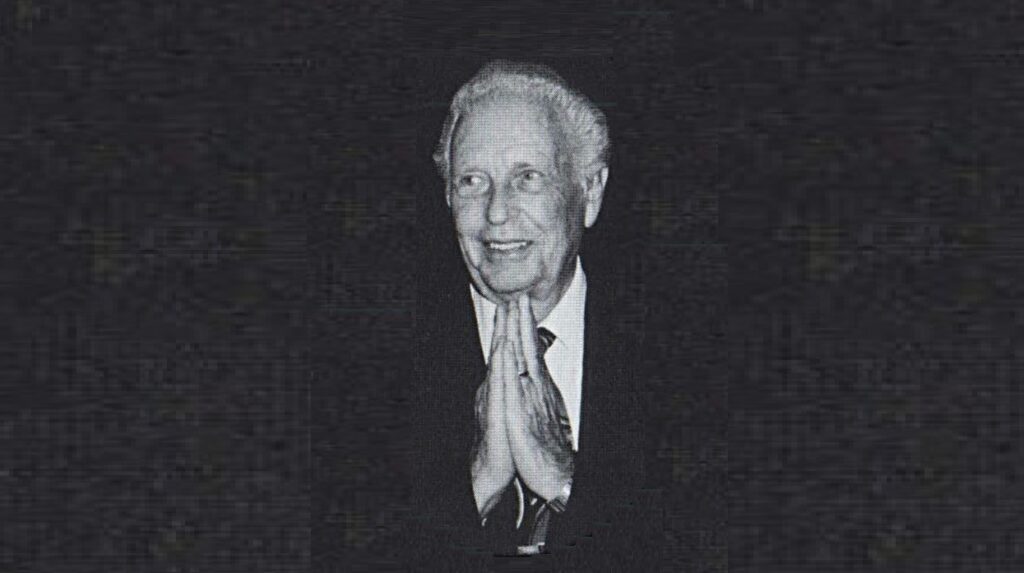
00:05 Clarence Richard Wright. 9th December 1911 ~ 9th January 2002
00:14 In 1935, Yogananda returned to India for a last visit with his great guru, Sri Yukteswar Giri
00:17 “I sailed from New York on June 9, 1935 onboared the Europa. Two students accompanied me: my secretary, Mr. C. Richard Wright, and an elderly lady from Cincinnati, Miss Ettie Bletch”
03:24 Traveling by ship and automobile through Europe ~ The entourage visited England, Scotland, France, Belgium, Holland and Switzerland. In Italy they visited Venice, Assisi and Rome, and embarked from Brindisi for Athens
03:32 From Greece they visited the Holy Lands and Egypt, where they embarked for Bombay. Yogananda and his entourage arrived in Bombay in the summer of 1935
03:40 Yogananda visited Harry Lauder in 1935, when he toured Europe on his way to India. He writes in his Autobiography of a Yogi ~ “Our party spent a pleasant day as guests of Sir Harry Lauder at his estate in Scotland”
03:53 Yogananda ~ “I wanted to make a pilgrimage to Bavaria. This would be my only chance, I felt, to visit the great Catholic mystic, Therese Neumann of Konnersreuth”
05:11 “In Italy we made a special trip to Assisi to honor the apostle of humility, St. Francis.”
05:18 Yogananda with pigeons, Piazza San Marco, Venice in June, 1935
05:26 C. Richard Wright, Paramahansa Yogananda, Ettie Bletch in Cairo, 1935
05:32 They board the SS Rajputana in Egypt, and sail for Bombay
05:54 Yogananda and entourage arrive into Bombay onboard the SS Rajputana on August 22nd, 1935
08:01 C. Richard Wright films the 1935/36 tour
08:09 Yogananda visits Mahatma Gandhi in Whardha, August, 1935
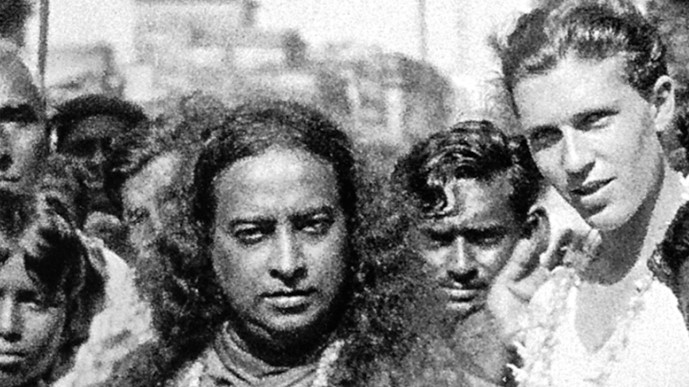
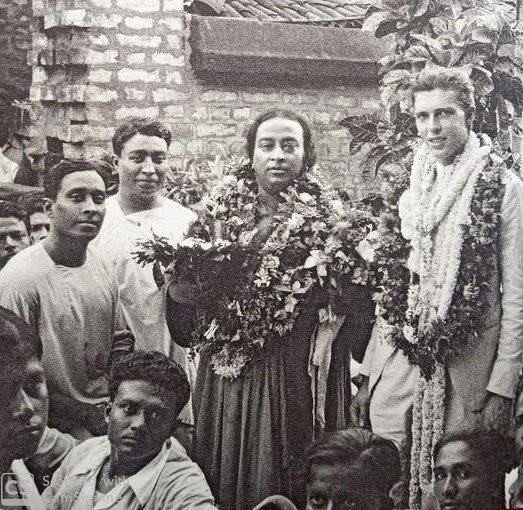
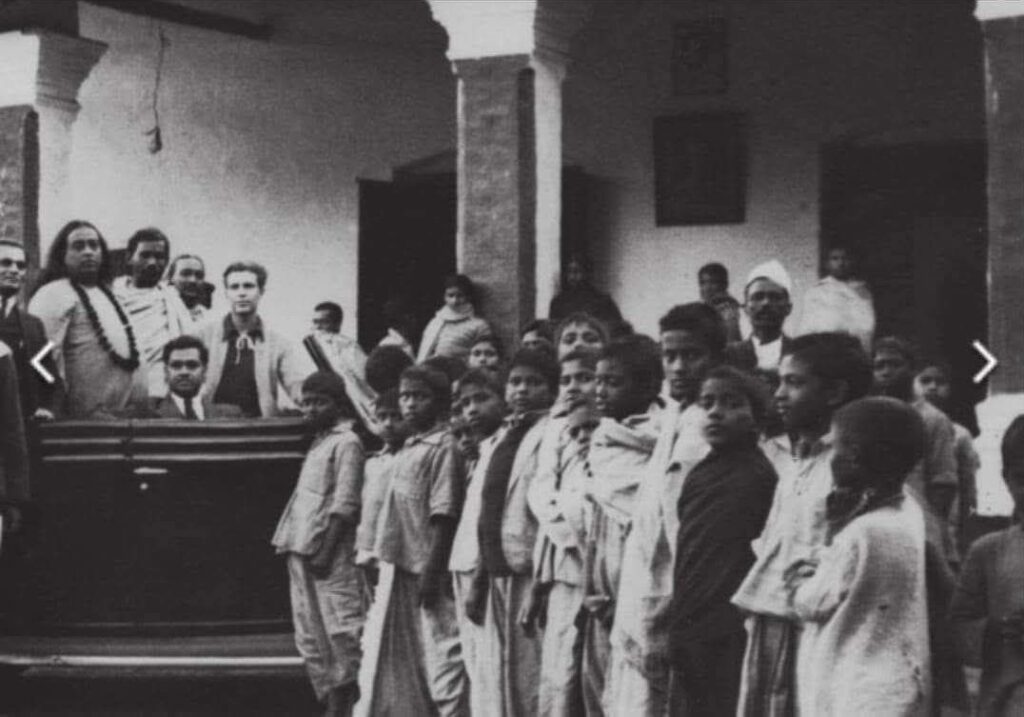
09:12 Yogananda’s return to India, 1935, Howrah Railway Station, Calcutta. (L to R) Maharaja Shrish Chandra Nundy, Yogananda, Sananda Lal Gosh, Bishnu Gosh, and some of the crowd of devotees who came to welcome Yogananda home
09:21 4 Garpar Road
11:48 Paramahamsa Yogananda in the Panchavati at the Dakshineswar Kali Temple
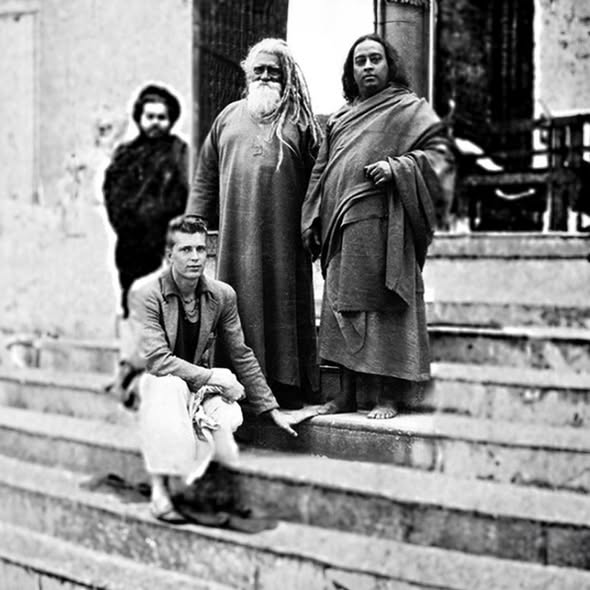
11:54 Yogananda visits his great guru, Sri Yukteswar Giri at Priyadham, his Serampore ashram
13:55 Ichapur, September 3rd, 1935
14:03 Yogananda and party on site of family’s ancestral home in Ichapur. Of the original estate, only an empty field and one tree remained
14:08 Yogananda visits his school in Ranchi
14:47 Yoganada meets Shankari Mai Jiew at the Ranchi Ashram
15:31 Hundru Falls, Ranchi
17:27 The entourage visit the old family home in Gorakhpur, where Yogananda was born
17:40 Yogananda meets Sir Chandrasekhara Venkata “C. V.” Raman in Mysore in 1935. Raman received the Nobel Prize in Physics (1930) for his works on scattering of light and discovery of the Raman effect
17:49 Mysore
18:00 “You are the first Westerner, Dick, ever to enter that shrine. Many others have tried in vain”
18:19 The Yuvaraja of Mysore invited Yogananda and his party to his summer palace to enjoy a ride on one of his elephants. This film was taken by officials of a London Film Company
22:39 The entourage visit Ramana Maharshi, November 1935
From Face to Face with Sri Ramana Maharshi ~ Two of the many questions asked by the Swami’s secretary C.R. Wright, were:
How shall I realise God? God is an unknown entity. Moreover, He is external. Whereas the Self is always with you and it is you. Why do you leave out what is intimate and go in for what is external?
What is this Self again? The Self is known to everyone but not clearly. The Being is the Self. Of all the definitions of God, none is so well put as the Biblical statement “I am that I am” in Exodus (Chap. 3). Knowing the Self, God is known. In fact, God is none other than the Self.
23:54 Yogananda and Yogi Ramaiah, Sri Ramanasramam
24:20 Yogi Ramiah and Ramana Maharshi
25:20 Dihika
26:16 Paramahansa Yogananda visits Anandamayi Ma in Calcutta, December, 1935. They would later meet again at Yogananda’s school in Ranchi
27:03 In late December 1935, the day after Sri Yukteswar’s Winter Solstice Festival, Yogananda receives from his guru the highest spiritual title “Paramhansa”
27:24 Kumbha Mela in Allahabad, January, 1936
27:31 Yogananda meets Krishnananda at the 1936 Kumbha Mela
27:41 The party meet Kara Patri on January 21st, 1936, at the Kumbh Mela
29:13 After the Kumbha Mela, Yogananda and party travel to Agra
35:30 Yogananda visits Swami Keshabananda at Katayani Peeth, his temple ashram in Vrindavan, with Paramahansa Yogananda
36:16 Visit to Bareilly
36:31 Yogananda and Swami Gyanananda, Mahamandal Hermitage, Benares, February 7th, 1936
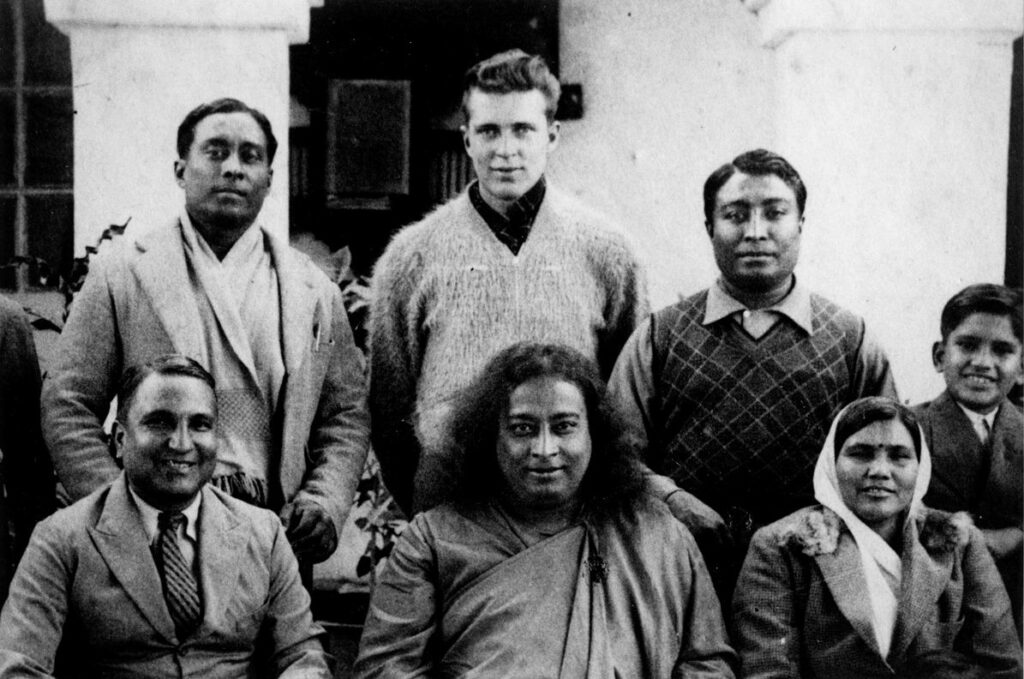
36:39 Yogananda, Ashalata, Srikrishna, Parlul, Sananda, Richard Wright in Benares, 1936
36:44 Richard Wright, Paramahansa Yogananda, Madan Mohan Malaviya. Vast herbal knowledge is found in ancient Sanskrit treatises. Himalayan herbs were employed in a rejuvenation treatment which aroused the attention of the world in 1938 when the method was used on Pundit Madan Mohan Malaviya, 77-year-old Vice-Chancellor of Benares Hindu University
37:12 Tapaswiji Maharaj and Pandit Malaviya appear in a 1938 edition of Look magazine
37:45 Giri Bala. This great woman yogi has not taken food or drink since 1880. Yogananda with her in 1936, at her home in the isolated Bengal village of Biur
37:55 In early March, back in Calcutta, a telegram calls him to Puri ~ there Sri Yukteswar Giri entered Mahasamadhi on March 9th
38:19 Puri
39:44 1977. Karar Ashram is the coastal hermitage founded by Sri Yukteswar Giri in 1903, to teach Kriya Yoga as taught by Babaji and Sri Lahiri Mahasaya
40:15 Richard made arrangements for them all to sail from Bombay in early June, and they left from Calcutta during May driving the Ford. On arrival they were told there was no room onboard for the car, so the trip was postponed as they were going to need it again in Europe
40:25 Regent Hotel, Bombay, June 1936, Yogananda witnesses the resurection of Sri Yukteswar Giri
41:34 They were back in England by September 1936, finally sailing from Southampton on the ship “Bremen” for New York, arriving there on October 23rd. Crossing the continent in the trusty Ford they reached Mount Washington headquarters of the SRF in late 1936
41:42 SS Bremen enroute to New York!
46:03 Richard Wright and family
48:06 Ashrams of India
Israel & Egypt
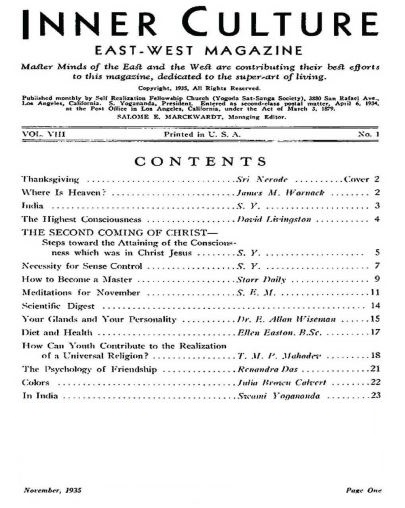
Inner Culture ~ East – West Magazine October, 1935.
Written by Paramhansa Yogananda. Cairo, August 11, 1935.
Due to fast moving and constant, continuous travel, I have not attempted to write to you. Consider this letter written from Jerusalem, the Holy Land – the land of Christ. Jesus has been gone a long time, but Christ is still tangibly active in Jerusalem. He was with me everywhere, and I remembered all devotees in Him. I saw Bethlehem, where Jesus was born, the mountain where He was tempted by Satan, the house of Mary and Martha, the tomb of Lazarus, the place of the Resurrection, hall of the Last Supper, Gethsemane, where Judas betrayed Jesus, and, above all, the Mount of olives, where He was received up into Heaven.
Jesus, invisible, was with me always in Jerusalem and went with me everywhere. It is too sacred to express. Sometime I shall write about it. Antiquity was unfolded before my eyes – as depicted in the Divine drama. I was overwhelmed. May you all meditate so deeply that you will really behold Jesus yourself.
I have seen every nook and corner of England. I liked its serious literary atmosphere. I liked the real welcoming spirit in Scotland. I like the German awakening – a new Germany. I liked the awakening of the Jewish people in Palestine, where they are trying to establish a country of their own. I liked the French cosmopolitan spirit – a unity of all races. There is no difference to them between brown, white, or nubian-dark skins. God Himself has become all the colors, as you students of Self-Realization know.
I loved the Swiss scenery, the best in Europe – a very cultural and rural atmosphere. I liked the Italian spirit of unity, but was very sorry that Italy is bent on war with Abyssinia when the world is still suffering from the evils of the last war. I was captured by the ancient ruins and their associations in Rome and Greece. The Greeks are very honest and artistic. They can almost weave their fancies in alabaster.
Jerusalem – best from a spiritual standpoint; greatest, though still primitive and dirty physically, yet it surpasses all Europe spiritually. Jesus was doubly real after visiting Jerusalem. Holy places change souls if they have faith in the vibrations of saintly people.
Cairo is beautiful. The sphinx and the pyramids talked to me much about ancient history. However, I mustn’t tell everything now, but must leave something for the future in case you want me to come back soon. Really, I am homesick for the Headquarters and all of you, and the angel land of Los Angeles. I did not know that I would love America and her ways so much after seeing the ways of Europe, Palestine, and Egypt – but more hereafter
With utmost blessings to your able leader, Seva Devi, and all of you, I remain ever yours,
Swami Yogananda
(Meditate deeply)
Yogoda Satsanga, 1996.
Margaret Wolf interviews Richard Wright.
M.W : You accompanied Yogananda on his trip to India in 1935 and 36. He quoted some of your impressions from your travel diary in Autobiography of a Yogi. Can you share some of them with us?
C .R .W : After traveling through Europe, Palestine, and Egypt, we arrived in Bombay and headed across the continent to Calcutta. This is much like landing in Los Angeles and making a trip to New York. When we got off the train in Calcutta, an immense crowd of people was at the railway station to greet us. I didn’t understand it at first; I thought all those people were traveling themselves or picking up other travelers. But they had come to greet him! The word had been passed all across the continent that he was coming home, and there were literally thousands of people at the station to welcome him. The flower garlands draped around his neck were so high he could hardly see over them! The devotion, the respect his coun trymen showed him was unbelievable.
Paramahansaji’s brother Bishnu directly to his father’s residence. His other brother and his sisters were there with their families; aunts and uncles, students and friends all gathered to greet him. We lived there on and off-as our home base, so to speak-for most of our stay in India.
Arrival in India
Inner Culture ~ East – West Magazine November, 1935.
Excerpts from a letter written by Richard Wright. Bombay, August 25, 1935.
Dear Friends:
Lo and behold! India at last! The magic pattern of entrancing India is gradually taking form before our very eyes even in “anglicized” Bombay. Incidentally, this hotel pictured above is the largest hotel and one of the finest buildings in Bombay, overlooking the harbor and very near the famous royalty arch, “The Gateway to India.” Hotel has huge, arcaded halls with “inside verandah-like” halls.
In view of our haste and “on-the-go” anxiety, all I’ve been able to observe of a people, their customs, their cities has been rather “all-surface,” so take my words with salt and forgiveness. I’ll try to do better in India. Although our usual haste is beginning to be necessary, for we leave this afternoon for Calcutta, via Mail Train, Swamiji’s impatience and intense enthusiasm cancelling the motor tour across India, but we shall motor back via Kashmiri, etc. Stopping off at Wardha to meet Gandhiji. Imagine, Gandhi! I’m practically wordless! Then Calcutta and Swamiji’s family!
Just short sentences – ”Rajputana” pulled into Bombay’s huge harbor on Aug. 22 at 2 P.M. – Swamiji welcomed by garlands and bouquets of flowers by Dr. Nawie, friends, and the various persons – (his photo appeared in several papers with stories of organization, etc.) Everywhere we go, Swamiji is welcomed and greeted in great awe and respect and admiration – He cuts quite a figure in his long, flowing hair, orange robe, orange sox, orange sandals and orange cane – looked divine with wreaths of richly fragrant flowers of every hue – great reception filled us with smiles and India – consciousness.
Customs are slow and pecky as English – but why not? – ie, Custom officials – sightseeing
“tantalizers” of India already at work with port cards, stamps, locks, etc. – snake-charmers with cobra, mongoose, and flute very eery and strange and fascinating – (more of this later) – Gaping and sneering at “tea-sipping” customs officials, while delaying me 3 hours first day and 2 hours 2nd day – a genuine Indian dinner as guests of Dr. Nawie – large metal plates the size of a Chinese gong, 4 or 5 small metal cups, no accessories, just washed fingers, and an endless parade of courses – our first dinner consists of 13 separate distinct preparations – each course being a handful as there are so many – like sitting down to a whole dinner of samples, but nevertheless, filling and satisfying – courses consisting of rice, condiments of rare delicacy and exquisitely flavored vegetables with the most delicate spice I’ve tasted-and a whole lot of things impossible for me to describe at this early date-and such sweetmeats! Oo la la! – hungry? – just picture us sitting in a small, high-ceiling room, around small round tables, dipping our fingers in these delicacies – that’s living! – How my heart aches for you all as I see myself lost in rapture over these thrills of India,
In my other letters, shall tell you about Bombay, and its museum buildings, street cars, natives, streets, bazaars, markets, poor natives sleeping on the streets at night with just a thin shawl for a mat-tress, and so on, and on.
On the train from Bombay to Calcutta
Inner Culture ~ East – West Magazine December, 1935.
Excerpts From a Letter from C. Richard Wright. October 9, Calcutta, India.
The last real news I wrote was from Bombay, so I shall continue from there on. We boarded an antiquated electric train in Bombay on a certain day back in August (25), bound for Calcutta, via Wardha (Mahatma Gandhi’s Village.) Our compartment was quite roomy with its leather cushion seats along three windows on each side. The mossstained, weather-beaten, ugly tenement buildings in Bombay and its suburbs appeared quite jumbled together as we went racing by, or more appropriately, as we went bouncing by, for Indian trains are better as massage machines than conveyances.
Gradually the scenery changed from antiquated buildings to more antiquated thatched huts, then to rich green marsh land, or lands spotted and striped with ponds and muddy streams wending weary trails through verdant – appealing countrysides with green grass, blocks of rice fields, grazing cows and their lonely young, and scantily clad cow-herder, a mere lad hanging onto a staff and hiding from the burning sun in a pointed hood, gazing quite forlornly at the rushing trains.
Toward dusk my artistic appreciation swelled high as I saw whole herds of these “humped-back” bullocks trudging wearily along muddy winding trails, heading for some lonely cluster of thatched huts, while the dreary-eyed lad tagged along behind, perhaps with visions of repeating the same thing tomorrow and for many days to come, or at least until he has sons of his own. By the way, these humped-back bullocks, smeared gray with mud, and standing to the ankles and higher in thick, mud-soaked heals, give one the impression of a rare combination of beauty and ugliness. Reams could be written of this impression.
Majestically beautiful are the tall cocoanut palms, outlined against a blue and changing sky, stalking like sad specters symbolical of the poverty and impoverishment of India. And how the emerald beauty of the hills, made round by jungle-like vegetation, glistened with the raindrops of the past few days. And the inspiration was climaxed by a huge, arching rainbow, toward which we seemed to be ever reaching, but never attaining. I shall reserve further descriptions for the future, so that I shall not be totally speechless when I return, but in one sense such descriptions could go on forever, for every new scene is worthy the pen of a poet.
Southern India
Inner Culture ~ East – West Magazine March, 1936.
Excerpts From a Letter from C. Richard Wright. Mysore, India, November 17, 1935.
Would give anything if all of you were here right now to enjoy the grand and glorious scenery of Southern India. Brilliantly green rice fields, varied by tasseled sugarcane patches, nestle in protection at the foot of rocky hills – hills dotting the emerald panorama like pimples of black stone – and the play of colors is greatly enhanced by the sudden and dramatic disappearance of the sun as it seeks rest and solitude behind that solemn hill of solid black stone.
All in all, many rapturous moments have been spent in gazing, almost absent-mindedly, at the ever-changing canvas of God stretched across the firmament, for His Touch alone is able to produce colors that vibrate with that freshness of life. That youth of colors is lost when man tries to imitate with mere pigments, for God resorts to a more simple and effective kind of oils – oils that are neither oils, nor pigments, but are mere light rays. He tosses a splash of light here, and it reflects red. He waves the brush again and it blends gradually into orange and gold, then with a piercing thrust He stabs the clouds with a streak of purple that leaves a ringlet or fringe of red oozing out of the cut in the clouds, and so, on and on, He plays, night and morning alike, ever-changing, ever-new, and ever-fresh; no patterns, no duplicates, no colors just the same.
Man strives to imitate and emulate the works of a Supreme Artist, but little does he realize that he must first become that Supreme Artist before he can dabble in the palette of that Artist.
The beauty of the Indian change of day to night, and vice versa, is beyond compare elsewhere; often the sky looks as if God took all the colors in His Kit and gave them one mighty toss into the sky, caring not for the heterogeneous kaleidoscope created.
I must relate the grandeur and splendor of a twilight visit to the huge dam constructed just 12 miles outside of Mysore at Brindavan – Swamiji, his brother Bishnu, his nephews, Buddha and Biju, and a friend and true Brahmachari, namely, Ramachandra (a worker for Gandhi in those parts) and I, all actually crawled into a small open-air bus, and with a small boy as official cranker, or battery substitute, we started off over a nice, smooth dirt road, just as the sun was settling on the horizon and squashing like an over-ripe tomato.
Our journey led past the omnipresent rice fields in squares, through a lane of comforting banyan trees, in between a grove of towering cocoanut palms, with vegetation nearly as thick as in a jungle, and finally, as we approached the crest of a hill, we came face-to-face with a huge artificial lake, reflecting the stars and fringe of palms and other trees, all bordered by the row of electric lights on the brink of the dam – Krishnaraja Sagar – and down behind the dam our eyes met a dazzling spectacle of colored lights playing on geyser-like fountains, like so many fountains of colored ink spouting forth -gorgeously blue waterfalls, brilliantly red cataracts, green cataracts, yellow and red sprays, elephants spouting water, all a miniature of the Chicago World’s Fair – and yet, so outstanding because it is located in a land of poverty and destitution, all impoverished by greedy superiors. Truly, my heart pounded like a trip hammer, for I felt as if I was standing before those dancing fountains of water and light in front of the Firestone Building at the World’s Fair – and, as one climbed above these sprightly fountains, the definite colors gradually changed into a harmony of blended colors – lavender, orchid, ochre, maroon, azure, opal, cream, emerald, and the like.
As I try to paint this picture in words, I feel like slitting the canvas, for it is such a feeble, futile task. I could spend hours trying to dab around with words, but I shall leave such art to Swamiji, who is so enthusiastically received everywhere that I fear it will take more than my strength to bring him back to America, but don’t worry, if God says yes, we’ll both be back home ere many moons, and if He says no, well, why worry, that’s God’s business.
NOTICE – We regret that Swamiji’s article on the Gita has not yet arrived from India. The series will be continued as soon as the copy comes in.
Mysore
Inner Culture ~ East – West Magazine February, 1936.
Excerpts From a Letter from C. Richard Wright. November 22, 1935.
All is well and Swamiji is being highly appreciated in India, especially in Southern India as guest of His Highness the Yuvaraja of Mysore (the brother to the present Maharaja – ruler or king – and heir-to-the-throne of the most advanced state of Mysore).
Swamiji gave an inspiring, eloquent lecture before the students of Maharaja’s College, November 18th, and another in the Town Hall on the 20th, before capacity audiences, to the wild acclamation and appreciation of his lecture and healings. And just this evening Swamiji enraptured a gathering of the elite and distinguished at the Third Princess’s Mansion, attended by His Highness the Yuvaraja, H. H. the Yuvarina, H. H. the Maharini, and a host of state and royal officials-a splendid reception of his lecture on “Art of Contacting God” – applause and praise – and so it goes, wherever we travel – and that explains our prolonged or lengthened sojourn in India – nearly three or four months more, ere America’s shores will raise tears in our eyes and a flutter in our hearts.
Important news! Visited the beautiful Chamundi Temple, with its gold and silver altars, situated on Chamundi Hills, overlooking Mysore, which was so suggestive of Los Angeles with its blinking lights and brightly illumined gold dome of the Palace – and imagine, I entered the sacred portal of this shrine, bowed on hands and knees before the Goddess Chamundi (goddess of the Maharaja’s family – every family has its patron god or goddess), and received the blessed flowers and rose water from the altar, just as the others did. And it was in this Temple that Nila Cram Cook (former disciple of Mahatma Gandhi) was refused admittance, and for which reason she launched her fast, which lasted for three weeks or so, and was refused only because she was an European – and here I went in, without any question or hitch, by Swamiji’s side – just realize the importance of it – one out of thousands who have tried.
Another rare privilege – my first elephant ride yesterday. His Highness, the Yuvaraja, at whose invitation we are in Southern India, invited us to his summer palace to have a ride on one of his elephants – a huge one. There is a ladder provided to climb aloft to the “howdah,” or elephant’s saddle, which is a silk-cushioned box-like saddle, and then for a rolling, tossing, swaying and heaving down into a gully, hanging on for dear life, but too thrilled to worry or exclaim. Thus, I was initiated into the ranks of an elephant rider – a strange, thrilling experience, especially in the atmospheric setting of India.
This coming Monday we have an invitation from one of the officials of a London Film Company to attend a jungle location, where elephant scenes are going to be shot – and so, my life is gradually absorbing new experiences. The four enclosed leaves were picked from the famous Banyan Tree under which Ramakrishna meditated, when we visited his sacred ground at Dakshineswar just six or seven miles from Calcutta.
Have spent most of the day strolling in the India markets and pricing and handling valuables just as if I owned them, and enjoying them just as much. This market is an India market catering to English clientelle and it is housed in a huge red structure covering an entire block, and the inside is literally packed with stalls or shops; one making picture frames, one selling flowers, one selling books; another selling ivory and sandalwood objects, still another displaying sweets, another selling shoes, another jewelry, another saris, another trinkets of all kinds, from razors, knives, combs, toothpaste, shaving brushes, wristwatch straps, toys to coat hangers, belts, while another sells fruits and vegetables, and another cameras. Each stall is conspicuous because the merchant sits on the floor, no chair except for English customers. Later on I’ll describe the Indian market for Indians.
Ranchi
Inner Culture ~ East – West Magazine April, 1936.
Excerpts From a Letter from C. Richard Wright. Brahmacharya, Vidalaya, Ranchi, India January 5, 1936.
A THOUSAND regrets and tears for causing such alarm and fears when my pen and mind refused to cooperate as Time sped by, and I should know how much even a little word means, especially since I so selfishly and anxiously await your every letter. But believe me sincerely when I say it grieves me more to be forced to remain so silent, I, who owe it all to you. I feel so repentent for my selfish, greedy silence that I hereby and hereon command myself to sit in meditative thought and silence for one minute (an interval) . . .
Please feel with me that the more I fill the cup and the less I pour out, the more I’ll have to give you on my return.
It has been no easy task for me to adapt my awkwardness to the many strange ways and customs, and added to this the fact that I require at least two continuous, undisturbed hours to scribble a letter, two hours that are nigh impossible when Swamiji is laboriously and continuously calling: “Mr. Wright, Mr. Wright,” and Heavenly Father knows that I serve him all too briefly and stingily even now, and when India’s charms are everlastingly beckoning and enticing me by a “come here, and look, and feel,” and when my lackadaisical inertia grips my pen and thoughts, what am I to do, I ask you?
Perhaps you are wondering: “How is it that he has so much time to write so casually now?” Well, much to the joy of my writing, but much to the sorrow of myself, Swamiji found it necessary to return to Calcutta by train to attend to some details, and so I was left behind in Ranchi here at the Ashrama to help them start a series of Fortnightly Lessons, as we have the Weekly Lessons in America. So, besides feeling lonely, I’m feeling a bit relaxed, at least enough to scratch out a few lines.
A little atmosphere or background is befitting this leisurely writing. Right at this moment, as I scribble along, dragging my thoughts behind, I’m attracted by the keen pointed shadow my pen-point casts as the ghostly, yellow light flickers from one of those old-fashioned kerosene (coal oil) lamps, (lanterns) casting weird, eerie shadows on the white walls of my little den at the Ranchi Ashrama or newly acquired India Temple.
As I sit here, all is calm and quiet; most everyone is snug beneath blankets, and were I to take a stroll or stumble around through the larger rooms of the Ashrama or Vidalaya (school) at this bewitching hour of eleven, I’d chance upon 20 or more cots all filled with a bundle of bedding and a boy, just about eleven or twelve years of age, in each bed, in each room, and were anyone to study the various sleeping postures, he would find every conceivable kind of sleeping position here depicted by these boys. Why, there’s even a leg dangling out, and he’s a bit brave on this cool night, I might say.
Really, one’s thoughts can go far astray in this soothing atmosphere; this calmness is as conducive of meandering thoughts as a trip-around-the-world, if you know what I mean. I can sit here under the spell of this lamp and the calmness and coolness of the night and travel mentally to our night at the Pyramids, our night at the Dead Sea, our dip in the Sea of Galilee, our camel ride on the fringe of the desert, our pause at the Birth Manger of Christ, our dawn ride out of Jerusalem, our elephant ride, or our stroll through Sir Walter Scott’s Abbotsford, or Robert Burns cottage, or St. Peter’s in Rome, St. Mark’s in Venice, or St. Paul’s in London, our sojourn with Gandhi, our many visits with Swami Sriyukteswarji, (yes, he speaks English, but my opportunities of conversing are scarce, since the Swamijis have so much to exchange) and so on and on, endlessly, happily. (To be Continued)
Ranchi
Inner Culture ~ East – West Magazine June, 1936
Excerpts From a Letter from C. Richard Wright. Brahmacharya, Vidalaya, Ranchi, India January 5, 1936
This night is entrancing, for a moon nigh full is gladdening and enlivening the palms, the bayle, the banyan, the mango, and the sal trees with a brilliantly bluish hue like the dazzling blue-white diamond; all objects are alive or dead with the coldness of a phosphorescent bluish tinge; even the Ashrama building, mothering so many slumbering souls on her bosom, looks stark and cold beneath the moon’s icy gaze. Once seen, an Oriental moonlit night can never be forgotten. It’s iciness is as stabbing as a cold, curt word – all scenery seems to have been frozen to a pale ashen whiteness beneath its merciless gaze.
And now, through the icy stillness of this Oriental night is throbbing the drums of the natives or Aborigines, echoed by shrill-throated mongrels, and re-echoed by the insistent shrill of the world-famous crickets. The slumbering hush of night is ruffled by the rolling of the drums and an occasional sputter of native chanting – only that which is caught on the crest of the night zephyrs. I daresay my pen feels like whispering, instead of scratching its way in this hush of night. A night like this is loved by all weak-voiced Nature, for then it reigns aristocratically; perhaps that’s why I like the night – nothing and no one can stifle me or my thoughts. Be that as it may, I’m tossing around in the entrancing lap of the East, and hope I’m making you envious, envious enough to make you want us to return so that we may share our experiences with you.
Everything seems quite lonely and empty with Swamiji gone. I hurried to the evening dinner quite anxiously, hoping to fill in those dull, vacant minutes at least with food, and as I cautiously hastened along, swinging a flickering lamp, thoughts dancing with the shadows, I passed just beneath the small, grated window of Swamiji’s old room when he was Acharya (principal) of the School, and just as the small, mischievous boys used to do to him, when he was meditating or sitting quietly, wrapped in seclusion, I fell a victim to such memories and stealthily and gleefully tossed a few pebbles into the room through the same small barred window, inwardly pleased with the tinkling of stone on some glass object inside, but sadness followed, for no Swamiji was there; but anyway I played as if he were there, and thus my reveries led me into an abbreviated childhood.
Well, I continued to dinner, headed for the kitchen veranda, where all the boys sit in two rows, facing each other, squatting before a brass plate the size of a round platter, with a brass cup at one; side and a brass bowl at the other side, the former for water, the latter for dhall, when I was beckoned by an old friend of Swamiji’s, Swami Shivananda, to come into his private den and eat with him as his guest.
Refusing not being my style, (especially when Indian food is concerned) I accepted and placed a two-square rug (very common as “squatting” rugs, as I call them) up on a discarded wooden bed, pre-sensing the numbness were I to squat on the cement floor, as is the custom, and, climbing aboard, I sat cross-legged awaiting food service.
First, a huge brass plate was brought, next a brass cup full of water, next an alluminum bowl with curried and spiced potatoes, and then the food was brought -a monstrous helping of rice, (bhat) warm, (garum) was served, rutis (large, dry, wholewheat cakes, like our buck-wheat cakes, and used nearly as commonly as we use bread), followed by dhall, and curried vegetables, plus several spiced dishes still quite foreign to me by name and content.
My right hand worked furiously and unhesitatingly with the food. “Scoop up with the fingers, lift to the mouth and push food into the mouth with the thumb” is the technique, and I might add, I can hold my own with the best of them in stoking my mouth thusly. I did quit finally, drank my “garum dood” (warm milk) and merely rolled off that wooden bed, for my latitude had grown to equal my longitude.
Sincerely, I intensely enjoy these strange, odd experiences. Every new experience, and the old ones too, makes my heart yearn and ache for you all to be here enjoying this wonderful atmosphere.
Meetings with Sri Yukteswar
Inner Culture ~ East – West Magazine May, 1936
Excerpts From a Letter from C. Richard Wright.
Dear All:
No doubt, you are quite puzzled, perplexed, and annoyed at my apparently greedy silence regarding Swami Sri Yukteswarji; and in one sense I don’t blame you. But in another sense I believe you would not blame me, for this is the reason. I felt this way: far be it from me to attempt to describe one so great and saintly with my limited understanding and superficial glances. I could write reams and reams perhaps about his appearance and the outward aspect of the man, but would I be doing justice to the Saint within? So I waited and waited, hoping to glean more and more of the Saint, the true Swami Sri Yukteswarji.
On every visit we made to his humble Ashrama out in Serampore, just 15 miles outside of Calcutta, I tried and tried to penetrate the Bengali conversation between the two Swamijis, for English is null and void when they are together, although Swamiji Maharaj (as called by others) can and sometimes does speak English, although every time I’ve been present every precious moment is devoted to an exchange of expressions and not wasted on merely passing the time of day. I’ve felt so privileged and elated at just being present in their company, that to utter a word or question in English would have been sacrilegious. But to a certain extent, much less than desired, I’ve had a chance to taste the saintliness of this Great One, in his jovial smile and twinkling eyes.
One quality I have discerned in his merry, serious conversation, is a decided positiveness in his statements – the mark of a wise man, who knows he knows, because he knows God. And so it is, anything I could write would only be based upon the limited external impressions and perception, and not upon the true basis of the saint-his spiritual glory. So, if I’m forgiven for my inaptitude and inability to do the inner man or saint justice, I shall begin my tale (from my notes) on a certain day back in September, as a matter of fact on the 30th.
On this day we left Calcutta, filled with the highest anticipation and full of the great joy that we had been experiencing in the receptions here and there. Our journey to Serampore, just 15 miles out among the villages outside of Calcutta, led us over very picturesque roads crowded with heedless pedestrians or rag-clad natives and most insolent and inert “hump-shouldered” cows and dogs. One common scene that is always of fascination is the water buffaloes with their huge bulkiness, climaxed by a crown of flesh and bone on their shoulders, “worn so,” or created so, by the heavy poles stretching across their necks in the form of a yoke, for centuries and centuries; at least, one would be led to believe that this physiological characteristic had been formed from the constant burden they had to bear over so many centuries, and yet they appear docilely vicious in their huge black, scarcely-haired hides, with long horns swooping and dipping back toward their shoulders, so meek and so fierce, in appearance only, however. It is not uncommon to see herds of them standing majestically in ponds of mud or dirty water out in the villages.
Well, enough of the cows, or at least of the way I described them, so on we went through the conglomerated, congested, and “un-white-winged” villages, and entering Serampore we passed by the queer shops and motley mass of humanity, turned to the right, and proceeded past the adobe, tile-roofed and thatched-roof huts or hovels, past the favorite eating haunt (a shop) of Swamiji during his school days at the college in Serampore, and suddenly turned to the right again down a narrow, walled lane, then a sudden left turn and there before us towered the humble, but inspiring two-story Ashrama of Swami Sri Yukteswarji, with a Spanish-style verandah on the upper floor or balcony, and the most impressive thing about it was its humble solitude. In grave humbleness I strode behind Swami ji into the courtyard or patio within the Ashrama walls, and likewise the inner portion of the upper story was lined on three sides by a verandah. We proceeded up some old stone steps, hearts pounding, up steps no doubt trod by myriads of Truth-drinkers; up through this crumbling, but sacredly humble abode we continued, the tension growing keener and keener, when suddenly, without ostentation or fore-preparation, there before us near the head of the stairs of this quaint verandah, appeared the Great One, Swami Sri Yukteswarji, standing in his noble pose of great wisdom. He has a decidedly sloping forehead, indicative of a lofty vision and sincerity of purpose, a decided purpose, and God-Wisdom.
Then my heart heaved and swelled as I felt myself blessed by the privilege of being in his sublime presence. Tears nearly blurred my eager sight when Swamiji dropped to his knees, and with bowed head offered his Soul’s gratitude and greeting, touching his feet, and then his own head in humble obeisance to his Guru; he arose and was embraced on both sides of the bosom. It was like the joyous greeting of father and prodigal son, but in this case, triumphant son; no words passed, but the most intense feeling was expressed in the silent words of the heart.
How their eyes sparkled and fired with the warmth of renewed Soul-union! A most tender feeling surged throughout this humble patio; even the sun seemed to elude the clouds to add his blaze of glory to the sublime occasion. Then my humbleness waxed high, and on bended knee and dropped head, I added my Soul’s love and thanks for all I’ve thrilled to and hope to thrill to; touching his feet, calloused by Time and Sacrifice, and receiving his blessings by touching my own head after rising, I stood to face two beautiful, deep eyes, sparkling with joy and wisdom, and introspectively smouldering; the brown iris of his eyes glistened in a ring of ethereal blue.
We were then taken into his sitting room, the whole side of which opened to the outer verandah or balcony, first seen from down below, shoes were removed, and as he braced himself against his very simple bed, sitting on a straw mattress on the cement floor, we all circled ourselves about him, (Swamiji near his feet) and with pillows to lean on or ease our positions on the straw mat. With a quick, cursory glance, I noted this rather dilapidated room, suggestive of the owner’s nonattachment to material comfort or objects, a room with fading white walls and fading stripes of blue plaster, with an old picture of Lahiri Mahasaya, at one end of the room, garlanded in simple devotion, and an old picture of Swamiji (Yogananda) as he arrived in Boston with the other religious representatives; another old picture of Swami Sri Yukteswarji that appeared in an old issue of East-West Magazine, and through the doors opening out onto the outside verandah I could see plantain (banana) and cocoanut palm trees towering over the roof of the Ashrama in peaceful protection; I saw a strange occurence of modernity and antiquity, namely, a huge, cut-glass, electric chandelier, covered with cobwebs through disuse, and a “Singer sewing machine” calender: all in all, a quiet, trim room breathing peace and calmness supreme, rustic but pleasant, plain but comfortable.
Swami Sri Yukteswarji seems overjoyed, though his predominance of wisdom hinders his flow of feeling, at least outwardly, as well as I can discern from the Bengali conversation. He is of a large, athletic stature, hardened by the trials and sacrifices of renunciation, with majestic and divine poise at all times – a sloping forehead as if seeking the heavens, a divine look or countenance, with a large, homely nose, with which he apparently amuses himself by flipping and wiggling it with his fingers in idle moments, like a child; powerful sepia eyes haloed by an ethereal blue hazy ring; clad in simple dress – the common “Dhuti” and a shirt called “Punjabi” (similar to our woolen under-shirts with buttons), both once dyed a strong ochre color, but now only a faded orange shade. He has quite a jovial and rollicking laugh deep in his chest, causing him to shake and quiver throughout his body – very cheerful and sincere. Great wisdom and strength of purpose and determination are very apparent, although I spent every visit in stupid amazement, not knowing the language; his face and stature denote sublime power; he moves with a firm tread and erect posture; hands and fingers also appear powerful. It is interesting to note that he has to merely clap his hands together and ere finishing he is served or attended by some small disciple; incidentally, I am very much attracted by one of his disciples, a thin lad with long black hair to his shoulders and a most penetrating pair of black sparkling eyes, and a heavenly smile through pearly teeth; his eyes twinkle, as the corners of his mouth rise, like the stars and the crescent moon appearing at twilight.
Swami Sri Yukteswarji’s joy seems quite intense at the return of his “product,” and he seems to be somewhat inquisitive about “the product’s product.” Swamiji presented him with some gifts, as is the custom when the disciple goes to his master; they were received with appreciation and joy, for he seemed quite proud to show them to all visitors. Sri Yukteswarji’s thinning hair is parted in the middle, begins a silver, and changes to streaks of silvery-gold and silvery-gray and silvery-black, ending in ringlets or curls at his shoulders; his beard and moustache also are scant or thinned out, but it enhances his character as deep and light at the same time. Pigeons are sharing our quarters in the Ashrama up in the eaves, under the red tile roof.
Next on the program; We were thrilled by sitting down to a larder as guests of Sri Yukteswarji, good, tasty, simple, and plain, all “vegetable and rice” combinations. Sri Yukteswarji was pleased at my grasping onto India’s customs, as “finger-eating,” for example. It all seems like a fairy dream, and any expression of gratitude or emotion on my part would appear coarse in the atmosphere of such divine blessings.
Well, after several hours of Bengali and the exchange of warmth, we bade adieu with a pronam, “saluted” at his feet, or rather, paid obeisance at his feet, and departed with an everlasting memory of a truly divine greeting and meeting and feeding. My only regret was my ignorance of the language, which isolated me from the inner man, the Saint, but I felt, and shall carry that feeling, as my divine blessing.
In Bombay
Inner Culture ~ East – West Magazine August, 1936
Excerpts From a Letter from C. Richard Wright. Royal Hotel, Bombay, India, June 2, 1936.
Sorry that time does not permit my long tale of our terrific motor journey from Delhi to Bombay along the edge of the vast Rajputana Desert-but that must await our return, as must many other anecdotes.
At the present moment I am relaxing in the more moderate climate of Bombay, not relaxing exactly, for I am arranging a three-day campaign in Bombay, while Swamiji has returned to Calcutta.
Constantly he remarks on the loyalty and devotion of his little nucleus back in America, and it is the cooperation and steadfastness of all in the West that will finally lure him away from the eager clutches of the Eastern devotees. (Wish I could bring home several for companions.)
So, all in all, it is a trifle empty and quiet in Bombay, with Swamiji off in Calcutta, but he will be here in time for his lectures on the 8th, 9th, and 10th of June.
Bombay is the cleanest and most Westernized city in India, full of activity, both modern and ancient – beautiful buildings of grand architecture with elaborate decorations and trimmings in a setting of shady trees and palms – wide boulevards twist about the island or peninsula on which rests Bombay, and the “Champs Elysees” of Bombay is Queen’s Road, which skirts the bay and beach and climbs atop Malabar Hill, where is seen a glorious panorama of Bombay by night, with its multi-colored neon lights and nickering signboards and firefly auto lights weaving about the maze of streets.
The city proper is a whirlpool of activity, with large department stores, small shops, street peddlers, horse-drawn, four-wheeled buggies (quite dignified), trams with trailers, double-decker trams, rubber-tired buses, bicycles, and the latest and best automobiles in all India – a progressive city in a retarded India, with much wealth apparent. And Bombay enjoys the best climate of all India’s large cities; Calcutta at 105 degrees, Delhi at 109 degrees; Lahore at 115 degrees, Benares at 107 degrees, with Bombay at 97 degrees, and the monsoon is expected to burst here next week, and then things will be cooler, and, of course, wetter. But India suffers greatly just before the monsoon, but is somewhat more bearable thereafter. All in all, Bombay is rather appealing in its way, and the same is true of all Indian cities – in their own way they attract.
Well, the blue of the night has settled about us, with a fresh sea zephyr kissing the leaves and cavorting in our room in ecstasy under the fan, so there is not much else to do but pray that you are all well, and assure you that we are the same.
Visit with Giri Bala
Inner Culture ~ East – West Magazine October, 1936.
A Letter from C. Richard Wright.
At 4:30 a.m., Soshi Babu shook my shoulder and announced: “Swamiji wants you to get ready to go to Bankura Balsura, about 125 miles from Ranchi. So, after the usual oblations and delays we (Swamiji, three other disciples, and myself) started at 6:30 a.m. A beautiful hilly road wound in and about the hillsides, with a cool breeze slipping in through the windows, urging me on to greater speed. How delightfully cool it was; such a sharp contrast to the memorable journey from Calcutta to Ranchi a few days back.
The scenery was very picturesque, with wooded hillocks, terrace rice fields, shaded serpentine roads, occasionally crossing and recrossing the midget railway running between Ranchi and Purulia, energetic natives bearing burdens of logs, straw, and what-not, and straggling bullock carts, rolling and heaving like a ship at sea – a picturesque sight are these skeleton, two-wheeled carts drawn by small, equally-skeletal, hump-shouldered bullocks, yoked by a long pole resting on a ridge in the necks. And such carts are forlornly tossing to and fro on the ruts of the road and hesitatingly moving aside as we fiercely honk our way. At 10:30 a.m. we arrived at Purulia, met the brother of Giri Bala, finished curry and luchis in a street shop, and were again on our way to Bankura.
Our way led out into plains, with baked rice fields suggesting the poverty of the people, and still these under-nourished natives are obliged to work endlessly from dawn to dusk, yet perhaps a bit leisurely or lazily. Along the way we passed many groups of natives repairing the road, breaking stones, bearing baskets of rocks and broken stones, with many village girls burdened with a baby in a hammock-like swing slung from the shoulders and strapped at the side, who were bearing loads of stones. Others were sitting in the shade of a tree, smashing stones.
On and on we paced over this dry, sun tortured area (luckily we were blessed with a breeze cooled by yesterday’s clouds.) Finally we arrived at Bankura. After a lavish meal at Soshi’s family house in this old small town, we set out for Biur, in the depths of the Bankura District, to fulfill a pilgrimage to visit Giri Bala, who is said to have fasted for many years. The trip was our first real experience of penetrating into the heart of the interior, where the rest of the world may go by, unknown, with no regrets.
Our way twisted and turned through groves of palms, through unspoiled, unpolluted, untouched villages, nestling beneath a forest of trees. Very fascinating are these villages of thatched mud huts, decorated with the name of a God on each door, with many small naked children, boys and girls, innocently playing around, pausing only to stare at or run wildly toward this big black bullock bus cart tearing madly around and through their village. The women folk merely peeped from the shadows of their homes at the moving auto, while the men leisurely lolled beneath the trees on the roadside, staring nonchalantly. We passed very quaint villages, with the villagers all bathing in the community tank and the women carrying to their homes large brass and earthen jars, filled with water.
(As I am writing these notes, Swamiji is chanting and playing the harmonium with a small gathering of eager souls sitting on the floor in rapturous silence.)
The road led us a merry chase over rut and ridge, finally growing worse and worse as we neared the minute village of Biur. We bounced and tossed over the jutting causeways, dipped into small streams, detoured around a new, unfinished caveway, slithered across dry, sandy river beds, and toward 5:30 p.m., after going some 48 miles from Bankura, we arrived at Biur, a very quaint village, isolated in the interior of Bankura District and hidden in the protection of palms and dense growths, and isolated from strangers during the rainy season, when the rivers are raging torrents and the roads as serpent-like as the mad rivers.
Asking for a guide from among a party of worshippers on their way from a temple, we were besieged with hordes of small, bare bodies and scantily clad lads climbing on the sides of the car, eager to show us Giri Bala’s hut.
And now our first experience penetrating into an interior by motor car. The road led toward a grove of palms sheltering a mass of mud huts, but not until it tipped the car at a sharp angle, tossed it up and dropped it down; this narrow path led to the trees, around the trees, around tanks, over ridges, down banks, and on into the bowels of the mud hut village.
First, the car became anchored on a clump of earth, requiring a lift of earth clods, then it was stopped by clumps of trees in the middle of the cart track, necessitating a detour down into a dry tank, which also required some scraping, edging, and leveling; again and again the road appeared to be impossible, but the pilgrimage must go on, so a native lad cleared the debris away while hundreds of natives stared at us.
Soon we were again threading our way along the twisting, shifting, rutted road, following the two ruts of antiquity. The car leaned to one side, all of us got out, pushed the car along, all got in, and we were off again through the trees with women staring at us from their homes and men trailing along beside and behind us, with children scampering and racing to swell the procession-around clumps of earth, clumps of brush, and over ruts and tiny hillocks, always pausing to clear the way by scraping, edging, etc. Several times it seemed as if we could go no farther, but with a little edging and leveling we were able to go over this sharp ridge, over this clump, over this rut, and so forth. Perhaps ours was the first car to traverse these roads, penetrating so far. Bullock carts are far more common.
What a sensation we created – a white man pioneering in a big black car right into the isolated fastness of their village, destroying the privacy and sanctity of their cluster of thatched mud huts.
Halting within a few hundred feet of her home, (Giri Bala’s) we felt that our pilgrimage was reaching fulfillment, after a long struggle, a 15,000-mile journey, and a rough jaunt at the end. We approached a large, two-storied building, quite a dominating building among these mud huts, with its brick and plastered construction. It appeared to be rather misplaced amidst the humble, ancient mud huts, and it was under the process of repairs, for the typically Indian scaffolding of bamboo was skeletoned around it.
With feverish anticipation and suppressed rejoicing, we finally stood before her open doors, awaiting her appearance – the climax to a long, eventful journey, and how curious the simple village folk were, young and old, women aloof somewhat, but just as anxious, and men and boys right at our heels staring with intense curiosity at this spectacle.
Suddenly, from the darkness within, there appeared at the simple open doors a short figure hidden behind a cloth of dull goldish silk of indigenous manufacture, typical of Indian women. She drew forward hesitatingly and modestly, peering slightly from beneath the headfold of her “swadeshi” cloth. Her eyes glistened like glowing coals in the shadows of her headpiece and we were enamored by a most benevolent and kindly face – a face of realization and understanding. Meekly she approached and graciously assented to our snapping a few pictures in the “still” and “movie.” Patiently and shyly she endured our photo techniques and adjustments, etc. Most motherly was her expression as she stood before us, clad in the simple loose flowing cloth of plain yellowish silk, with only her downcast face and her tiny feet showing, a face of rare peace and innocent poise; a childish, quivering lip, a feminine nose, narrow, sparkling eyes, and a wistful smile.
Humbly she took her seat on the verandah, crosslegged, hands in pronam gesture, and with silent patience she answered our questions and comments. Very briefly, in one or two words, often just “yes” or “no,” and very quietly, she answered only those questions which did not refer to the teachings; on those questions which delved into her secret reservoir, she remained mute and distant. Several questions caused her to lapse into deep silence and she paused as if in deep reflection before answering our questions. Her voice was low and reserved, her spirit deep and serene.
But scientific reasons led us to ask:
- “Is it true that you have fasted for 52 years? We want to hear this from your own lips.” After a minute of reflection she said: “Yes, since I was 12 years, 4 months old, and I am now 68.” (Her answers, of course, were given in Bengali and interpreted for me by Swamiji.)
- Q. “How is it explained?” A. “I had a contact with a Sadhu, who gave me a Kriya.”
- Q. “Do you not even drink water?” A. “I have no necessity of drinking water. If drinking water were a necessity, it could not be resisted.
- Q. “What is this Kriya method?” A. “I am forbidden by the Sadhus to teach this Kriya to others.”
- Q. “Have you made up your mind never to teach it to others?” Her only answer was a blank silence.
- In answer to the many other questions asked by Swamiji she gave the following: “The Sadhu is my Sanyasini Guru. I also have a domestic Guru.
My fasting is not due to medicines, but to the power of the mind. My practice consists of chanting a mantra and practicing a certain breath control (very difficult for ordinary persons). I had this power from my previous birth. I haven’t taught anybody – have no willingness to do so. I have no disease, nor experience of any.”
- Q. “Do you know how long you will live?” No answer.
Thrice the Maharaja of Burdwan took her to his palace for visits of two months, 20 days, and 15 days in order to test her. She has no hunger or thirst. Feels only slight pain when injured. Can control her heart and breathing. Has no excretions. The sunlight and air are somewhat necessary. Was married; no children. Meditates at night. Attends to domestic duties daily. Slightly feels the change in climate from season to season. Often sees her Guru in visions, as well as other great souls. Met her Guru at the age of 12 years, 4 months, when at a bathing ghat on the Ganges at Nawab, near Itshapure, as he materialized before her and gave her the teachings. On that day her domestic Guru initiated her. She sleeps very little, for sleeping and waking are the same to her.
By this time dusk had closed down around us like an immense veil. Many shadows, cast by a small kerosene lantern, danced in the trees above us, reflections of some thirty natives, all’ eagerly and curiously watching the proceeding.
As we paid our homage to the enlightened one, others crowded about and pronamed at Swamiji’s feet; Giri Bala also followed suit, showing her humbleness, the sign of a realized one. So touching was the scene that it is even now emblazoned on the memory. When great ones meet, the humbleness is a joy to behold.
Regretfully we parted, but joyous for the experience.
Visit with Kara Patri
Inner Culture ~ East – West Magazine November, 1936.
A Letter from C. Richard Wright.
I quote the following from my notes of Jan. 27, 1936:
The scene is laid near Allahabad at the junction of the Ganges and Jumna Rivers, during the Kumbha Mela, the great gathering of Sadhus and Seekers, held every three and six years.
We next drove down the river bed (Ganges) to the undernourished sacred river. Alighting and treading some distance through the thickening smoke and treacherous sands, we approached a cluster of tiny, very modest straw huts. Suddenly, we drew up before one of these insignificant, temporary huts with its pigmy doorless entrance, the shelter of a young, wandering Sadhu, or mendicant, noted for his exceptional intelligence and capacities, named Kara Patri. There he sat, crosslegged in a pile of straw, his only covering, and incidentally his only possession, being an ochre cloth draped over his shoulders; and this was only temporary, for soon warm days would come.
Truly a divine face smiled at us as we crawled into the hut on all fours and pronamed at the feet of this enlightened Soul, while the kerosene lantern at the entrance flickered weird, dancing shadows on the thatched walls. His face, especially his eyes and teeth, beamed and glistened with the blessing of simplicity and freedom, “doing everything with the searchlight on God.”
Although I was puzzled by the Hindi, his expressions were very revealing, as he was full of enthusiasm, fire, intro- spection, love, happiness, divine glory, freedom, and all the other divine qualities. No one could be mistaken as to his greatness. Imagine the happy life of one unattached to a material life, free of most clothing, wearing only one cloth; free of food craving, never begging; never touching cooked food except on alternate days; no begging bowl; eats only one meal a day generally; free of all money entanglements, never handling money; never storing things away, always trusting in God; free of transportation difficulties, never riding in vehicles, but always walking on the banks of the River Ganges, or others; never remaining in one place longer than one week in order to avoid becoming attached to anything.
Such a modest Soul! free of worldly entanglements and struggles, but unusually learned, having read all the religious Scriptures, the Vedas (very lengthy), Vedanta, and so forth, and with an M. A. degree in four subjects, with the title of “Shastri” (master of Sanskrit) from the Benares University.
A grand feeling pervaded throughout as we sat at this Saint’s feet and listened to his noble expositions. It all seemed to be an answer to my desire to see the real, the ancient India, for he is the true representative of this land of Spiritual Kings. We bade pronam and reluctantly departed from this embodiment of God and Man, grateful for his hospitality and spirit.
And so, if I have not been too vague, you will see that there is something to this world of ours after all. Such men as I have just described come on earth to elevate those of us who are caught in the muck and mire of these passing fancies and pleasures.
Biography
No birth/baptism record has been found for C Richard Wright son of Clarence Aron Wright and Rachel Leah Wright as shown on the ‘U.S., Find A Grave Index, 1600s-Current’ record that gives his full birth and death dates, death and burial locations. The last event was in Forest Lawn Memorial Park Cemetery at Glendale, Los Angeles County, California, United States of America. The plaque on his grave gives his full name as Clarence Richard Wright, though Paramahansa Yogananda (Ghosh-44) referred to him as Mr C. Richard Wright, a student[1], and elsewhere in the book, all in the years 1935-1936, as Mr Wright and Dick. The 1920 Census record has him as Richard Wright, aged 8, born in New Mexico, living at 7th Avenue, Salt Lake City Ward 4, Salt Lake, Utah, and the 1930 as Clarence R., when he was aged 18 and single and living at home on C Street, Salt Lake City, Utah. The plaque also indicates that he had been married – “Beloved husband, father and brother. 1911-2002.” The heading on the actual record has C Richard “Dick” Wright[2].
He first encountered Paramahansaji when he and his mother and sisters attended the Guru’s lectures in Salt Lake City in 1931. They were all immediately drawn to Paramahansanji’s ‘dynamic personality’ and ‘electrifying presence’[3]. His mother, Rachel Leah Terry-4723 Wright became Shyama Mata, and 2 sisters, Rachel Faye Wright-26441 Sri Daya Mata, and Lucy Virginia Wright-26504 Ananda Mata, all took their vows. Richard also had a younger brother Dale Wright who was also a lifelong follower of Paramahansaji’s teachings.
“Though he never took monastic vows, Mr. Wright lived at the Mt. Washington ashram as a single person beginning in late 1932” and “For ten years Richard Wright was one of the Guru’s close personal assistants, rendering him enormous help in the early years of SRF.” “He was an original member of the Board of Directors of SRF when it was incorporated in 1935, and was elected Secretary at that time.”[4]“He assisted Paramahansaji with his lecture tours and class series all over the United States. He also helped to inaugurate the comprehensive home-study series of SRF Lessons, through which the Self-Realization teachings and meditation techniques have become a way of life and path to God for countless persons all over the world.”
Thus, he was Secretary to Paramahansa Yogananda when they sailed from New York on the ship “Europa” on 9 June 1935, together with another student, an elderly lady, Miss Ettie Bletsch, and a Ford motorcar. It seems, Mr Wright’s job as Secretary involved driving the Ford, looking after the luggage, changing any arrangements that there was a need to change, keeping a Travel Diary, taking movies films and photographs, and generally be a companion for Paramahansaji, during the year and a half they were away. The travels are described in Chapters 39 to 47 (see ref.1), with some quotes from the Diaries on pp 431-434, 442-443, 464-465, 529-531. Dick was with Paramahansaji as they moved through Europe, initially to meet with the Saintly Theresa Neumenn, across the Mediterranean by ship to Palestine, visiting the sacred sites, and Egypt, by sea to India arriving at Bombay on 22 August 1935, putting the car on the train to Calcutta, to meet Paramahansaji’s family and Swami Sri Yukteswarji his master and guru. They had broken their journey across the continent to meet with Mahatma Gandi at Wardha. Wherever they went they were met by rousing receptions from large crowds.
They headed south and were in Mysore in November 1935, indeed they were so entranced by Southern India, culminating in a meeting with Sri Ramana Maharshi (birth name Venkataraman Lyer-2), a guru of international renown, they would have stayed longer but the schedule would not permit it.
They returned to the north, where Dick would have encountered the biggest crowd ever, though not there for them, when they went to the Kumbha Mela at Allahabad on the Ganges on 23 January 1936, with nearly 2 million people present. After that they visited 90 year old Swami Keshabananda, a disciple of Lahiri Mahasaya, the guru of Paramahansaji’s guru, at Brindaban. On 9 March 1936 Swami Sri Yuketeswar made his transition and he was buried the next day with Paramahansaji conducting the rites.
On May 5th, 1936, they visited the fasting saint, Giri Bala (see ref.1, Ch.46 ‘The woman yogi who never eats’), at Biur in Bengal, northwest of Calcutta, reaching their destination along tracks not driven on by a Ford car before! Another saintly lady he was to meet was the “Blissful Mother” Ananda Moyi Ma (see ref.1, Ch.45 The Bengali “Joy-permeated Mother”), her birth name being Nirmala Sundari Devi-48.
Mr Wright made arrangements for them all to sail from Bombay in early June, and they left from Calcutta, driving in the Ford in May, but on arrival were told there was no room for the car, so the trip was postponed as they were going to need it again in Europe. They were back in England by September 1936, finally sailing from Southampton on the ship “Bremen” for New York, arriving there on 23 October, and crossing the continent in the trusty Ford to reach the Mount Washington headquarters of SRF in late 1936.
Europe, Middle East, North Africa
1935
On June 9, Yogananda sails from the USA back to India.
On his way, he stops in Europe, visiting by car England (lecturing in London, visiting Stonehenge), Scotland, France, Belgium, Holland, Germany (visiting the Bavarian stigmatist Therese Neumann), Switzerland, Italy (Venice, pilgrimage to St. Francis of Assisi, and lecturing in Rome), Greece (visiting Athenian temples), Israel (pilgrimage to Jesus’ places), and Egypt (visiting ancient pyramids).
In India
1935
In August 22, 1935, Yogananda arrives by ship in Bombay. His first stop, still in August, is in Wardha, visiting the great political saint, Mahatma Gandhi.
Then Yogananda travels to Calcutta, seeing family and friends.
In Serampore, he meets his guru Sri Yukteswar again, after 15 years.
The next visit is to his school in Ranchi.
In October and November 1935, in South India, he visits in Mysore (meeting Sir C. V. Raman, the Indian Nobel Prize physicist), Bangalore, Hyderabad, Madras, Arunachala (meeting Ramana Maharishi). He gives many lectures.
In December, Yogananda meets the great woman saint, Anandamoyee Ma in Calcutta, and later again in his school at Ranchi.
In late December 1935, the day after Sri Yukteswar’s Winter Solstice Festival, Yogananda receives from his guru the highest spiritual title “Paramhansa”
1936
In January, Yogananda visits the Kumbha Mela in Allahabad. Afterwards he travels to Agra (Taj Mahal), Brindaban (Swami Keshabananda, and ancient temples), Delhi, Meerut (once his brother Ananta’s home), Bareilly (visiting a boyhood friend), Gorakhpur (his birthplace), and Benares (Vishvanath temple, Lahiri Mahasaya’s home).
In early March, back in Calcutta, a telegram calls him to Puri: there Sri Yukteswar entered Mahasamadhi on March 9.
In June, back in Bombay, Yogananda witnesses the resurrection of Sri Yukteswar.
Some of the quotations in the book – Autobiography of a Yogi – from Dick’s diaries show the impression his travels with Paramahansaji had made on him but that was only the tip of the ‘iceberg’ from the aspect of self-realization!
“After returning from India, he was placed in charge of the offices and personnel at Mt Washington. In 1937 he was elected as Treasurer of the SRF, and hence served as Secretary and Treasurer for the next four years. In the same year he married Helen Louise Ewing on 8 May 1937 in Los Angeles, California, USA.
By the time of the 1940 United States Census Clarence R Wright, aged 28, was married and living with his wife Helen Louise, aged 25, at 4912 San Rafael Avenue, Los Angeles City, California. Helen had been born in Fargo, North Dakota. Richard gave his occupation as Secretary and Treasurer in a Church organisation.
On 16 October 1940, Clarence Richard Wright completed a U.S. WWII Draft Card on which he gave his age as 28; employer, Lockheed Aircraft Corp; birth date, 9 Dec 1911; birth place, Santa Rita, New Mexico, USA; and next of kin Helen Louise Wright.
In January 1941, with the blessings of Paramahansaji, Mr Wright resigned from the Board of Directors, having assumed the responsibilities of a householder, and began a long and distinguished career as an aerospace engineer with Lockheed Corporation.” (ref.3).
The beautiful tribute (see ref.4), when he was being looked after by the monks and nurses at the Encinitas Ashram, after his wife passed away, as Paramahansaji had told Sri Daya Mata would be needed (see ref.3) before his passing, states that “throughout his final months, Mr. Wright was permeated with a joy and divine peace that uplifted all around him.” He knew when he was going home, and “four days after the spiritual celebration of Paramahansaji’s birthday (January 5), he left his body for the bliss and freedom of the heavenly realms.” He died on 9 January 2002, aged 90, at Encinitas, California. This is confirmed as 92024 Encinitas, San Diego, California, USA with his SSN: 557-28-6094.
Clarence Richard Wright was survived by 3 sons and a stepdaughter (ref.3).
Sources
- ↑ ’Autobiography of a Yogi, 1993, Self-Realization Fellowship, p.419
- ↑ https://www.findagrave.com/cgi-bin/fg.cgi?page=gr&GRid=112759478&ref=acom
- ↑ https://yoganandasite.wordpress.com/2016/04/03/richard-wright-beloved-spiritual-son-of-the-guru/
- ↑ Tribute to Richard Wright; His Great Contribution to the Guru’s Work, January 8, 2017 ~ yoganandasite. https://yoganandasite.wordpress.com/2017/01/08/tribute-to-richard-wright-his-great-contribution-to-gurus-work/
- Residence: 1920 United States Federal Census. Year: 1920; Census Place: Salt Lake City Ward 4, Salt Lake, Utah; Roll: T625_1865; Page: 7B; Enumeration District: 148; Image: 596.
- Residence: 1930 United States Federal Census. Year: 1930; Census Place: Salt Lake City, Salt Lake, Utah; Roll: 2421; Page: 7A; Enumeration District: 0065; Image: 611.0; FHL microfilm: 2342155. Ancestry.com. 2002.
- Arrival: Ancestry.com. New York, Passenger and Crew Lists (including Castle Garden and Ellis Island), 1820-1957 [database on-line]. Provo, UT, USA: Ancestry.com Operations, Inc., 2010. Year: 1936; Arrival: New York, New York; Microfilm Serial: T715, 1897-1957; Microfilm Roll: Roll 5890; Line: 9; Page Number: 69.
- Marriage: Ancestry.com. California, County Birth, Marriage, and Death Records, 1849-1980 [database on-line]. Lehi, UT, USA: Ancestry.com Operations, Inc., 2017. California Department of Public Health, courtesy of www.vitalsearch-worldwide.com. Digital Images.
- Residence and Occupation: Ancestry.com. 1940 United States Federal Census [database on-line]. Provo, UT, USA: Ancestry.com Operations, Inc., 2012. Year: 1940; Census Place: Los Angeles, Los Angeles, California; Roll: m-t0627-00388; Page: 8A; Enumeration District: 60-1155.
- WWII Draft Cards: Ancestry.com. U.S. WWII Draft Cards Young Men, 1940-1947 [database on-line]. Lehi, UT, USA: Ancestry.com Operations, Inc., 2011. The National Archives in St. Louis, Missouri; St. Louis, Missouri; WWII Draft Registration Cards for California, 10/16/1940 – 03/31/1947; Record Group: Records of the Selective Service System, 147; Box: 1985.
- Death and birth: Ancestry.com. U.S., Social Security Death Index, 1935-2014 [database on-line]. Provo, UT, USA: Ancestry.com Operations Inc, 2014. Number: 557-28-6094; Issue State: California; Issue Date: Before 1951.
- Death and burial: Ancestry.com. U.S., Find A Grave Index, 1600s-Current [database on-line]. Provo, UT, USA: Ancestry.com Operations, Inc., 2012. Original data: Find A Grave. Find A Grave. http://www.findagrave.com/cgi-bin/fg.cgi.
Timeline of Yogananda’s Life
Childhood
1893 – 1902 He is born and lives in Gorakpur (to age 8). Here little Mukunda receives a mystical letter from God.
1902 He visits Ichapur (“at the age of 8”). An important moment, as here he has a vision of God as Light, described in the Autobiography of a Yogi.
1902 – 1904 He lives in Lahore (age 8 to 11). Here Divine Mother lovingly answers Mukunda’s prayers, bringing him two desired kites (see Autobiography of a Yogi).
1904 – 1906 He lives in Bareilly (age 11 to 12). Here Yogananda loses his mother who died in Calcutta, during wedding preparations for her eldest son, Ananta (see Autobiography of a Yogi).
May – July 1906 He lives in Chittagong (age 12)
From 1906 He lives in Calcutta (from age 12)
As a Youth in India
1908 At the age of 15, Mukunda establishes his first ashram: the Sadhana Mandir in Calcutta.
His favorite activity is meeting saints: Swami Pranabananda (with 2 bodies), the blissful Master Mahasaya, the impressive Tiger Swami, the levitating Bhaduri Mahasaya, the scientist J. Chandra Bose, and others.
1909 His ashram is moved next to Tulsi Bose’s home. It includes a “Saraswati Library.” (In 1910 moved elsewhere.)
1910 Mukunda meets his guru, Swami Sri Yukteswar.
College begins in Calcutta, at least nominally. He is he is hardly present.
1913 “Studies” continue in Serampore.
He meets Rabrindranath Tagore for the first time, “shortly after he received the Nobel Prize”.
1915 Mukunda receives his university degree.
In July his guru initiates him in the ancient Swami order, giving him the spiritual name, Swami Yogananda Giri.
1916 Yogananda re-starts the ashram at Tulsi’s home. Here he accepts the first boys for school training.
Yogananda discovers the principles of the Yogoda-exercises, which later become his Energization Exercises.
From August to November he visits Japan.
1917 Yogananda founds the Yogoda Satsanga Society.
He also starts a school in Dihika (Bengal).
1918 The school is transferred to Ranchi (Bihar).
1920 Still in India, Yogananda publishes his first book: “Dharmavijnana” (Wisdom of Dharma), later called Science of Religion.
Two years after founding the Ranchi school, he once again meets the Nobel-prize poet, Rabrindranath Tagore, and discusses schools with him.
In Ranchi, he receives an invitation from America, to participate in a “Congress for Religious Liberals”.
In Calcutta, on July 25, the supreme Guru Mahavatar Babaji blesses him for his mission in the West.
In America
1920 On September 19, Yogananda arrives in Boston.
Dr. Lewis becomes Yogananda’s first American Kriya-disciple.
For three years, from 1920 – 1923, Swami Yogananda lives and teaches in Boston.
1922 In June, he establishes his first American teaching center at N. Waltham, MA.
1923 Yogananda publishes his book of poetry, Songs of the Soul.
He also publishes his first written lessons: YOGODA INTRODUCTION
Yogananda’s starts his transcontinental lecture tours. He lectures in the major cities, in the greatest halls, of America. Thousands hear him everywhere.
He lectured in Worcester, MA (November 5), New York (November 24, for 4 months)
1924 Yogananda publishes his book Science of Religion, and also his Scientific Healing Affirmations.
May 1 He begins month-long classes in Philadelphia, PA. Here the well-known symphony conductor Leopold Stokowski becomes his student.
August 11 Yogananda begins a series of classes in Denver.
The famous horticulturist Luther Burbank becomes Yogananda’s student.
He meets Tara Mata, his editor-in-chief.
In September, Yogananda visits Alaska, traveling in a steamer.
1925 Yogananda publishes his YOGODA COURSE.
In July, he meets his most highly advanced woman disciple, Sister Gyanamata.
October 25 Yogananda establishes his headquarters at Los Angeles, Mount Washington.
There at Mt. Washington, he tries to establish a “how-to-live” school.
Yogananda in this year begins to publish his magazine. He named it variously: East-West (1925 to 1936) and (1945 to 1947); Inner Culture (1937 to 1944); Self Realization Magazine (1948 to 1969); Self-Realization (1970 to present). The magazine features amongst other articles his commentaries on the Second Coming of Christ (from 1932), on the Bhagavad Gita (from 1932), and on the Rubaiyat of Omar Khayyam (from 1937).
He meets Kamala Silva.
1925 – 33 Yogananda continues to lecture to thousands, all over America. His fame spreads.
George Eastman, inventor of Kodak camera, becomes Yogananda’s friend and student.
1926 Yogananda publishes his ADVANCED COURSE IN PRACTICAL METAPHYSICS.
Clara Clemens Gabrilowitsch, the daughter of Mark Twain, becomes Yogananda’s disciple.
1927 On January 24, President Coolidge receives Yogananda at the White House.
1929 Yogananda meets the famous opera singer Amelita Galli Curci, who becomes his disciple.
Durga Ma becomes his disciple.
He publishes Whispers from Eternity.
Dhirananda betrays him, even fighting against him in a lawsuit.
Yogananda decides to visit Mexico, giving lectures and meeting Mexico’s president, Portes Gil.
1930 Yogananda publishes his SUPER ADVANCED COURSE
1931 Daya Mata becomes Yogananda’s disciple. With her arrival Yogananda’s monastic order starts.
Yogananda also meets Yogacharya Oliver Black.
1932 On January 10, Yogananda meets Rajarsi Janakananda, his most advanced disciple and successor.
Yogananda publishes his Metaphysical Meditations.
He organizes a “Summer School” at Mount Washington.
In May, East/West publishes names of famous students of Yogananda:
Amelita Galli-Curci; Luther Burbank; Luigi von Kunits, Conductor of the New Symphony Orchestra of Toronto, Canada; Huston Ray, brilliant pianist; Countess Ilya Tolstoy; Homer Samuels, distinguished pianist; Vladimir Rosing, eminent tenor and director of the American Opera Co.; Clara Clemens Gabrilowitsch; Maria Carreras, famous pianist; George Liebling, pianist-composer; R. J. Cromie, Owner-publisher “Vancouver Sun”; Louis van Norman, Commercial Attach, U. S. Dept. of Commerce; Douglas Grant Diff Ainslie, English poet and author; Alfred Himan, editor “Singing”; Rev. Dr. Arthur Porter, pastor, Salem Congregational Church, York, England.
In 1932 Ananda Mata joins the monastic life.
From 1934 Yogananda withdraws from “campaigning” in America, and stays mostly at Mount Washington. Hard times begin, eating mostly self-grown tomatoes.
In 1934 Yogananda publishes his ADVANCED SUPER COSMIC SCIENCE COURSE.
Until 1934, he had used the Indian name Yogoda Satsanga for his organization, also in America. From 1934 on he calls it Self-Realization Fellowship.
In 1935 Yogananda registers Self-Realization Fellowship as an official church.
Europe, Middle East, North Africa
1935 On June 9, Yogananda sails from the USA back to India.
On his way, he stops in Europe, visiting by car England (lecturing in London, visiting Stonehenge), Scotland, France, Belgium, Holland, Germany (visiting the Bavarian stigmatist Therese Neumann), Switzerland, Italy (Venice, pilgrimage to St. Francis of Assisi, and lecturing in Rome), Greece (visiting Athenian temples), Israel (pilgrimage to Jesus’ places), and Egypt (visiting ancient pyramids).
In India
1935 On August 22, 1935, Yogananda arrives by ship in Bombay. His first stop, still in August, is in Wardha, visiting the great political saint, Mahatma Gandhi.
Then Yogananda travels to Calcutta, seeing family and friends.
In Serampore, he meets his guru Sri Yukteswar again, after 15 years.
The next visit is to his school in Ranchi.
In October and November 1935, in South India, he visits in Mysore (meeting Sir C. V. Raman, the Indian Nobel Prize physicist), Bangalore, Hyderabad, Madras, Arunachala (meeting Ramana Maharishi). He gives many lectures.
In December, Yogananda meets the great woman saint, Anandamoyee Ma in Calcutta, and later again in his school at Ranchi.
In late December 1935, the day after Sri Yukteswar’s Winter Solstice Festival, Yogananda receives from his guru the highest spiritual title “Paramhansa.”
1936 In January, Yogananda visits the Kumbha Mela in Allahabad. Afterwards he travels to Agra (Taj Mahal), Brindaban (Swami Keshabananda, and ancient temples), Delhi, Meerut (once his brother Ananta’s home), Bareilly (visiting a boyhood friend), Gorakhpur (his birthplace), and Benares (Vishvanath temple, Lahiri Mahasaya’s home).
In early March, back in Calcutta, a telegram calls him to Puri: there Sri Yukteswar entered Mahasamadhi on March 9.
In June, back in Bombay, Yogananda witnesses the resurrection of Sri Yukteswar.
Back in America
1936 In September 1936 Yogananda returns to England for a few weeks, lecturing there again, and arrives in late October in New York.
In late 1936 he is back at Mt. Washington.
1936 Returning from India, Yogananda is given the beautiful Encinitas hermitage as a gift from his most advanced disciple, Rajarsi Janakananda. A period of writing begins for Yogananda.
1938 Yogananda publishes his Cosmic Chants.
He also publishes his PRAECEPTA LESSONS.
The Golden Lotus Temple of All Religions is constructed at Encinitas: the first temple to carry the name “of All Religions.” It slips into the ocean in 1942.
Yogananda dedicates the Self-Realization Church of All Religions in Washington, DC.
1939 The YSS headquarter is established in Dakshineswar, India.
Brother Bhaktananda becomes Yogananda’s disciple.
1941 Yogananda founds a Yoga University at Mount Washington, which is later discontinued because of lack of interest from the public.
1942 He dedicates a Self-Realization Church of All Religions in Hollywood.
In the early 1940s Yogananda starts a “World-Brotherhood Colony” at Encinitas, inviting families to live there. It was discontinued due to lack of interest from the public.
1943 Yogananda dedicates a Self-Realization Church of All Religions in San Diego.
1944 He publishes his Attributes of Success, now called Laws of Success.
1945 Mrinalini Mata becomes his disciple.
1946 Yogananda publishes his main and most famous book, the Autobiography of a Yogi.
Uma Mata, Brother Bimalananda and Mukti Mata become his disciples.
1947 He dedicates a Self-Realization Church of All Religions in Long Beach.
1948 Yogananda dedicates a Self-Realization Church of All Religions in Phoenix.
Yogananda experiences his great samadhi. “I will always be in that state now, but nobody will know.”
Swami Kriyananda becomes his disciple.
1949 The Lake Shrine property is donated to Yogananda, which he dedicates as a shrine in August 1950.
Yogananda publishes his guru’s book, The Holy Science.
On November 1, he greets India’s Prime Minister Jawaharlal Nehru in San Francisco.
Brother Anandamoy joins the SRF monastery (he met Yogananda in 1948)
Peggy Deitz, Yogananda’s later chauffeur, becomes a disciple.
1950 – 52 Yogananda spends much time in seclusion, in his desert retreat Twenty-Nine Palms, to complete his writings, especially his Bhagavad Gita commentaries.
1950 Roy Eugene Davis becomes Yogananda’s disciple.
1951 He dedicates the India Center in Hollywood.
Mahasamadi
On March 7, 1952, in the Biltmore Hotel in Los Angeles, during a function for Mr. Sen, the Indian ambassador to the USA, Yogananda consciously leaves his body. He had known the day, cause and circumstance of his passing beforehand.
His case is unique in America’s history: for three weeks, up to the point when the casket is closed, Yogananda’s body shows none of the normal signs of physical decay, odor, or disintegration. The Western world is amazed as it witnesses a “phenomenal state of Immutability,” which was described in TIME magazine.