In Search of the Holy Grail and the Precious Blood by Ean and Deike Begg (1995)
The Holy Grail: what magic the name conjures up even for those who have forgotten its story. It is the ultimate quest and the one that most characterises the adventurous spirit of the West. It has become a metaphor for all that is most desirable and hardest to achieve.
Mysteries are by definition hidden and secret. But is there any light that can be thrown on the supreme mystery that is the Grail? If it was the Cup of the Last Supper then it is the symbol of divine love that, stemming from the Sacred Heart of the Cosmic Christ, gently penetrates the souls of all who obey the new commandment of Maundy Thursday: ‘Love one another’. If it is the Celtic cauldron of rebirth and inexhaustible nourishment it offers each of us the strength and courage to pass through the day and the world in the memory of our true selves and our purpose here on earth. The Grail King who lies in our interior castle, guarding the vessel which contains the secret of our real identity, is, perhaps, none other than our own inner god who sent us forth on our quest of soul-making.
The many versions of the Grail legend are too diverse to summarise, but the main elements are these:
1 Something has gone wrong. The world has run out of meaning and it is women who first sense this. The old king, standing for the established order, is impotent and the land is waste.
2 A youthful hero, typically an orphan, is destined to find the Grail, heal the old king and take his place. Two or three other chosen ones may share his vision and his quest. The Grail is glimpsed and then lost because a vital question has not been asked. This may be a failure of compassion in which the hero neglects to ask the old king what he is suffering; or it may be a failure of understanding what the Grail is for and whom it serves.
3 The Grail itself is active: something is operating in human lives that transcends conscious intentions. It names those who are to be its servants and leads them on their individual quest. It designates the high places where its presence will be commemorated and is the architect of the Grail castles and temples.
4 There is a fellowship or family of the Grail who continue to further and protect its interests in the world.
The Grail itself assumes many forms, but in all of them it radiates a supernaturally brilliant light. In the first version, that of Chrétien de Troyes (c. 1180), it is a magical dish, carried by a Maiden, which serves each guest with the food he most desires. Later it became associated with the Cup of the Last Supper. It has also been seen as a cauldron, a stone, a book, a human head, a table, or an ark (in both senses). Among modern writers, Baigent, Leigh and Lincoln present a fascinating case for the Grail being itself the Holy Blood that still flows in the veins of families descended from the union of Jesus and Mary Magdalen and the line of David.
At the Crucifixion, Longinus, the blind centurion (see Mantua), pierced the side of Christ, causing the precious blood to flow. Joseph of Arimathea caught this in the cup used by Jesus and his disciples at the Last Supper. Joseph was imprisoned for forty years, during which time he received secret teaching from Jesus and was nourished by the Grail. According to legend, Joseph, after his release, crossed the seas with a few followers, including Bron(s), the Rich Fisher, to Marazion in Cornwall. He eventually settled in Glastonbury, where he founded the first church in Britain. One night, centuries later, the Grail brought by Joseph appeared to King Arthur and his knights as they were gathered at the Round Table. Borne by two angels it hovered above them in all its splendour and mystery filling all who beheld it with a sense of holy awe. The Grail then vanished, and Merlin, Arthur’s spiritual guide, inspired the knights to set out one by one in quest of it.
The mysterious force of the Grail drew them, like the eternal feminine in Goethe’s Faust, ‘onward and upward’, beyond their existing boundaries and known capabilities, urging them to try this way or that, to risk failure and make fools of themselves, until the chosen few came to experience the ultimate Grail reality: union with the divine. For eight centuries, after its appearance in the pages of Chrétien de Troyes, the mysterious, indefinable symbol that is the Grail has continued to point seekers towards the purpose and meaning of individual existence.
New symbols emerge when the times demand them. What was it about the twelfth century that needed the Grail? As Christendom emerged from the Dark Ages, its great unifying goal was the deliverance of Jerusalem and the Holy Places from Islam. In 1099, the First Crusade under Godefroy de Bouillon (allegedly descended from Jesus and Mary Magdalen) freed Jerusalem, and a Kingdom was established there to ratify the victory of the Cross in the city of David.
Once again, pilgrims were able to flock to the Holy Land and reassure themselves about the historical and geographical facts of their faith. But the triumph, won through massacres and injustice, foundered over the next century amid internecine quarrels, incompetence and the dazzling victories of a new Saracen leader, Saladin. With access denied to the sacred centre of the world, pilgrimage became increasingly an inner quest. At this very moment of crisis and defeat, the Grail emerged as a beacon of hope and consolation into the consciousness of the West. But the Grail, for all its glory as the dominant motif of European literature, was never fully assimilated or accepted by the Catholic Church. The movement associated with it had its roots in places other than Rome.
It grew out of what was called the matière de Bretagne, the legends and myths of the Celtic peoples preserved by bards and disseminated in translation through the courts of France and England. The Grail appeared at that point in the Arthurian story when victory had been achieved by the fellowship of the Round Table. Now, a new idea was needed to stir the knights out of their complacent round of feasting and tournaments. In the various accounts it is women who tell the men that something is wrong: the old order is stagnant and a new vision is needed. The Table gradually emptied, the fellowship broke up and each knight set out on his solitary search. It is no coincidence that the luxurious courts, established by the victorious crusaders in the Near East, had certain similarities to Camelot in its period of decadence.
It was, however, not just Jerusalem that was lost. An alternative Church, that of Love, Amor, the inversion of Roma, was murderously suppressed by Christian crusaders. It was a religion centred on the Languedoc, based on St John’s Gospel of love, that honoured women as teachers and priestesses and rejected the formal sacraments of Catholicism. This was Catharism, part of the old Gnostic stream, whose source was Alexandria and which came to the West directly through the cult of Mary Magdalen and her companions, in the fifth century. It also permeated Europe indirectly via Armenia, Byzantium, Bulgaria, the Bosnian Bogomils and the heretics of Lombardy. Its tentacles were everywhere, reaching as far as the Rhineland, Flanders, Champagne and England. But its headquarters was the Languedoc, where it was firmly established by 1180. Here the Albigensian Crusade was launched in 1209 to extirpate it. Its last stronghold, Montségur, fell in 1244.
The connection between the Cathars and the Grail has been much debated. What is certain is that these two streams, Catharism and Grail Christianity, in which the heresies of the East fused with the Druidic-Celtic Church of the Montegut West, co-existed as expressions of the spirit of the age that did not see eye to eye with Rome.
They met in the Parzival of Wolfram von Eschenbach, the towering genius of the Grail tradition. It was not through conventional Catholicism and its sacraments that the hero achieved the Grail, but through the teaching of wise hermits, similar to Merlin and the Cathar Parfaits.
The troubadours, the poet-minstrels of Languedoc, propagated, in a hidden way, the teachings of Catharism through innumerable hymns of praise to love and La Dame, not quite the same as the official Our Lady to whom the Church was erecting great cathedrals throughout Europe. The troubadours’ Lady was sometimes representative of Catharism itself, but sometimes also seen, with astonishing psychological insight, as that inner feminine other that is the object of man’s quest and love and needs to be experienced with a real woman. This was their expression of the Grail quest. The troubadours were condemned eventually, along with Catharism. The urge to honour the feminine became restricted to the official cult of the Virgin Mary and Catholic marriage. Arid male intellectual scholasticism ruled the universities. To the Inquisition’s repression of heretics was added the persecution of witches. Women lost all the rights and privileges that they had enjoyed, both in Celtdom and Catharism. Even the practice of their traditional skills, especially healing, was criminalised and punished by torture and death.
It seemed, by the beginning of the fourteenth century, that the light of the Holy Grail had failed. The great lords and ladies of the Grail, such as Eleanor of Aquitaine, Richard Coeur de Lion and Frederick II of Hohenstaufen, belonged to a past that had refused to be bounded by rules and labels, whether sexual or religious. Eleanor left the king of France to marry the king of England. She inspired courtly love and the Courts of Love, through which people felt their way towards a new male-female relationship. Frederick took all knowledge as his domain, filling his court at Palermo with Jewish and Muslim scholars as well as great astrologer-mages like Michael Scot. Instead of leading a Crusade against Jerusalem he simply did a deal with the Saracens. Both he and the Lionheart, Eleanor’s favourite son, were thoroughly unpopular with the papacy for their individualistic and unorthodox beliefs and behaviour.
The last Cathars were not rounded up until several decades into the fourteenth century, by which time another great calamity had befallen the forces of enlightenment. The Knights Templar, whom Wolfram named as the Guardians of the Grail, were driven from their power-base in Outremer (the Near East) with the fall of the Latin Kingdom of Jerusalem, and returned to the West, especially France. Their great wealth and influence aroused the envy of Philip the Fair, King of France. At dawn, on Friday 13 October 1307, he struck, arresting all members of the Order in his domains. Accused of heresy, blasphemy and sexual vice, they were tortured and killed. Philip’s creature, Pope Clement, dissolved the Order in 1312. Not all Templars perished, but continued to flourish under other names in other lands, like Scotland, Portugal, Spain and Germany. In England it was claimed that the Templars had become infected with the alleged abominations of Catharism. Earlier, they had declined to take part in the Albigensian Crusade and even protected the persecuted Cathars. This same terrible fourteenth century also witnessed the outbreak of the Black Death and the Hundred Years War, two of the greatest scourges ever to afflict Europe.
What became of the Grail movement? Its servants went underground and survived as alchemists, Freemasons, Rosicrucians, artists and astrologers. The tarot deck emerged as the living testament to the Cathar/Grail doctrine of transformation. Another testimony is to be found in the series of tapestries in the Cluny Museum in Paris, known as The Lady of the Unicorn, in which the unicorn, persecuted and penned in, stands for the remnants of Catharism.
Official Christianity was infiltrated by the Grail movement in a way that could be accepted by the conventionally devout and was free of any apparent trace of heresy. It was Robert de Boron, in c. 1200, who first identified the Grail with the Cup of the Last Supper. This is the vessel now venerated in Valencia Cathedral, whose earlier history had strong links to the Grail movement in Aragon (see San Juan de la Peña). At Genoa, a rival Grail, the Sacro Catino, was also accorded the highest honours. Traditions of ancient Celtic cauldrons of healing and rebirth were brought under the aegis of the Church and occasionally performed similar miraculous functions. Many other jars and vases from antiquity, some considered to be the one in which Jesus turned water into wine, became sacred relics and goals of pilgrimage. Black Madonnas, harking back to pagan goddesses and, perhaps, secret traditions concerning Mary Magdalen as the Grail-bearer, were enthroned in the most popular shrines of Europe. Saints whom the official Church viewed with some suspicion, like Joseph of Arimathea, Nicodemus, Lazarus, Longinus and Amadour, were inextricably intertwined with Grail Christianity and could not be wholly excluded from the calendar, especially when miracles confirmed their prestige and popularity. The Cistercians, whose greatest leader, St Bernard, wrote the rule of the Order of the Temple, made a great effort to incorporate the Grail within Catholicism in the first half of the thirteenth century, but it never quite caught on with Rome.
So, apart from Langport in Somerset, where a medieval stained-glass window shows Joseph of Arimathea with the two cruets containing the blood and sweat of Christ, the mysterious Rosslyn Chapel in Scotland and the modern Grail Church of Tréhorenteuc in Brocéliande, Brittany, you will seldom see the Grail depicted in churches.
The impetus of the Grail movement within the Church was transformed into the Cult of the Sacred Heart of Jesus and the Immaculate Heart of Mary, in which its symbolic meaning was worthily preserved and amplified. Before that, the focus had been on the related cult of the Precious Blood. There are four major sources for relics of the Precious Blood:
1 Blood collected at or after the Crucifixion by Joseph of Arimathea, Nicodemus, Mary Magdalen or Longinus.
2 Blood from a ‘miracle’, such as that which took place in Beirut in 765, when an image of Christ was crucified and pierced by Jews, releasing large enough quantities of the precious liquid to satisfy the growing demand for such relics in the West. No doubt Heiligenblut is a distorted memory of this event.
3 Miracles in which the blood and wine of the Eucharist turned spontaneously into the literal body and blood of Christ (see Bois-Seigneur-Isaac, Bolsena, O Cebreiro et al).
4 Particles of blood of unknown provenance, like that found in the supposed tomb of St Philomena. There are a few miracles of liquefying blood belonging to various saints, the most famous being St Januarius of Naples. We have included St Pantaleon because we continually found traces of him and his hermetic background along the way (see Ravello and San Pantaleón et al).
We should add here an appendage to the cult, stemming from the only known shedding of the divine blood prior to the Passion: that which flowed from the Circumcision of Jesus. This tradition led us on a merry dance in search of the Holy Foreskin (see Calcata, Charroux and Niedermünster).
It may seem surprising that such apparently literal avidity for relics could be connected with the subtleties of Grail Christianity. The connection is to be found first of all in the sites, many of which were holy long before the advent of Christianity and are places of power belonging to the sacred geography of Europe. Then there are the many saints who have re-potentised these shrines with their presence and prayers. Finally, the miracles – especially of healing – so well attested for so long at many of these sites, convinced us that literal pilgrimages to them bring their own blessings.
Apart from the Holy Grail and the Holy Blood, we have included sites associated with the Holy Lance. The Church has grown now wary of this cult (see St Maurice, Vienna and Nuremberg) and seeks to dissociate itself from it to the extent that the Vatican museum now denies any knowledge of the spear-relic it once possessed.
In fact the lance had a healthy Judaeo-Christian background, being made by Phineas, grandson of Aaron, according to a legend, admittedly transmitted by the Gnostic, Ephrem the Syrian. Saul, in his madness, hurled it at David, and it was later used by Longinus to pierce the side of Christ and release blood and water into the Grail. But it became suspect to the Church as the spear of Lug, the Celtic sun-god who possessed all skills and, above all, as Gungnir, the spear of death and victory, belonging to Wotan, the most repressed of all the pre-Christian gods. That Hitler took an interest in it did nothing to increase its respectability. It now resides in the Hofburg in Vienna. What was strongly believed to be the Spear of Longinus surfaced at Antioch thanks to a vision granted to a monk called Bartholomew in 1098 during the First Crusade. It passed for a time into the hands of the Count of Toulouse. This was presumably the relic discovered by Saint Helena, mother of the Emperor Constantine, along with the True Cross and other instruments of the Passion. The Lance was for a time in the possession of the Emperor of the East in Constantinople, who pawned the head, later redeemed it and sent it to Saint Louis IX of France. The rest of the Lance remained in Constantinople until the fall of the city in 1453, when it passed to Sultan Mohammed II. His son, Bajazet, gave it to the Grand Master of the Knights of Saint John of Jerusalem in exchange for certain favours. The Grand Master, in turn, gave it to the Pope. It was received with rejoicing in Rome in 1492 and placed in Saint Peter’s.
At the end of the eighteenth century, the Grail movement resurfaced with English and German Romanticism. It flowered in the second half of the nineteenth century in the poetry of Tennyson and, above all, in the alliance of King Ludwig II of Bavaria and Richard Wagner, to reawaken the spirit of Wolfram von Eschenbach and the Minnesänger. Their aim was to form a new art that embraced poetry, opera and architecture (see The Grail Castles of Germany).
After the two world wars of the twentieth century it seems that the old order and the old certainties are passing away. Communism, capitalism and Christianity are all under question. In Britain few have much faith in the impregnable establishments of yesteryear. Even the monarchy no longer seems unassailable. Long ago two women, Guinevere and Morgan- le-Fay, engineered the fall of Arthur’s House of Pendragon. Could much the same be happening today to the House of Windsor?
What of the future? Two of the great prophets of the New Age of Aquarius (whose symbol has always been the Cup) were deeply concerned with the meaning of the Grail. One was Rudolf Steiner who built a modern Grail Castle at Dornach and inspired many writings on the history and meaning of the Grail. The other was Carl Gustav Jung. He left to his wife Emma and his closest collaborator Marie-Louise von Franz the honour of investigating the subject, which culminated in their important book, The Grail Legend. He himself lived much of the myth in his own life. When he was lost in the wasteland and the perilous forest during the First World War, after he renounced his role as Freud’s heir apparent and set out to find his own way, it was a woman, Toni Wolff, who helped him on his journey. At the end of this experience he had a vision of the dead returning from Jerusalem, angry, because they had not found what they were seeking in conventional religion. Later, he had a dream that he was to swim to an island off the coast of Britain and bring back the Grail. For many this is precisely what he has done – regenerated the quest for the truth within, for those disillusioned by Round Tables and establishments, politics, technology and churches.
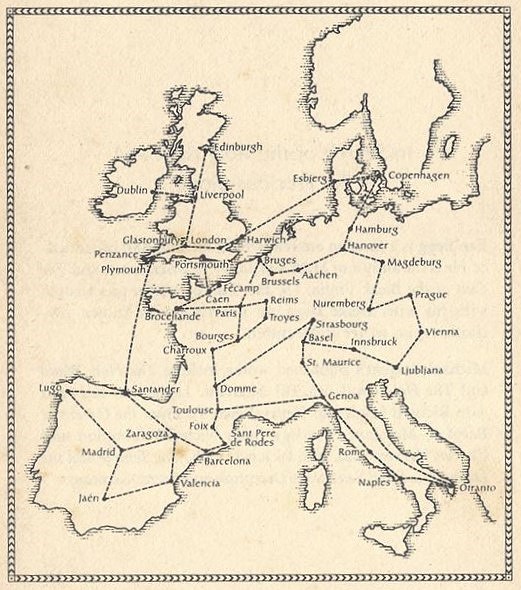
The quest is clearly an inner one. So why did we pursue it so literally, zig-zagging wildly across Europe in search of spear-heads, phials of blood, large pots and little prepuces? We are both depth psychotherapists who walk happily amidst a forest of symbols, for whom literalisation is anathema. Our book, On the Trail of Merlin, had brought us, as it were, as far as the Round Table, so the next project that Merlin proposed, the Holy Grail, seemed a logical sequel for us. But more than logic was involved. So much of our work is in the wasteland of male-female relationships, where the old paths and guide-lines have disappeared, that we wanted to make this project our Holy Grail. It was a mad idea that only Parzival, the Pure Fool, could understand. Our one-month honeymoon was spent each night but two in a different place, driving 4,000 miles through twelve countries, doing our research as we went along. We started by arriving at the ferry with a ticket a month out of date. Later we broke down on the Vienna-Graz motorway in a heat-wave, having filled our diesel-tank with petrol. The next day we embarked on the unknown perils of former Yugoslavia without car insurance. There were some nights when we found no room at the inn.
However crazy the experience, we recommend it to all like-minded fools. For what is inner calls for incarnation on the outside and any outer pilgrimage is but a symbolic enactment of the inward quest – to where? Perhaps Cana of Galilee, where Jesus turned water into wine at the wedding of an unknown couple, believed by some to have been his two beloved disciples, John the Divine and Mary Magdalen. From this mystical inner marriage flowed two of the major sources of Grail Christianity: the Cathar Gospel of Love and the ideal of feminine wisdom. For us, a lapsed Lutheran and a heretical Gnostic Catholic, it was apparently sheer chance that brought us to examine the possible meaning of interior marriage in Reichenau, on August 15, Feast of the Assumption. This is the day when the feminine principle annually celebrates the restoration of its divine rights. Here we received the Body and Blood of Christ for the first time. We also discovered in that very church what was claimed to be the vessel, called the Kana-Krug, in which Christ performed his first miracle, which proclaimed, to those that had ears to hear, the meaning of his mission. This seems to us to be no less than the achievement of the Holy Grail itself, a consummation that belongs to the great Wedding Feast of the divine Bride, the Heavenly Jerusalem.
The Holy Grail is one of the most powerful myths in Western Culture. At the centre of this myth is the story of the chalice containing the Holy Blood of Christ, shed when Longinus pierced his side at the crucifixion. The Search for the Grail has inspired artists and mystics for hundreds of years. Many churches and cathedrals were built on sites that claimed their part in this sacred mystery.
Imbued with the spirit of the ancient quest and aware of its power as an antidote to our modern spiritual malaise, Ean and Deike Begg travelled throughout Europe, researching myths. This book is an illustrated account of their search and a practical, informative guidebook for travellers and seekers. It is full of fascinating information, such as the name of the Spanish cathedral that holds the cup of the Last Supper, the story of how a fig tree carried the Precious Blood to France and the secret of the Grail castles of Germany.