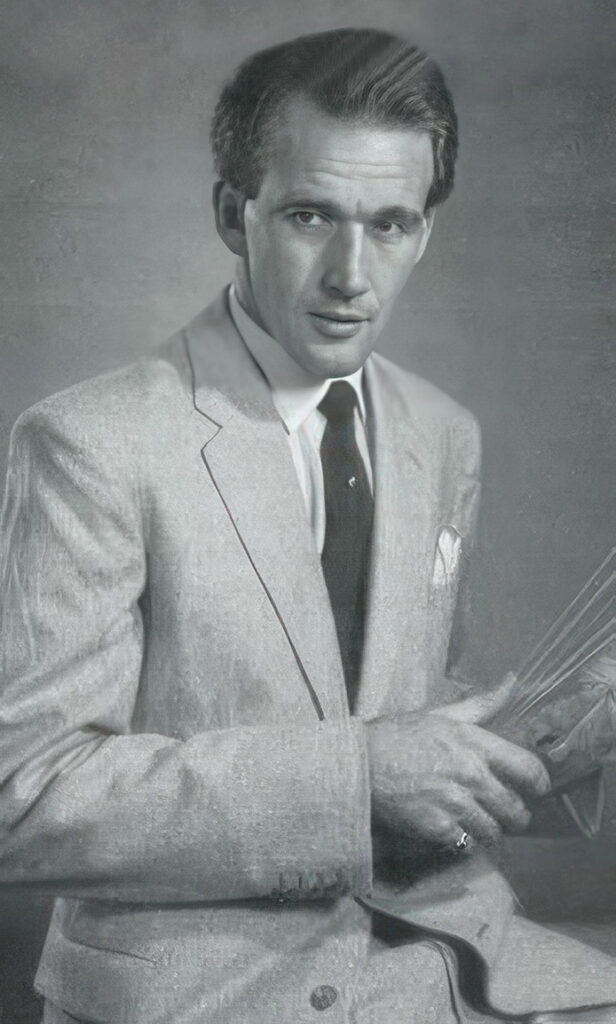
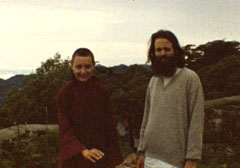
English Anthropologist Colin Turnbull arrives in Sri Ramanasramam in 1949/50.
Colin M. Turnbull (23 November 1924 – 28 July 1994) was born in Harrow, England and educated at Magdalen College, Oxford. After serving in the British Royal Volunteer Reserve during World War II, he returned to Oxford and finished his education. Turnbull ultimately received his Ph.D. from Oxford in 1964. Turnbull was awarded a two-year grant to study Indian Religion and Philosophy at Banaras Hindu University in India. He also studied in India under Sri Anandamayl Ma and Sri Aurobindo (1949 and 1951), and then went to Africa where he was introduced to the Mbuti Pygmies. Turnbull traveled extensively and studied various religions and cultures. He studied Hindu religions in India, the African culture, Samoan culture, and ultimately was ordained as a Tibetan Buddhist monk by the Dalai Lama.
In 1989, following the death of his partner Joseph Towles, Turnbull moved to Bloomington, Indiana, to assist his friend Thupten Jigme Norbu (the elder brother of the 14th Dalai Lama) in building the Tibetan Cultural Center. Later, he moved to Dharamsala, India, where he was ordained as a Buddhist monk in the Tibetan Gelugpa tradition by the Dalai Lama, taking the name Lobsong Rigdol. In 1994, Colin M. Turnbull died in Lancaster County, Virginia.
From The Flute of Krishna by Colin Turnbull – unpublished.
It was quite dark when we reached Tiruvannamalai. When the bus stopped David [McIver] and I transferred into a small covered cart known locally as a “jet,” because of the lightning speed with which the one old bullock pulls it. We left the town and skirted the foot of the hill for several miles before we came to the ashram. It was too late to think of disturbing anyone that night so David volunteered to put me up in his room. This was on the other side of the road from the ashram compound, and was at the end of a small, low building. Tired by the hot and wretched journey it did not take long for me to get to sleep.
When I woke in the morning I was completely refreshed. Even the great bulk of Arunachala seemed more friendly, and my delight knew no bounds when I emerged from the room and walked over to the ashram, for here was something which might well have been the ashram of one of the ancient sages. A pleasant stone temple in the middle of a shady compound was surrounded by thatched huts, and nowhere was the hand of modern civilisation to be seen. The trees waved, the birds sung and even old Arunachala seemed to smile in the morning sun.
I was taken round to the back, where 3 huts stood, each consisting of a single room. One of these was to be mine while I stayed at the ashram, and going inside I found a simple square room with a wooden bed standing on a tiled floor. Nearby was the dining room with kitchens attached. Orthodoxy again intervened; partition down the centre of the room divided Brahmins from non-Brahmins.
I was taking coffee from a brass bowl when a message came that the Maharshi was in the main hall and would see me.
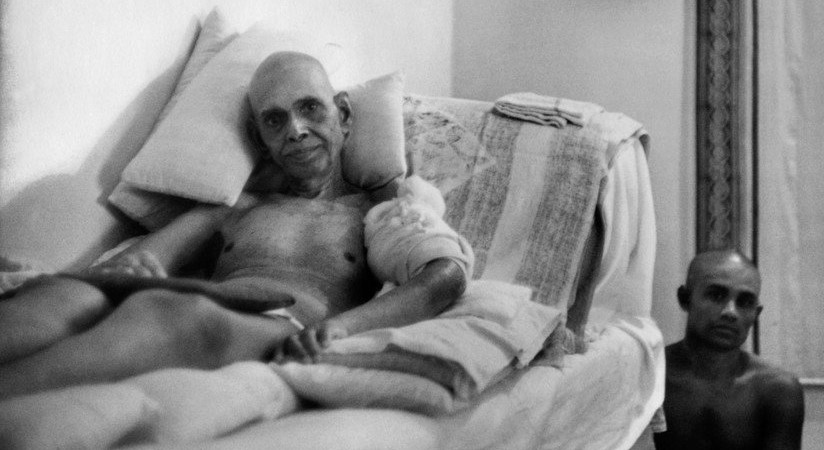
As I left the dining room and crossed the gravel yard towards the temple, knowing that the Maharshi spoke some English. I framed to myself the way in which I would greet the sage, and the questions I would ask. I was led through an immense stone doorway to the hall, and then left there alone. To one side a small area was railed off, and in this was a large stone couch with a bed in front on which lay the Maharshi. A brazier burned on a stand beside him, and from this a stream of incense smoke trailed up to the ceiling. Two attendants gently massaged the limbs of the old man, who still continued to look away from me.
I was about to take a step forward, when the Maharshi turned his head and looked at me with an expression which I have never seen before nor expect to see again. There can be no comparing of the degree of greatness of these spiritual giants, but the quality in all of them seemed different. Anandamayi, Sivananda, Krishnamurthy, Aurobindo, and now Maharshi. When Anandamayi first looked at me I felt a shock of surprise, and sensed a goodness and purity beyond description; with Aurobindo it was a feeling of an inflow of almost unbearable power. Now Maharshi turned his grey head and gave a smile of greeting which was at the same time warm and empty. The warmth lay in its sincerity; the emptiness in the fact that the Maharshi was utterly detached from the world around him, let alone the individual he was greeting. His arm twitched with pain, but his expression remained unaltered, sublime. As soon as I could pull myself together I turned tail and made my exit as quickly as possible without even so much as one of the fine words I had prepared.
It was not long afterwards when it was time for the hour when the public were admitted into the hall, and this time I crept in at the back and sat down, leaning against one of the many carved pillars. The Maharshi had drifted off to sleep, and his head rolled over one shoulder. Occasionally he would wake up with a jerk, look around the hall, fan himself slowly with his bamboo fan, then go back to sleep again.
It was not an impressive sight, but that did not seem to matter after I had seen his face when he greeted me. The other people in the hall seemed of the same opinion, and sat around quietly meditating or gazing up at the saint. One side of the hall opened into the temple, and from there came the sound of priests chanting Vedic hymns. This continued to the end of the allotted hour when we were all ushered out. We had to remain outside until evening, when once again the doors were opened for an hour.
In the evenings the Maharshi was awake and would look around the hall or gaze outside through the open doors to the countryside beyond. He seldom looked at anyone directly and seldom spoke, and while he was awake his expression never changed.
Ramanashram was an ideal place for quiet meditation and it seemed to derive this atmosphere from the rugged hill behind and from the ancient temple. Those wishing to lead a life of contemplation came for this reason and also because they received strength and help from the presence of the Maharshi. There have always been saints associated with Arunachala, and no doubt now that Ramana has died another will come to carry on the tradition.
For the beginner who has little idea of how to proceed, however, the place was not well suited. The Maharshi gave no instructions, and the host of books available were only reports of sayings of the sage. In earlier days he had frequently talked with his disciples, but now he was an ill man and spoke to no one except his oldest followers.
I asked if I could see him before I left, and on the morning of my departure one of the attendants signalled to me to remain as the others filed out of the hall.
I went up to the couch and sat down beside it. Without thinking I rested my arm on the coverings, and the disciple who was massaging the Maharshi made to move me further away. Perhaps he was jealous that a newcomer should be accorded the privilege of an interview, or he may have been annoyed that anyone should disregard the doctors who had advised against any more private discussions. But the Maharshi made it plain that I was to come as close as I wished, and he then talked to me for half an hour, sometimes in English and sometimes in Tamil which was translated for me. It was a difficult conversation, for each time I used the words “you” and “I” the sage would smile and ask:
“Who ‘I’? Who are ‘you’?”
For him there were no such distinctions; he could see only the one Self, the Divine Presence in all. That, he said, was the reality; the differences and distinctions which make up every minute of our waking lives are self-created, illusory, the result of ignorance. By constant meditation, constant inquiry into the real nature of things, he said, this one Self becomes apparent, and when that happens there is no need for conversation.
I asked him why he allowed his body to suffer if, having reached this state of spiritual development, he had the power to heal it. He replied that the body was a shell; in the light of the ultimate reality it was an illusion, there was no point in his interfering—he felt no pain. All this time his body was twitching and jerking, yet his face betrayed no symptoms of suffering. I was not to be put off and demanded:
“Even if you feel no pain yourself, is it fair to allow those who love you to suffer, as they do just through seeing your body in this condition?”
He looked at me with a smile, feigning not to understand.
“What is all these ‘you’s’ and ‘me’s.”
I was about to give up the conversation as too difficult if these pronouns were to be banned, but the Maharshi put out his hand to touch me and told me it was no good his trying to explain in words matters which were beyond description. He said that the only way to know that state was to experience it, and to experience it one had to get rid of all false notions of difference between individual “selves.” It does not matter whether we lose ourselves through contemplation of the problem as such or through a merging of ourselves with the image of our beloved; or even by cold systematic reasoning. As soon as we finally lose all sense of identity, then the great Truth becomes apparent and That alone exists.
At that time I did not derive much benefit from his words, and when I left I was conscious only of his beaming smile and his extraordinary selfless character. It was disappointing not to have received more concrete instruction, I thought, from such a renowned sage.
He sank back on the cushions, and lay there, gazing out of the open doors and over the ashram compound, to the country beyond. His eyes saw I know not what but I felt it was not the same as what my eyes saw. For the Maharshi there was no conflict or opposition, joy or sadness, life or death.
At that time I did not fully understand this apparent emptiness, and I was more impressed by Arunachala then by this saint. But Maharshi would have been content. “What is the difference?” he would have probably asked.
I took my leave and left the sage on his couch, smiling into the temple hall, attendants massaging his arms and legs.
Not many months later he “died,” if one can use such an expression. He is probably as much there as he ever was, only now there is no body to distract one and tempt one into judging him as a common mortal. Out in the courtyard I put my bedroll into a cart and bade my farewells, and was carried slowly out into the blazing sun and down to Tiruvannamalai. Even when I was on the train I was unwilling to go, and leaned out of the window until the Holy Mount of Siva was out of sight and the shrine below but a memory.
Ramana Maharshi Archival Film https://ashramsofindia.com/ramana-maharshi-archival-film/
Early Western devotees of Ramana Maharshi 1911 to 1939 https://ashramsofindia.com/early-western-devotees-of-ramana-maharshi-1911-1939/
Early Western devotees of Ramana Maharshi 1940 to 1950 https://ashramsofindia.com/early-western-devotees-of-ramana-maharshi-1940-to-1950/
MATAJI By Colin Turnbull, M.A., Ph.D. (Premananda)
The world is shaken by a series of wars, it is filled with suspicion and hatred, there is no peace for the body, mind or spirit. That is how we of the West felt at the end of the last World War, and we feel the same today. Everywhere there is disunity, unhappiness, and emptiness in our innermost lives.
The last war was, in some ways, necessary for our spiritual welfare. It shook us all into a momentary realization of our need for a firm spiritual foundation for our lives. The churches were filled and for a while it seemed that we were turning to God at last. The war ended, however, and the churches became empty again, and God was forgotten; man returned to his normal humdrum life, moved mainly by purely material considerations. Material considerations were, m fact, our only guide and standard, even morality was largely a matter of social convenience. There was a spiritual emptiness and although many were too engrossed in their whirl of activity, there were some of us who felt only a great loneliness, and a longing for something deep and lasting on which to build our shattered lives. Our eyes had been opened and we could no longer remain satisfied with a way of life, which not only ignored the world outside our own small society, but ignored the very deepest meaning and purpose of life itself.
I left my home and came to India for the sole purpose of discovering what it was that was missing in my life, and of filling that spiritual emptiness, which made life, seem so pointless. I had studied Indian philosophy and had a number of Indian friends, and felt convinced that in India I would find not only what I myself wanted, but what the whole of the western world needed.
It was not easy at first, although the Hindu family with which I lived in Baroda treated me as their own son. I learned to live the Indian way of life without too much difficulty, but all the time I was aware of some intangible difference between us, something which they had and I had not. Then I came to Banaras and settled own at the University to a serious and concentrated study of Indian philosophy. I found an increasing amount of intellectual satisfaction and yet that “something” still eluded me. Argue and reason as I might, I could not break that chain which anchored my inner life to the West and prevented me from feeling at one with my Indian friends. As long as I concerned myself with the intellect the Spirit eluded me.
I had read many books on yoga, and although again I could find myself in complete intellectual agreement with the system, yoga meant nothing more. Then, one day, a friend at the University told me that there was a woman in Banaras who was regarded as a saint and would I like to meet her? My immediate reaction was “No,” but when I saw some of the articles in that book compiled by her devotees I felt less certain.
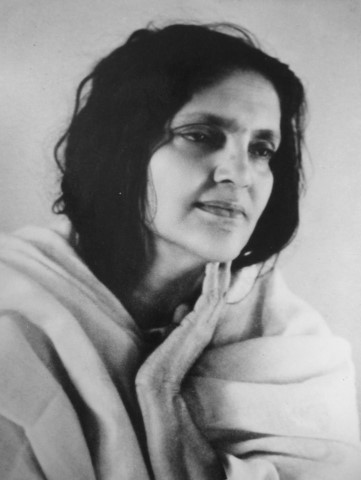
It was Anandamayi Ma, and although I still felt that my western ways of thought and conduct revolted against the idea of a woman saint, I could not help feeling a curiosity, and beneath that something more-irresistible attraction, which came through the pages of the book and filled my thoughts as I sat in the Guest House reading it.
It was through no will of my own, it was something inevitable, like the action of a magnet, and one evening I found myself wandering through Lanka and down to Assi, and then through the narrow twisting lanes until we came to Anandamayi Ashram. There were three of us, and we had all come to India from the West for the same purpose, the other two were Americans; one went to Ramana Maharshi and the other to Sri Aurobindo not long after the day we first met Anandamayi Ma.
I cannot describe that first meeting; there was a large crowd, all sitting on the lovely terrace over the Ganga. And there, in the midst of us, in simple white clothes, was Anandamayi Ma.
The first sight of Her unsettled me, and made me feel as though the precarious hold I did have on life was being swept away, and after She had said a few words to us I felt almost glad to get away and return to the safety of the University. It was, I suppose, the natural reaction to the impact of two worlds. I had been on the borders between East and West still holding grimly on to the West because it was all I knew, but now I had been plunged into the unknown by the mere sight of a woman.
The very next day, in the morning, I was again making my way to the Ashram, and this time I sat for an hour or more in the hall beneath the terrace listening to the Kirtan and to Anandamayi as She spoke and laughed and sang. She sang and She seemed to be singing to me. All the time She was asking me the question She had asked one of my friends the evening before: “Will you surrender, will you do whatever I tell you, without question?” Those were Her terms if I was to get any further, and again I felt a wild urge to run away. One of the devotees (Dr. Panna Lal) even asked me directly, in English, and although I opened my mouth I could say nothing.
It was not long afterwards that Anandamayi became “Mataji” and I became “Premananda,” and from then onwards there was never any question of doubt. Mataji filled exactly that emptiness I had felt in the western world, and through Her I learned how to lead a whole life, how to carry the Spirit into the every-day world, how to lead an every-day life that is at the same time a dedicated life, and intensely spiritual. The combination of spirituality and practicality is one of the most valuable gifts that the East has to offer to the West, and Mataji taught accordingly.
In Her ashrams I felt the bond of brotherhood which will eventually unite the world, and in the mutual love and consideration which pervaded all those gathered around Mataji, I found a way of life which is yet but a dream among the majority of the peoples of the western world. There was no question of rich or poor, good or bad, high or low, there was perfect brotherhood among all. I think that perhaps the greatest things I learned were a love for Truth and a love for all my fellow beings. Truth can be a hard master, but there are none better, for Truth is one of the ways in which the Spirit is revealed. Those around Mataji could not help but be impregnated with this wonderful ideal, and at the same time feel all the petty differences and distinctions which normally surround us, disappearing. Here was life as it should be led, life for the One Self, not for the little individual self, a life in which all of us could join equally, no matter how feeble and weak we were.
I find it impossible to describe Mataji, and have given up trying to do so. She is both a woman and not a woman, for in Her bodily form She gives us a living example of what life should be like -and just to see Her is to know – and yet after a few minutes in Her presence you know that the body is a mere shell, and that Mataji is essentially far beyond its narrow confines. Mataji is everywhere and at all times for those who want Her, and nothing is more delightful than complete surrender and a great plunge into the ocean of Truth, Goodness and Beauty with which Mataji surrounds Herself. She has something different for every one of us, each according to his innermost nature and it seems almost wrong to speak or Write about such a person, as that immediately limits Her.
Not long before I left India to return to the West; a number of us were returning in a bus from a visit with Mataji to Pao Puri and Nalanda. It was a tiring journey, but we were all singing kirtan for the first hour or so.
We seemed to exhaust the possibilities of even this but one of Mataji’s fondest devotees went on singing “Ma, Ma, Ma, Ma, Ma, Ma,” until we reached home.
We tried to persuade him to introduce some variety, but he resisted our attempts and even refused to add “Jay Ma, Jay Ma” for our benefit. He was right. How useless words are! And if we must use them it is better to confine ourselves to as few as possible. For him Mataji was the only reality in the world. He was a samnyasi and wanted one thing only – he could see that one thing in Mataji. So why sing elaborate kirtan when he could do just as well by singing the name of ‘Ma” only?
Over here in the midst of the turmoil and trouble of western life I often think of that bus ride, and as I sit in the evenings and think of Mataji I find that all words and thoughts leave me, and I am conscious only of ‘Ma” and all She stands for. It is the only thing which makes life worth while under such conditions, and it is an additional proof that it is in the eternal Truth which is so perfectly revealed in Mataji that the world today will find the foundations on which to build a happier future.
Mataji has a message for each one who comes to Her, but in Her very being She is a message for the whole of mankind.
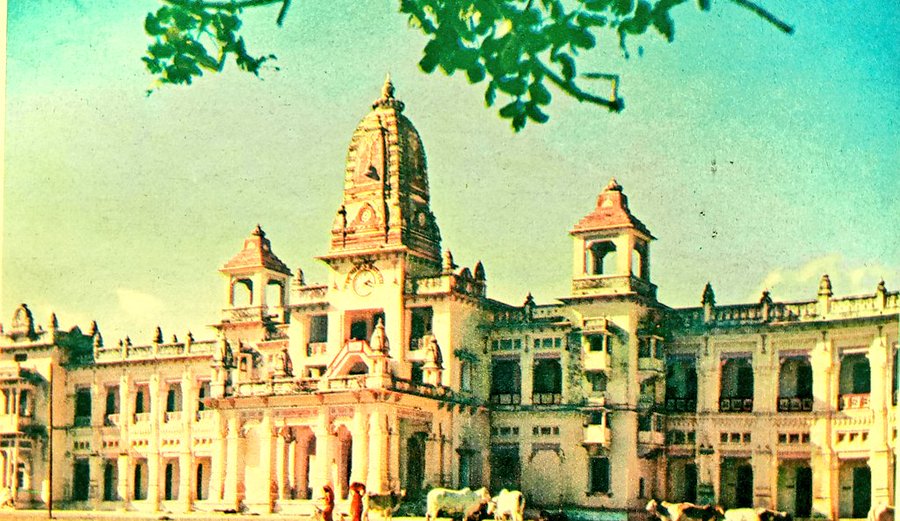
Westerners in Benares 1947 ~ 1950.
Colin Turnbull
Newton Beal– a fellow student at Benares Hindu University
Judith Tyberg https://ashramsofindia.com/judith-tyberg-jyotipriya/ and David Mirer
Lewis Thompson, poet
Athmananda – (Blanka Schlamm) https://ashramsofindia.com/blanca-schlamm-atmananda/
another devotee, Ram Alexander, of Assisi, Italy.
ONCE BACK AT OXFORD, Colin spent a considerable amount of time with Indian students. Although the number of Indian students peaked in the early 1920s, when the colonial administration was struggling to educate Indians in a British manner, in 1940 there were still plenty of students for Colin to befriend. Unfortunately, Magdalen, like Corpus and University Colleges, had a history of anti-Indian sentiment. Throughout the university, Indians were generally marginalized from many social activities, and increasingly so as Indian nationalism took hold. Indians were less likely to want a British education and the British began to resent Indian elites. By establishing close friendships with Indian students, Colin was expressing his devotion and love of the Other. His best friend during the immediate post-war years was Satya Paul Mayor, an undergraduate studying engineering at Magdalen. Paul was Punjabi but was born and raised in England. Colin and Paul were close, even more because both of them had served in the navy; Paul wanted to be in the air force but people of Indian descent were not permitted to join. Colin also met Kumari Mayor, Paul’s sister. She would become one of the most important women in his life. But despite having good friends, Colin was unhappy in England. His relationship with his parents, especially his mother, was strained. His father had begun to pressure him to become an accountant, a profession for which Colin had no interest at all, and Dot had become increasingly possessive of him. Her hold on Colin was even more tenacious since, with Ian’s death, Colin was her only child. Dot, in fact, resented Colin’s independent spirit and remarkable ability to form personal attachments far more than she would later resent his emerging homosexuality. Even as a teenager, Colin’s good looks and social skills exceeded those of his mother. Tall and handsome, with long fingers and enormous hands on which he wore a ring with the Turnbull family crest, he would walk into a room, ethereal and refined, and find all eyes on him. As he got older, he paid less attention to his clothes, but that became part of his charm, a nonchalance that rarely looked contemptuous or stuffy; instead he showed himself to be carefree and affable, exuding a nuanced chic. In comparison to Colin, Dot had few friends and seemed to have little difficulty terminating what friendships she had; Jock’s friends were almost exclusively business partners or clients. Colin, in contrast, established friendships like the Pygmies built makeshift huts. They were perfectly good, if impermanent, shelters that could be made quickly, for short or long stays; when they were physically abandoned, they could be revisited and, if not, they were seldom destroyed but simply dried up and faded away, suffering no insult, only the ordinary passage of time. One way Dot felt she could hold on to Colin was to sabotage his efforts to find a girlfriend or to marry. On a Saturday evening in 1948, a year before he finished his studies, Colin was spending a few days at home on break from Oxford. As he was getting dressed for a date at the opera, in his finest clothes and opera cloak, his mother answered a knock at the door. It was Robin (Robinetta) Roberts, dressed in a ball gown. Robin said she was there to meet Colin, but was told by Dot that Colin was not at home and that she should therefore leave immediately. A few minutes later Dot told Colin that his date had departed, that she had sent Robin away because she disliked her. As his young nephew David watched from the corner of the sitting room, Colin threw whatever breakable objects he could find into the fireplace. And so, in 1949, when Colin finished his undergraduate studies at Oxford and faced the question of what do with his life, he was decisive. His best friends were Indian. Most of the women he dated were Indian. He was fascinated by Hinduism and even considered studying at Oxford for an advanced degree in Indian religions. Best of all, India was far from England and his parents. He would go to India to study Indian religions at Benares Hindu University, a place recommended by his Indian friends at Oxford. At another level, however, his interests were less academic. He knew that what he really wanted was to follow a spiritual path, simply to be in India, to be away from other Europeans, to break through India’s illusions. Like many tourists he was captivated by the mere anticipation of being there. But while other Europeans might stay at luxury hotels and be satisfied by the snake charmers and dancing monkeys performing beneath their balconies, Colin would begin a different journey. On the way into Bombay from the dock, Colin was thrilled at the sight of the Marine Drive snaking along the bay. The street lights glowed along the drive into the distance, hence it’s nickname, “The Queen’s Necklace.” In the heart of Bombay, and in front of his hotel, he was assailed by an odor so foul it was hard to bear. The smell of feces was everywhere; lepers and other deformed beggars came toward him for money, and polio victims crept along the edges of the crowded streets. The four-star Taj Hotel, where Colin had a reservation, ought to have been a refuge, but he liked it better outside. That was the India of Indians, he thought: poverty, illness, hunger and, within such dire circumstances, a resolute quest for spiritual fulfilment. The magic that attracted tourists was a sleight of hand. India’s real magic, Colin believed, was an inner spiritual life accessible only to a special few. He wanted to be one of them. The record of those two important years in India consists of two accounts separated by more than forty years. The first account is the photo-diary Colin kept and presented to his parents in 1951.
The other is a manuscript entitled “The Flute of Krishna,” part summary of the 1949–51 diary and part elaboration on it, which he compiled in Samoa in 1991. He was never able to shape “The Flute of Krishna” into a publishable text or one that went beyond a description of the events of those two years. The text offers little information about Hinduism, and in neither account was he particularly introspective in the sense that he looked explicitly at his psychological development at the time. Yet, in his vivid descriptions of events, he does offer some clues to his inner life. The texts suggest that 1949–1951 were crucial years in setting him on the path to becoming an anthropologist. The texts also suggest that his sexual identity was unresolved. That resolution would emerge ten years later. Neither Colin’s parents nor his teachers were enthusiastic about his plans to study for a Ph.D. in religion at Benares Hindu University. His cousin Bill Mackenzie at Magdalen worried that Colin was simply a dilettante – musician, minister, farmer, scholar, and now truth-seeker. In early March 1948, Mackenzie wrote Colin to warn him that the quality of Indian universities was sub-standard, and that religious studies had no practical value. “It seems a pretty desperate project,” he wrote. “You would certainly involve yourself in a disaster unless you worked pretty hard under some supervision in London, presumably at the LSE [London School of Economics] . . . I cannot see what you would get out of it either as education or as a qualification for your future career.” Colin wrote back two days later. “I quite understand your lack of enthusiasm for the idea and take heed. As you say, as either an education or a qualification, the value is doubtful, but the point is that now I have decided to pursue an academic career . . . I am well aware that I did not work when up [at Oxford], I didn’t shine particularly at what I did do, not for lack of desire, however. I desperately wanted to get to grips with some interesting work, but it was all so utterly pointless – training that I was going to my father’s office. The fault was mine, for not training my mind. But now I do know it – at last – beyond any shadow of doubt; and lo! the miracle has happened, believe it or not, and I am working!” A week later, he wrote again to assure his cousin that he had also begun learning Hindi and Sanskrit, as well as the teaching of English as a foreign language, and that he expected a teaching diploma would “bolster up” his admittedly weak wartime B.A. and increase his chances to qualify for government funding for his education. He added that while he understood that many people at Oxford believed an Indian degree would not be taken seriously, Benares Hindu University was an exception to the “low standards of Indian universities, especially where Hindu Philosophy is concerned.” Colin did not tell anyone that he had already decided to look for a guru and would become a vegetarian. With those correspondences and with his stated enthusiasm for study, Colin silenced his critics and was on his way to India. Within a few days after his arrival, Colin travelled to his friend Paul Mayor’s family home, not far from Benares, for a short stay before classes began. From the boat Colin had sent a telegram to Paul’s brother Dev saying, “Arriving with empty pockets and loaded machine guns.” This caused a stir in the intelligence department; Indian authorities made frequent calls to the Mayor house, eventually inspected it thoroughly, and summoned Colin to the police station on his arrival to lecture him on the dangers of loose talk. Dev’s wife, Geeta Mayor, who entertained Colin as well as the intelligence department, recalls that despite his antics “Colin had an elegant presence, soft spoken, one could not help feeling he was made for a special life.” Not long after registering at Benares Hindu University, Colin heard about the great religious teacher Sri Anandamayi Ma whose retreat or ashram was nearby. Sri Anandamayi Ma (1896–1982) was well known in India by 1949, and she is remembered today as one of the most famous of all Indian gurus and certainly the most famous twentieth-century female guru. Colin thought about going to see her, but first he wanted to travel north into the Himalayas where he thought the most holy gurus lived. Colin wrote a friend about his discomfort upon hearing of a famous guru who manufactured lapel buttons with his image on them, made phonograph records, and sold t-shirts. He imagined that Himalayan gurus were different. He joined two European hikers on a difficult journey into the Himalayas in search of his high-minded and reclusive gurus, and though Colin was in excellent physical condition, he grew weaker and weaker. After reaching one peak on a long ascent, he fell to his knees to catch his breath. His friends went ahead and Colin promised to catch up with them. But he grew dizzy and slightly disoriented, knew he could not go any higher, and ended up crawling halfway down the hill through the thick underbrush until he collapsed. He slept outside that night, continuing down the hill the next morning and along the way eating whatever leaves looked edible in order to get some strength. Finally, he came to a road and collapsed again. A farmer with a two-wheeled cart picked him up and took him to a nearby temple and, as he lay there in the cart, barely conscious, he saw a man coming toward him. The man called out to Colin in a loud voice, “So, you didn’t want to come and visit me!” Colin recognized him. He was the man on the lapel buttons and the t-shirts. The guru took him in, diagnosed him with hepatitis, nursed him back to health, and told him to go back to Benares to be with the famous female guru Anandamayi Ma. Colin found the approach to Anandamayi’s ashram far from prepossessing, but when he got into the main courtyard he quickly understood why ashrams were places for enlightenment, peace, and self-discovery. He later remembered, “From the narrow main street leading from the university down to the city centre, a series of alleys ran off to the right, down towards the river. These alleys were only a few feet wide, and were as much frequented by cows as by humans. The result was that it was both wet and messy underfoot. And it was quite a long walk to get to this particular ashram. However, once there, stepping through a large but otherwise unimpressive archway, you came into an absolute haven of peace and beauty and cleanliness. A great terrace, lined with flowering trees and shrubs, overlooked the sacred Ganga River, and if Anandamayi was herself in residence — as often as not she was away visiting one of her many other ashrams – the terrace was crowded with people of every class and caste imaginable, the poor jostling the rich, the Sudras the Brahmins, to get close to this famous teacher and hear what she had to say.” Colin went there with two Americans: Judith Tyberg and David Mirer. Judith was from California; she was known in India as Jyotipriya, and had already lived with another famous teacher, Sri Aurobindo. She held a Ph.D. in Sanskrit studies and had published an important book with the Theosophical Society of the United States entitled Sanskrit Keys to the Wisdom Religion. David, a conscientious objector during World War II, had already decided to live with a third teacher, Sri Raman Maharshi in Tamil Nadu, southern India. In the courtyard, Colin and his friends searched for Anandamayi Ma but everyone was wearing white and to Colin they looked alike. Colin delighted in the uniformity; after all, he detested the markers of class and status in England. When Colin and his friends finally figured out who she was — a middle-aged Bengali woman sitting on a small carpet with long black hair falling carelessly over her shoulders — they walked toward her and sat down. An hour later Colin would write in his diary that when he saw her face everything vanished from his mind except a profound tranquillity. Colin asked Anandamayi Ma if she believed that by going to India he was rejecting his parents. He clearly believed that there was at least a kernel of truth in this proposition, but she put him at ease. Although one’s highest duty, she said, is to one’s parents, even that should not come before one’s duty to seek truth. With these simple words, Anandamayi Ma perhaps said more than she intended, for Colin not only left his parents physically; by embracing Hinduism, he was also repudiating his parents’ religions. Of the three American visitors, only Colin returned the next day. Nearly fifty women were having a lively discussion with Anandamayi Ma in Bengali, a language Colin did not know. “I thought this was really rather a waste of my time and was about to leave, but some intuition made me stay, telling me that something important was going to happen. Then Anandamayi Ma started singing a lovely little song, still in Bengali, and looking directly at me. I felt a net closing in around me, a net of utter serenity and charm, and resistance was impossible.” Anandamayi Ma was inviting, powerful, and full of love. One of Colin’s most salient memories was of her maternal love and, like all her devotees, Colin would call her Ma, or Mataji, meaning mother. He recalled of their first meeting that “A little boy came and curled up beside her, and Anandamayi caressed his long black hair until he fell fast asleep. Sometimes powerful, almost frighteningly so, [she] was now a fragile mother; but a mother with the magic of the moon and the stars and the whole universe within her, and within the child on her lap.” That vision of the boy, perhaps a vision of himself, compelled him to be with her, and in the coming weeks Colin went to the ashram every day. Anandamayi Ma then informed Colin that she had a room ready for him. If he was to live at the ashram, she wanted to know two things. First, what could she call him? Second, what yoga or spiritual path would he like to follow? He answered the second question first — “Gyana Yog, the path of the intellect” — and waited for Anandamayi to answer the first. “What about Shuddhananda? (lover, devotee of purity)?” “Whatever Mataji says.”) “Or Premananda (lover of love)?” “Whatever comes out of your mouth.” ee “Premananda All who knew him during this time would in future years call him Premananda. Anandamayi Ma told Colin he could never become a Hindu, there was no reason for him to change his identity. She argued that everyone in the ashram was identical no matter what they called themselves. In sending this egalitarian message, however, and by allowing Colin to live there, Anandamayi was downplaying one of the most significant features of her ashram; despite her distaste for hierarchy, the ashram was a place exclusively for Brahmins, members of the highest caste in India, and remains so to this day. In India, generally, Europeans have had an elite status, but within ashrams such as this one they were likened to Untouchables. Europeans followed no caste regulations, would touch anyone and eat with anyone, regardless of their caste, and were therefore polluted and polluting in the eyes of Brahmins. As a result, although there were many Europeans who became devotees of Anandamayi Ma, few Europeans are known to have actually lived at her ashram. A young writer named Lewis Thompson, Colin Turnbull, and an Austrian pianist and schoolteacher named Athmananda (whose European name was Blanka Schlamm), lived at the ashram, ate the same foods and wore the same clothing as the other devotees, but by permitting them to live there Anandamayi Ma heard many complaints. Some scholars of India find it curious that she had such great power and such strong convictions about inclusion, yet for the most part she complied with the Brahmins’ wishes to exclude nearly everyone else from her temple. Athmananda had been a devotee of Krishnamurti for three decades before committing herself to Anandamayi for thirty-two more years, until her death in September 1985. She kept a diary during the years Colin was at the ashram, and left it in her will to another devotee, Ram Alexander, of Assisi, Italy. Born in Austria to a Polish father and Czech mother in 1904, Blanka was twenty years older than Colin. She had an extraordinary gift for music and languages. As a young woman, she was organist in Holland for a church associated with the Theosophical Society, which was active in India. She accepted a teaching job at a school in Varanasi, India, and soon came to meet Anandamayi. Athmananda learned to read Sanskrit and, as she was fluent in French, English, German, Bengali, and Hindi, Anandamayi asked her to remain at the ashram as a translator and interpreter, not so much for westerners but for the many Indians who could not speak Hindi or Bengali, the only languages Anandamayi spoke. And yet Anandamayi also knew that if Athmananda stayed there she would be excluded from Brahmin functions and would feel marginalized without a companion. Lewis Thompson had been there before Colin; when he left, Anandamayi saw Colin (now called Premananda or Premanand) as a possible replacement. On December 19, 1949, Athmananda wrote to her diary: “Spent the weekend at the Ashram. [Ma] definitely tries to wean me from being too attached to Her. I asked Her about Premanand who had written to me. She said to tell him: “That which is most dear to you with that remain always. And this is also for you.’ I started crying when I heard this.” Athmananda agreed to look after Colin. She would remain with him during most of his stay at the ashram, and because he spoke neither Hindi nor Bengali she was the interpreter for all of his exchanges with Anandamayi Ma. Yet Colin makes no mention of her in his long manuscript, “Flute of Krishna” or in his other recollections of Anandamayi Ma published in India. Later, in his account of the Pygmies, those who helped Colin would also be erased from the record. The next month, Athmananda wrote: January 29, 1950 … No sooner has [Lewis] gone than She provides me with another sensitive young Westerner. She seems to want me to be in touch with at least one other foreigner. I suppose I need that. He is a nice fellow. When he talked to me yesterday, suddenly for a second, I noticed his beautiful blue clear eyes. There was a sudden instantaneous recognition. He told me some incidents from his life that are strangely parallel to mine: How he went fishing, and when seeing the first fish caught with the hook violently stabbed through its mouth, he threw down the rod and ran away in terror. Just like, [with] the chicken I had looked after. . . 12 February 1950 Yesterday translated a private [meeting] for Premananda [and Mal. I find myself becoming fond of him. It started the other day when he talked to me. Yesterday when he laid his soul bare before Ma I found him delightful, so pure and fresh and sincere and full of joy. He is simple and not at all complicated like Lewis was; he seems much healthier and there is not so much conflict in him. Ma evidently wants me to have some human relationship as She always gives me someone to look after, perhaps to counteract my tendency of being too cut off. In March, Athmananda wrote about how much she missed Lewis but she comforted herself with the thought of Colin: “Premanand is a charming boy, so balanced and sunny a creature.” At the ashram and with Athmananda’s help, Anandamayi Ma taught Colin important lessons about humanity that, he believed, framed his future intellect. Anandamayi Ma taught him that there was a universal humanity but that human beings had the capacity to shape their existence in myriad ways. In future years, Colin would quite consciously try to become the people he studied, transcending boundaries most people thought were impassable. She also taught that being born into high status, whether Brahim or Brit, was not necessarily desirable, for we are all humans and therefore subject to the same afflictions. On several occasions, apparently to emphasize her disapproval of social status, she had the Brahmins in her ashram feed everyone else, thus having them act as servants to those who, outside the boundaries of the ashram, would have been their subordinates. The end result of such a reversal of hierarchy was probably similar to that of the Royal Navy’s annual ritual reversal — momentary reversals of hierarchy that actually reaffirm the status quo. Colin did not let himself see the reaffirmation of entrenched hierarchy at the ashram as he had on the Navy boats. Once Ma showed Athmananda and Premananda a door leading from the terrace to her room made especially for them, all the while insisting that there was not a hair’s difference between them and the other, Indian devotees. But beyond this, she did little to change the ashram’s attention to hierarchy, and one could well argue that by constructing the special door she was acknowledging the need to isolate her relationship with Colin and Athmananda from the rest of the ashram. When Colin first arrived at the ashram, Anandamayi Ma conveyed her sentiments about the Indian caste system to him in a well-known story about a saint’s quest for moksha, freedom from the wheel of life and reincarnations, and release from the pains of desire in the external world.
From late 1949 through 1950, Colin still went to classes at Benares Hindu University but his relationship with Anandamayi Ma took precedence over his studies. He took every opportunity to be with her, especially when she was traveling, and she said it would be good for him to accompany her to Dehra Dun, near the city of Mussoorie in northern India. It was autumn, the time when the Durga puja is performed, the most important annual Bengali Hindu festival.
We do not know what Anandamayi Ma saw in Colin. He does not even hazard a guess as to why someone in such demand would spend so much time with him. It may have been because he was British. It may have also been the strength of Colin’s desire to learn her art, or even perhaps his willingness to see her as a mother and her ashram as the site of a second adolescence. But it may also have been all of these reasons combined with Anandamayi Ma’s desire for Athmananda to have a western, male companion. She believed in marriage, and she herself was married, though she also believed in complete celibacy. Like her other students, Colin found his own way. India, she said, was about self discovery. There was no real Anandamayi or Durga or Colin Turnbull. Anandamayi Ma taught him that there was only that which Colin made real for himself. She also taught him that something beautiful and pure can emerge from something ordinary, inconspicuous, or ugly, like a lotus growing up from the mud, its beauty and purity unsullied by its origin. Truth could be found in the most unexpected places, in the mountaintops of India or in temples and ashrams, but perhaps just as likely on a river bank, a city slum, or a farmer’s field. It might even be found in one person – someone who Colin might someday meet – in whom, deep inside, there was a brilliant light, an inner truth, struggling to blossom. Colin would keep a photograph of Anandamayi framed on the nightstand in his bedroom until his death. It stood right next to a photograph of his mother. In 1989, nearly four decades after he left India, he would place a second photograph of Anandamayi Ma in a Hindu shrine he constructed in his living room, amid icons and relics and silk, in between two photographs of his partner, Joseph Towles. Between 1949 and 1951, Colin spent brief periods of time with other teachers, such as Swami Sivananda, Krishnamurti, and Sri Aurobindo, but none influenced him as powerfully as Anandamayi Ma. He felt that his relationship with Anandamayi Ma was intimate, as it is supposed to be between teacher and disciple. The ultimate goal of the disciple is to put himself in the hands of a single guide, to find one’s self through the being of the other. This process informed his later work as an anthropologist. His relationships with the societies he studied, whose members he viewed as his teachers, were patterned on his earlier relationships with people like Anandamayi Ma or his Oxford tutor, A. J. P. Taylor. Reflecting on his teachers, Colin wrote: “The relationship and the conscious effort to dispel the duality [between teacher and student], is all the more powerful when there is only one teacher and one student. In the tradition of the guru-student relationship, it is felt to be essential for those who in childhood or early adolescence have consecrated themselves directly and entirely in the hands of one spiritual teacher who can, it is believed, teach the adolescent how to transform his growing sexual energy into pure spiritual energy.”
Colin spent two months living in the ashram of Sri Aurobindo, a teacher who Anandamayi suggested Colin visit. He taught Colin that the sacred and the secular could be joined together and that scientific explanations of human experience had their limits. Aurobindo’s ashram was in Pondicherry which, in 1949, was still under French control. Born in 1872, Aurobindo spent most of his early life as a student of classics. After studying at Cambridge University, he returned to India to take the civil service exam and passed everything except horseback riding, a failure that disqualified him from playing polo and therefore of gaining much status within the British colonial empire. He became an Indian nationalist and was frequently jailed by the British as a dissident. In Pondicherry, the French left him alone. Most ashrams were places for personal spiritual growth where people sought tranquillity, sanctuary, a time for self-reflection as they prepared to return, changed, to their everyday lives. But Aurobindo did not want to perfect the individual; he wanted to perfect all of humanity. Aurobindo argued that the Divine could be brought down into this world, blending the secular and the sacred and thereby saving entire communities. He believed that no fundamental transformations in society could be made until humanity altered its consciousness through the Divine and he described the descent of the Divine into the human world in his book The Human Cycle. Colin would later use the identical title for his own 1983 book on rites of passage in England, India, and Africa. Sri Aurobindo’s ashram consisted of offices, a library, a meditation hall, dining area, guest quarters, and a private residence for the guru and an elderly French woman called Mother. With wild hair and a dictatorial style, she ran the place. All communication with Aurobindo had to go directly through her. Few others ever saw the great sage. Each morning the residents of the ashram would gather beneath Aurobindo’s balcony. Mother would appear first and then the sage would appear to give his blessing through her. Later in the day, she distributed flowers as another blessing. And though she seemed to have little affection for Colin, or so Colin thought, on his twenty-fifth birthday she delivered birthday wishes and new bouquets of fresh flowers to him four times. He never discovered how she knew his birthdate. Mother, originally named Mirra Alfassa, was born in Paris in 1878, just six years before Aurobindo’s birth in Calcutta. She was a talented painter, knew Monet, Rodin, and other notable artists, but found her greatest inspiration in the occult. As Mirra’s spiritual power began to reveal itself, she gathered disciples and travelled to India in early 1914 to meet with the unusual man she had heard of in France, Sri Aurobindo. Mirra and the sage corresponded for the next six years, during which time Aurobindo’s wife, Mrinalini Bose died in Calcutta and Mirra divorced her second husband. In 1920, Mirra went to Pondicherry to stay. Aurobindo secluded himself at the ashram in 1926 and asked Mirra, now simply called Mother, to manage the day-to-day operations of the ashram, look after their disciples, and grade them on their progress. Mother was frightening and spellbinding. Despite her age, she played a good game of tennis and encouraged everyone to exercise. She failed Colin in calisthenics and suggested he did not have the physical strength to withstand the power of the Divine when it descended. In a strange way she completed Aurobindo, for in her extraordinary strength as a presence, as an administrator, as an athlete, she was the secular and worldly manifestation of his sacred, spiritual power. Aurobindo died in 1950 while Colin was still in India. According to his devotees the sage believed that it was time to work in more subtle dimensions of reality and so he willed himself to death. As he left his body in this world, he entrusted Mother to carry on. Mother died in 1973 when she decided that her own work on earth was complete. Today, Sri Aurobindo and Mother are buried side by side in the central courtyard of the Pondicherry ashram. The tomb is marked by a simple marble table that his devotees perpetually cover with fresh flowers. Their work continues in India and the ashram, at a new and larger site founded by Mother in 1968 about six miles north of Pondicherry, is now called Auroville and the ashram accommodates nearly 800 families. Auroville has administrative offices throughout the world and maintains an elaborate website. It is also engaged in a wide range of large-scale projects, including environmental regeneration, renewable energy, health care, and building technology. In 1999, a reporter for the New York Times recommended the ashram as a primary destination for tourists to India. In 1983 when Colin recalled Aurobindo and Mother, he suggested that they challenged any scientific models of bodily experience he may still have clung to at the time.
He wrote in the The Flute of Krishna “To be with either of them for more than a minute was enough to give me a violent headache. A headache is hardly a spiritual experience, you might say, but it was certainly evidence of some kind of power. [At his daily public appearance] Sri Aurobindo did not speak to anyone, he just sat there. It was when his eyes caught mine that my worst headache began, a pressure that at first was not painful, but which grew stronger the closer I got to the man. We had all been shepherded into the audience room in a long, orderly line, as though we were queuing for admission to a movie, and we were presented with a small flower each to put on the ground in front of Sri Aurobindo when we got to the head of the queue, with instructions not to pause or try to look or say anything, but to pass right on. I thought it was going to be a rather bad movie until I finally got up to the top of the stairs and into the far end of the room. It was more than the absolute silence as the long line steadily and slowly inched its way forward .. . There was nothing designated to create any kind of visual effect, no exotic music, no chanting, nothing to tell the senses that anything unusual was happening. . . “Then, although I had intended to behave according to the rules and regulations, my curiosity got the better of me and I moved my head slightly to one side to look ahead . . . that was when my eyes met those of Sri Aurobindo. The gentle flow, which I can best describe as being like what I feel when I sink into a deep hot bath, stopped fora frightening instant, then, instead of the whole body being gently warmed, my head suddenly started to boil. The flow came through his eyes, but the power, like the heat of an open furnace, came from his whole body and being. I was right in front of the man. My head wanted to burst from a pressure that seemed to come from both inside and outside at the same time. And once I got out I went straight to my room with a violent, painful headache that lasted twenty-four hours. I even took my temperature; it was perfectly normal.” Colin also embarked on a number of pilgrimages, trying to see as much of India as he could before he returned to England. Though Colin had no strict timeline, his companion on many of his trips, a fellow student at Benares Hindu University named Newton Beal, was due back in Ohio by the end of the year. Despite his stated desire to remain solitary for much of his time in India, Colin spent increasingly long periods with Newton, who would figure prominently in Colin’s future fieldwork in central Africa. Newton was a high school music teacher from Ohio who, for almost a decade, would accompany Colin on all of his travels in India and in Africa. They were also almost certainly lovers but perhaps not until they arrived in Africa. For in India, Colin tried to remain celibate as a way to honour Anandamayi Ma’s belief — a conventional Hindu belief — that the chaste are more likely to achieve a higher state of consciousness or self-realization. On one trip, Colin’s train stopped at Agra, the site of the Taj Mahal. Colin was averse to anything that resembled tourism and was against even getting out of the train. But a friend on the train with him — most likely Newton Beal — insisted on going to the great mausoleum and Colin gave in. It was truly beautiful and Colin marvelled at the love that Shah Jahan must have had to build something so extraordinary for his wife. In spite of the fog and rain that day, Colin and his friend decided to go in just as the gates were about to close for the night. “And just as we got to the end of that long reflecting pool, the moon broke through the clouds, and there was a shimmering white mass of marble, directly ahead of us. But inside it was even more beautiful, and even the guard was content to sit on the floor and just look at it all, and wanted us to do the same. Here was a Muslim saying the same thing as a Hindu — be a receptacle, let yourself be filled with the Divine.’ But finally he took us down to the actual tomb, and while we were there something else happened. From the main shrine above came the sound of a flute. It was the guard’s co-worker, he said, saying he wanted to go home. That may well have been all it was. But the flute, to me, was played as though it were played by one of India’s greatest masters, and it was a perfect complement to the shadowy moonlight shining through the lattice and the soft glow of the very marble itself. And, I swear, it was more than just beauty, it was a touch of the sacred, of the holy, that gently filled that huge tomb.” On that same trip, as they approached Kailas in the Himalayas, Colin was sitting alone in the early evening on a blanket beside a pilgrim trail, heating up some soup for himself, when he heard the flute again. “The trail ran along a ridge, with beautifully terraced fields dropping down into the valley about a thousand feet below. And from somewhere down there I heard the flute, as some shepherd boy was lazily waiting for his flock of sheep to return to him so he could drive them home for the night. I have no way of knowing what was in his mind. Rather like the guard at the Taj Mahal he may have been thinking only of getting home to a good hot meal. But beauty seems to have an insidious power of its own, and just as the guard was affected by the moonlight which somehow filled the empty vastness of that marble tomb, so this boy was perhaps affected by the natural beauty of the world around him, and transformed that beauty into the sound of his flute. His song was a song of love, and the yearning was so unmistakable the beauty was almost painful.” The title of Turnbull’s unpublished account of his time in India, “The Flute of Krishna,” is intriguing. The manuscript contains little that is sexual or erotic and yet Krishna is among the most erotic of gods. An incarnation of Vishnu, Krishna is the Hindu god of love. The young Krishna, disguised as a cowherd, is often depicted with a flute, which he plays so beautifully that few can resist it. The flute has often been interpreted as a metaphor for the irresistibility of the Divine and as a phallic symbol. Krishna’s Sanskrit name is Venu, which means flute, and he is sometimes called Venugopala, “the cowherd with the flute.” There are countless songs and icons portraying his efforts to steal the hearts of the Gopis, cowherd women. He also reproduced himself so that he could make love with many at the same time and even seduced his eldest aunt, Radha. Male devotees of Krishna will sometimes dress as women as a way of approaching Krishna as a Gopi. The name of Krishna thus evokes potent sexual imagery. (The British thought of him as something of a rake because he used his flute to entice women; the British even launched a court case against Krishna.) For Turnbull, India was a siren song, beyond both the erotic or divine. It was intoxicating and seductive. It was all-encompassing and irresistible. It may have been an unavoidable spirit filling the void left by Christianity. Though he imagined he had left England and his domineering mother far behind, he found distinct echoes of them in the ashram of Anandamayi Ma, a new loving mother before whom he was willing to fall to his knees whenever she called, and in Aurobindo’s awesome Mother who was both cool and caring, as ambivalent about Colin as any real mother might have been. The flutes he heard reminded him of an old Sufi poem, and that, in turn, reminded him of the possibility that spirituality, as Ma had told him, transcended the boundaries of different religions. Hearken to this reed forlorn Breathing ever since ’twas torn From its rushy bed a strain Of impassioned love and pain. The secret of my son, though near, None can see and none can hear. Oh, for a friend to know the sign And mingle all his soul with mine. ’Tis the flame of love that fired me: ’Tis the wine of love inspired me. Would’st thou learn how lovers bleed? Hearken, hearken to the reed. “Was [this] the flute of Krishna that I heard in that high Himalayan valley?” Colin asked himself. “The flute knows no barrier of religion. It may not even be a flute whose sound we hear. It can be a distant yodel of a lover calling to his beloved across the hills; it can be a turbaned patriarch of a music teacher, sitting serenely among all his cushions in a marble hall as snotty students bow and pay their respects to him, then breaking into smiles and song. Or an old man sitting up all night in an ashram hall, looking out over the River Ganges, waiting to greet the rising sun with the holy Gayatri on his lips. Or it can be an aged Abbot, smiling indulgently at the monks below him, chanting their hearts out, knowing that one day they too will stop and listen with wonder to the song they sing. As he prepared to leave India, he spoke with Anandamayi Ma about his return. Athmananda interpreted and added her own commentary in her diary. QUESTIONER [TURNBULL]: I am going back to avoid pain to my parents. But how far should I comply with their wishes? They expect me to settle down and get married. Mother: If you wish to get married you may do so though you may get caught in the movement of the world; but remember that all the Rishis [seers, to whom mantras are revealed] of old were married. Together with your wife go on aspiring towards the Divine. But if you do not wish to get married no one can force you. If you can keep your mind pure without marriage, so much the better. TURNBULL: Should I take up work for my father’s estate and property or welfare work for Indians and Africans? Mother: As you are going back, there is no harm in working. But don’t take up work that will bind you. Athmananda, his dutiful and forgotten translator and companion, would write: “I feel that Premananda will work in England; and though he may come here many times, it will only be to take with him Her light to the West. Suddenly I got a glimpse of how Europe will be influenced through people like Premananda, who is utterly devoted to Her. She told him to regard me as his ‘Didi’ (older sister). I am indeed lucky to have a brother like this and to get all Her teaching now in such abundance after having been kicked about and in everyone’s way for so long.”
On February 20, 1951, on his last day in India, Colin wrote: “The stars shimmered through the tree tops, and they seemed to shed minute tears. The moon was shrouded in mist, and I felt sad and content. The whole of the past two years seemed to unfold before me, and the night around me was peopled with the spirits of glorious Kashi [Benares] . . . For a brief moment I saw Anandamayi sitting on a moonlit terrace, a small boy curled up beside her, head in her lap. The Buddha sat in impassive contemplation beneath the mighty Bo tree. Time and space were empty things, and I felt the inexpressible silence of the northern snows. From the unfathomable mass of the Himalayas came the strains of Krishna’s flute, calling its wistful song, asking the eternal question. It penetrates deep into the souls of all who listen, touching them with a magic wand of love and brotherhood. The night was thronged with gods and demigods, and when I faltered at the thought of trying to live even a fraction of what I had learned, the gods took me in their arms. On all sides the unconquerable soul of India came flooding in upon me; challenging, encouraging, and drowning me in an ocean of utter bliss.” And when it was time to leave, Colin and Newton went by boat to the eastern coast of Africa. Quite unintentionally Colin would find himself in the Congo in the heart of the rain forest with the Mbuti Pygmies. There he would hear another resounding call, the molimo trumpet, and it would call to him like the flute of Krishna. It would sing of truth and beauty and goodness, not just for him but for anyone willing to surrender to the song and spirit of the forest, a place that both Colin and the Pygmies called mother. Colin had discovered something in India that would be his gift to Africa and anthropology, a lasting faith in emotional, spiritual paths to truth.
https://medium.com/@ulfode/westerners-in-benares-1947-50-25d3fc8a62fe