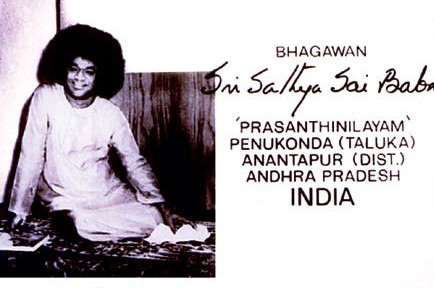
Sri Sathya Sai Baba’s (1926 – 2011) early Western devotees and visitors to the ashram from the 1940s onwards…
From The Hagiographer and the Avatar (2021) by Antonio Rigopoulos
“Foreign interest in the guru of Puttaparthi grew rapidly, especially during the period 1965-1975. Through their testimony and books, a few select Westerners, primarily from the United States, came to be co‑helpers in Biographer N. Kasturi’s endeavor of expanding the guru’s fame, paving the way to the ever‑growing “Western invasion” of Prasanthi Nilayam that would characterize the 1970s and even more so the 1980s. By the end of the 1960s, the first Sathya Sai Baba centres were established outside India, primarily in America but also in Europe and other parts of the world, and the year 1971 saw the publication of the first books about Sathya Sai Baba, written by Arnold Schulman and Howard Murphet. The 1970s witnessed a general growth in the number of foreign devotees and the Americans were no doubt the driving force of the guru’s movement.”
The experiences with Sathya Sai Baba are not always pleasant for the recipient. All genuine gurus do the unexpected, to shock and transform people: Neem Kaloli Baba, Nityananda… Even the ‘gentle’ sage of Arunachala, Ramana Maharshi, set up ashram builder Annamalai Swami to be in conflict with the ashram administrative head and told him not to say that he, Ramana, had told him to go ahead with a building project against the official administration’s plan.
English Officer 1940s (after October 1943) Puttaparthi
English woman 1946
Argentine Adelina del Carril de Güiraldes 10th November 1948, at a devotee’s house in Bangalore
French Sanskrit scholar from Sorbonne, Valestin January 1960 Prasanthi Nilayam
Americans Bob Raymer and Markell (Binky) Brooks 1962
American Nirmalananda 1963 Prasanthi Nilayam
Mrs Ruth Wilson 17th January 1964 Prasanthi Nilayam
American Hilda Charlton July 1964 Prasanthi Nilayam
Swiss school teacher Gabriella Steyer 24th December 1964 Whitefield
Howard and Iris Murphet Indian Spring 1965, at the Madras home of G. Venkateshwara Rao
Dr Hernando de la Cuesta from the United States and Pole Marek Tollik from the University of Paris 9th August 1965 Prasanthi Nilayam
Australian Frank C. Becker 22nd September 1965 Prasanthi Nilayam
Mr Harding from London arrived for a short stay 22nd January 1966 Prasanthi Nilayam
Swiss Bruno Kueazi 5th February 1966 Prasanthi Nilayam
Norwegian Alf Tideman Johanessan March 1966 Bombay
Yogini Indra Devi April 1966 Prasanthi Nilayam
American author Opal Macrae (nee Wheeler) 10th September 1966
Americans Mr and Mrs Margolis 28th October 1966 Prasanthi Nilayam
Canadian Mrs. Jasmin 10th November Prasanthi Nilayam
French Miss Gena Letang 13th November 1966 Prasanthi Nilayam
American Jaclyn Garon 1966 Prasanthi Nilayam
Greek Constantine Letnis 23rd January 1967 Prasanthi Nilayam
Julie Taylor and George Reid 29th January 1967 Prasanthi Nilayam
American yogini Judith Tyberg 1967
American Annalisa Rajagopal (nee Beghe) 1968 Prasanthi Nilayam
American John Hislop January 1968 Prasanthi Nilayam
Australian born American pilot, Charles Penn midnight 9th May 1968 Bombay
Polish Ramana Maharshi devotee Lucia Osborne May 1968 Prasanthi Nilayam
Americans Walter and Elsie Cowan 1968
Americans Mr and Mrs Anderson on Baba’s 43rd birthday celebrations in November 1968 Prasanthi Nilayam
American Richard Bock on Baba’s 43rd birthday celebrations in November 1968 Prasanthi Nilayam
Russian born American Herman 1968 Prasanthi Nilayam
Mrs Elizabeth Palmer 1968, again in 1970 and again in 1972 with her family
American playwright Arnold Schulman Whitefield in 1969 and a second visit in 1970
American Lyn Rubenstein (Leela) 1969
English woman Victoria (Vicki) Mills (Later Ruff and then Cruickshank) from London 1969 Prasanthi Nilayam
Honduran Miss Rosa Celeste Ravaneau 1969 Prasanthi Nilayam
American Diana Riordan (later Baskin) November 1969 at the Women’s College in Anantapur
American Yoga Teacher Bittina Biggart 23rd November 1969 Prasanthi Nilayam
American John Moffitt
American Anne Green (known as Janni, who later changed her name to Om) 1970
American Tal Brooke February 1970 Prasanthi Nilayam
Richard Bock’s fiancé Janet attends Shivaratri celebrations at Prasanthi Nilayam in 1970
John Lennon and Yoko Ono visited the Dharmasektra Ashram in Bombay in May 1970, and again in Prasanthi Nilayam sometime in late 1974
American Michele Malvin (married in 1977 Kaplowitz) arrives for Shivaratri, 1st March 1970 Prasanthi Nilayam
Hans arrived for Shivatratri 1970
Americans VJ Supera (Marsha) and sister India Supera arrived for Shivaratri, 6th March 1970
German Beno Wiesner arrived for Shivaratri 1970 and stayed for 2 years.
American Bruce Bradbury April 1970
American Robert Conger (Hanuman) April 1970 Whitefield
American artist Wendel Field 1970
British Martin Stamp 1970
American Dave Walker 1970 stayed for one year
American Gil 1970
Zolt and Sandy 1970
Peter 1970
Jai Devi 1970
Tony 1970
American Howard Levin 5th June 1970 Whitefield
American Heidi King January 1971 Whitefield
Americans Gale Molloy and her sister Nora Oswald and husband David Oswald September1971 Prasanthi Nilayam
American Marc Schles 1971
Americans Sharon and Gary Purcell April 1971
From Honolulu, American architect Steve W. G. Au and his wife Irene Botelho Au 1971 Whitefield
American Psychologist Phil Gosselin April 1971 Whitefield (Gosselin’s sister and her husband would follow later on, and his best friend arrived in January 1972)
Richard Alpert (Ram Dass) 1971 Whitefield
American music group Lightstorm (Johnima and Kalassu Wintergate, Silver and Sui-San) 1971 Whitefield
Americans Cathy and Richard Bayer at a private residence in Madras, Christmas 1971
American Andrea Schles 1972 for 4 months, 1973 second trip
American Psychiatrist Samuel Sandweiss at a devotees apartment on the outskirts of Bombay in May 1972. His Wife Sharon and four daughters would follow in the later years
American Michael Hollander August 1972 Prasanthi Nilayam
Venezuelan Arlette Meyer 1972
Mexicans Dr Luis Muniz and his wife Gail 1972
American Lila Youngs 1972 Prasanthi Nilayam
Scot Bill Aitken at his partner’s (The Maharani Prithwi Bir Kaur of Jind – The Phulkian Dynasty) Delhi house in 1972
American Peter Mt. Shasta Indian Fall 1972 Prasanthi Nilayam
Americans Sidney and Phyllis Krystal January 1973 Whitefield
American Swami Kriyananda January 1973 Whitefield
American Leslie Bouche 1973
American businessman Isaac Tigrett 1973 Whitefield
German Jew Al Drucker 1973 Prasanthi Nilayam
American Don Heath 1973
Icelandic academic, psychologist and psi researcher Haraldsson and Latvian born Dr Karlis Osis 1973 Prasanthi Nilayam
Americans Franklin Albert Jones (Adi Da) and Gerald Sheinfeld 1973
Australian surfer Peter Rae Whitefield 1973
American Larry Smith 1974?
Bolivian Romero Sotello Murillo 1974
Author Paul William Roberts September1974 Prasanthi Nilayam
American brothers Michael and Brian Steely arrive for Dasara 1974 Prasanthi Nilayam
Muriel J. Engle of Santa Barbara was among the first Westerners to travel to India to meet Sathya Sai Baba 1970s
Raja Yoga teacher Helene Vreeland was among the first Westerners to travel to India to meet Sathya Sai Baba 1970s
American John Moore January 1975
German Adi von Harder 6th November 1975 Prasanthi Nilayam
American Leni Matlin January 1976 Whitefield
American Jack Lenchiner April 1976 Whitefield
American Gary Yoder May 1976 Dharmakshetra for a week and the on to Ootacamund
Italians Antonio and Sylvie Craxi 1976 Whitefield
American Patricia Kelly 1976
Ravi Shankar and George Harrison December 1976 at the Dharmakshetra Ashram in Bombay
Ida Marion St. John from California and Gita Orescan from Germany
American Patricia Wing 1978
American attorney Robert Baskin mid February 1978 and stayed until the end of 1979
Canadian musician Walter Maynard Ferguson and his American wife Floralu “Flo“ Ferguson (Farmer) April/May 1978 Whitefield
American Professor Frank Baranowski July 1978 Whitefield
American Jack Hawley 1978 Whitefield and stayed for a month
British Peggy Mason and Ron Laing 1978
American Susan Salguero 1978
American Homer Youngs 1978
Danes Hagen and Tata Hasselbalch, Preben Plum December 1978 Prasanthi Nilayam
Americans Johnathan and Rose Roof January 1979
Americans Robert and Rita Bruce Easter 1979 Prasanthi Nilayam
American Dixie Cooper August 1979 Whitefield
American Bruce Bouche 1979 Prasanthi Nilayam and stayed for 6 months on this first trip
Argentines Ananda Giri, Monica Zocolosky, Marta Basan, and group 1979 Prasanthi Nilayam
American yoga teacher Larry Payne 1979
American Richard A. Nelson 1979
Dane Dr Thorbjørn Meyer February 1981 Prasanthi Nilayam and then with wife Marianne Meyer and 14 other Danes in December 1981
Argentinian Leonardo Gutter 1981 in the Madras ashram, Sundaram
Italian Catholic Priest Don Mario Mazzoleni August 1981 Prasanthi Nilayam
Dane Birgitte Rodriguez 1981 Prasanthi Nilayam. She lived on the Sri Aurobindo Ashram for ten years before meeting Baba.
Americans Raye and Joy Thomas December 1981 Prasanthi Nilayam
Argentine Mr. Hugo Baldi and family 1981
Americans Connie Shaw and fiancé Jim Wright 18th March 1982 Prasanthi Nilayam
American Judy Warner January 1985 Prasanthi Nilayam
Italian author Antonio Rigopoulos November 1985
Swiss Victor Tognola 1987
German author Jack Shemesh December 1987
Americans Charlene Leslie-Chaden and Syd Chaden December 1987
Italian Silvia Spinozzi January 1989
American John Prendergast
English Officer 1940s (after October 1943) Puttaparthi
During the 1940s, one day after Baba had returned to Puttaparthi from Uravakonda (Baba went to Uravakonda High School in early 1943, and left in October 1943), an English officer who was a big game-hunter had gone hunting in the forest on the other side of the Chitravathi River. He had shot a tiger and was driving back to Anantapur. Suddenly for no apparent reason, the jeep stopped right outside the village of Puttaparthi. Despite their best efforts neither the driver nor the officer could get the jeep started.
R. Balapattabi recalls in his book Nectarine Leelas – One day about ten of us were listening to Bhagawan’s exposition of philosophical scriptures, like the Upanishads, when suddenly He left us and went to His room. It was 9 am. Soon, an Englishman entered the Mandir followed by an Indian. The Englishman sat down on Baba’s chair. The Indian explained, “He is the Collector of Anantapur. We went for hunting last night in the forest, and while returning, our jeep was stuck up in the Chitravathi River. Right from 7 am we have been trying to pull it up – but even with four pairs of bullocks, it does not budge. The villagers told us that Baba could help us and we have come here.” Baba came out after half an hour. He said in Telugu, “Alas! You have killed a tigress whose two cubs are not even a month old! First you must arrange to keep the cubs in the zoo and save them.” This was translated into English. The Collector was astounded. He stood up and saluted Bhagawan. Baba materialised vibhuti and gave it to the Collector saying, “Throw it on the jeep; it will move.” That was done. The jeep sprang out of the riverbed. The Collector had the cubs sent to the zoo. He also presented the skin of the tigress he had shot to Baba. The tiger-skin is now spread under Baba’s chair in the Prasanthi Mandir.
Another slightly different version of events is that the driver had heard the stories about the young Sai Baba from the village, so he told the Englishman that there was a boy nearby who could create holy ash by a circular movement of his palm; the ash could cure everything and would probably even cure the jeep. Since he was stranded half-way and at a loss to know what was wrong with the engine, the officer agreed to wait in the jeep, while the driver went into the village to find Baba. The driver wandered through the streets of Puttaparthi for awhile and finally saw the boy and before he could say a word, Baba said, “I am coming to the jeep myself.” Baba walked across the sandy river bed to the place where the jeep had stalled. He looked inside the jeep and saw the beautiful tiger, which the officer had shot a couple of hours before. Baba explained to the men that it was he who made the jeep stop outside Puttaparthi, because the tiger that was now dead, and had been the mother of three two-week old cubs. The cubs were crying, hungry and lost without their mother. “Go Back,” Baba instructed sternly “Get those cubs and give them to a zoo where they will be well looked after. And do not shoot wild animals, for they have done you no harm. Why do you go in search of them surrounding them and laying traps to catch them?” Baba suggested that instead, the officer should shoot animals only with his camera; it was a superior weapon that would not maim or kill animals. The Englishman did just what Baba had said. He took the cubs to a zoo and from then onwards used only his camera for hunting. He discovered that hunting with a camera was even more challenging than with a gun and it was also a more peaceful, nonviolent and virtuous way to live.
The officer was so touched by Baba’s wisdom that he could not bear to look at the tiger skin when it came back from the taxidermist. So he took the skin to Puttaparthi where he met Baba again, and placed it at his Feet. The tiger-skin is now spread under Baba’s chair in the Prasanthi Mandir. The Tiger skin – the tiger is the vehicle of Shakti, the goddess of power and force. Shiva is beyond and above any kind of force. He is the master of Shakti. The tiger skin that he wears symbolises victory over every force.
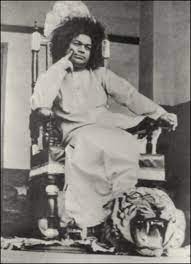
English woman 1946
There are of those of Western origin who had visited or had met Sathya Sai Baba very early on in the 1940s. The author recalls that one evening in late 1991, while dinning out at Koshy’s in Bangalore with a friend, who recognised one of the patrons, and elderly English woman, that night as one who had met Baba in 1946. Being brought up in India, she had remained in the country after partition in 1947.
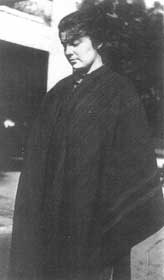
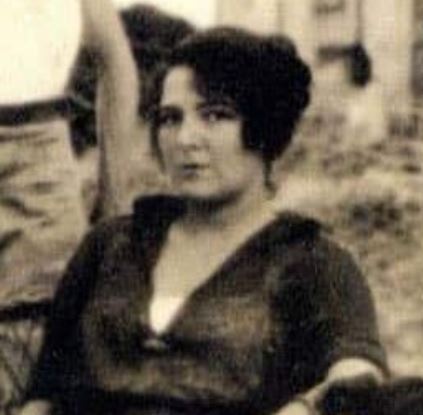
Argentine Adelina del Carril de Güiraldes 10th November 1948, at a devotee’s house in Bangalore
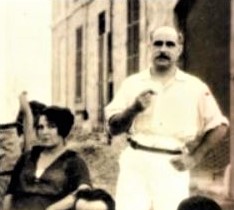
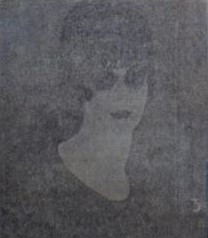
Adelina del Carril de Güiraldes (1889 – 1967), widow of renowned Argentine novelist Ricardo Güiraldes, was invited by a Maharani, a Sathya Sai Baba devotee, to meet the twenty-two-year-old Swami. Adelina, wife of Ricardo Güiraldes, famous Argentine novelist and poet, had been living in India for sometime and was dedicated to the spiritual path and to translating Indian scriptures into Spanish. The first meeting between Sai Baba and Adelina occurred on the 10th of November 1948, in a luxurious house in Bangalore.
In 1927, Adelina and her husband travel to India, to the Belur Math in Calcutta. Adelina was a disciple of Swami Viyoiananda, who founded the Ramakrishna Ashram in Bella Vista, Buenos Aires. She also dedicated her life to complete and disseminate the literary work of her husband. In 1938, she began her second trip to India, where she resumed her relationship with the Ramakrishna Order, this time settling in Bangalore.
When she encountered Baba for the first time, she realised, “Here was the One of whom the epic scriptures have been written.” Her heart filled with divine experiences, she returned to Argentina in 1951, taking with her Sai Baba’s materialisations and many thrilling stories.
In those days, Sai Baba would keep in contact with certain devotees by post. So it was with Adelina, whom he affectionately called “Mamina” or “Mamitha.” On one envelope, he wrote in his own hand, “Mamitha” – Pasupathi Kultiram, Sri Sathya Sai Baba High School Committee, Bukkapatnam.” This was a printed invitation, headed by a small photo of him, inviting her to the inauguration of that school.
Baba added, “Sri Sathya Sai Baba’s Blessings to Mamita and Ramu from Sathya Sai Baba of Puttaparthi. How is your health, Mamita?” The date is 8 August 1950. There are a number of letters, all handwritten and addressed to Mamina, dated 22nd January 1949, 11th September 1949, 30th March 1951, 9th June 1951, and 16th December 1951.
Adelina tells her first meeting with Sai Baba in her personal diary in this way:
«…. In the background there was a set of armchairs…”
… “ Next to my side stood a skinny young man with a baby face dressed in a long tunic with neck-length hair, extremely curly, that haloed his head”…
“…The Maharani places the tray of flowers and fruit at her feet; he bends down and touches them with the tips of her fingers in acceptance. Then they introduce me. The Swami indicates my seat next to him on the big sofa. I am full of amazement; I thought I met a venerable old Swami and it is almost a child that I have before my eyes. (…). They speak in “Kannada”, which I don’t understand, but I realize they speak about me: “South America, Ramakrishna Mission” and my name. I notice that the Swami looks at me askance. Then he starts addressing me in “Kannada,” which the owner of the house translates for me and when I answer they translate for the Swami. My concepts seem to please him. (…) Why doesn’t he show his powers to my friend? A slight frown on Sai Baba’s brow shows his disgust, but at once he smiles with his natural affability. I notice that he continually watches me and picks up my reactions to what he says and does.
Suddenly he says to me “Madam, do you want some vibhuti?” “Yes, Swami, with pleasure.” He raised his hand, did his usual turning gesture, and his little hand was full of vibhuti. He took a pinch and put it between my eyebrows and gave me the rest telling me to keep it. We continued talking and he told me “You are full of bliss and your heart is full of God.” He raised his hand again, made his gesture of rotation in the air and there was a small silver image of Krishna as a child.. “That is why I give you this image.” “Thank you very much… but tell me Swami, you are so young man, did you have to do much penance and austerities to have these powers?” “Oh, no, ma’am!” “What is your name?” “Sathya Sai Baba. Since I was born I have known who he was and the powers he possessed but I have not shown it until I was 16 years old. This time I have come into the world to heal the sick and bring the wicked to the path of God. My wonder knows no bounds.”
A short time later Adelina is invited again. She tells it like this “Come on, lady, the bhajans are very nice and they are waiting for you.” Suddenly it occurs to me to ask “Tell me, is there a young Swami there?” “It is he who asks for you, ma’am.” I immediately get ready and go with my boy (Ramachandra Gowda). All eyes were focused on the Swami. Suddenly I see his forehead covered in vibhuti with a thick strip of red kum kum, without him having brought his hands to his forehead. His lips move as if mumbling a prayer and his right hand makes a slight push-up gesture.
(…) After a while, they come to call me on their behalf. “I am very happy that you came, Mamita! Is this your child?” (referring to Ramu). “Yes, Swami.” He blesses him by telling me “Don’t fear anything for him, he has a good future.” (Mamita or Mataji in Sanskrit, is a reference to his status as adopter of the Indian boy, Ramachandra Gowda)
Since then I have seen him often. One day he has come to my house. “OH! what peace and bliss there is in every corner of his house” he tells me. He is pleased, there is no doubt. (…) .A few days later the Swami returns to Hyderabad. “Mamita, for Shivaratri in February you have to come at all costs. It is in Puttaparthi that I am in possession of all my power and I want to give you much needed health, strength and courage.”
In 1951, she returns to Argentina bringing with letters from Sai Baba which have become true relics for the Sathya Sai Baba organisation in Buenos Aires.
In 1952 she entered the ashram of the Ramakrishna Order in Bella Vista, Buenos Aires and stays until 1963.
The link below is a copy of the letter written Adelina where she recalls a meeting with Gabriela Mistral in Buenos Aires, 25 years ago, and points out that Juan Marín visited her. She comments on her personal matters, about her stay in India.
http://www.bibliotecanacionaldigital.gob.cl/visor/BND:135680
In 1913, Güiraldes married Adelina del Carril and both his life and his career as a writer were going to take a 180 degree turn. Knowing of his great passion for the gauchos and his great pen, it was Adelina who encouraged him so that, two years later, his first two books were published.
Grace Gomez Henriquez writes that Ricardo Güiraldes considered his wife, Adelina, his best manager. A Jealous guardian of her husband’s work and public image, Adelina supported him in all his literary and publicity undertakings, both by transcribing manuscripts and helping to preserve and disseminate his works.
Although a sculptor by profession, Adelina had a more outstanding literary life, especially in the 1920s.
Sadly, Güiraldes passed away in 1927, while in Paris, as a result of terminal lymph node cancer. His body was repatriated to Buenos Aires and is buried in the San Antonio de Areco cemetery.
Adelina decided to go to India after the writer’s death. It was a way of understanding the writer’s concern for ethics and metaphysics, in addition to his strong interest in Hinduism. Adelina found answers by continuing the path that her husband had started, on that path, she found the person she prosecuted, who gave direction to the unknown work of Güiraldes, writings, which from a subversive and libertarian place raised ideas and words of great depth, thoughts of a present full of future.
She meets in Bangalore, Ramachandra Gowda, an Indian, who from the age of three enters her life, she considered him an adoptive son, deposited in him, the work of Ricardo Güiraldes; that of projects, essays, reflections and notes; that of poems and stories with an existentialist content. The mysteries of life allowed a small part of India to reach the far south, to the land of gauchos, to bear witness to what a tireless thinker could not spread before his death. Ramachandra, arrived in Argentina, at the age of 14, from that moment, and together with Adelina del Carril, began a journey through the unpublished writings of the Argentine poet.
Rama Gowda lived until his death in Argentina, continuing the legacy that Adelina del Carril gave him as a child, to perpetuate the light of a brilliant mind.
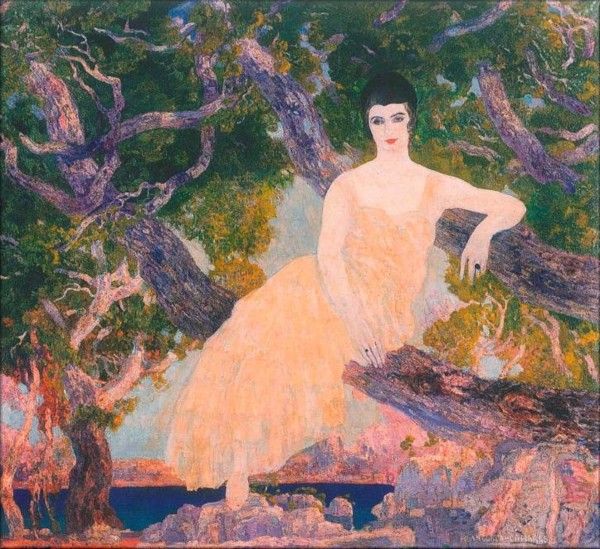
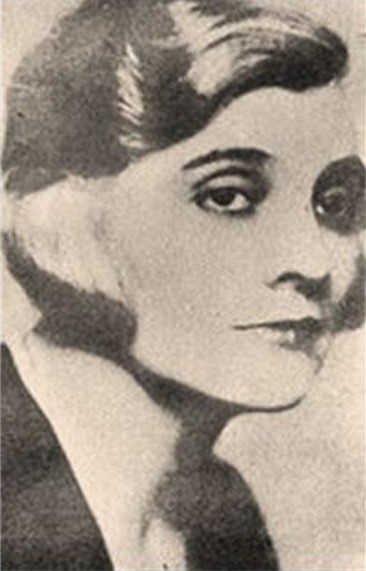
Adelina del Carril de Güiraldes. Photograph taken from Capitulo – la historia de la literatura argentina Issue 42.

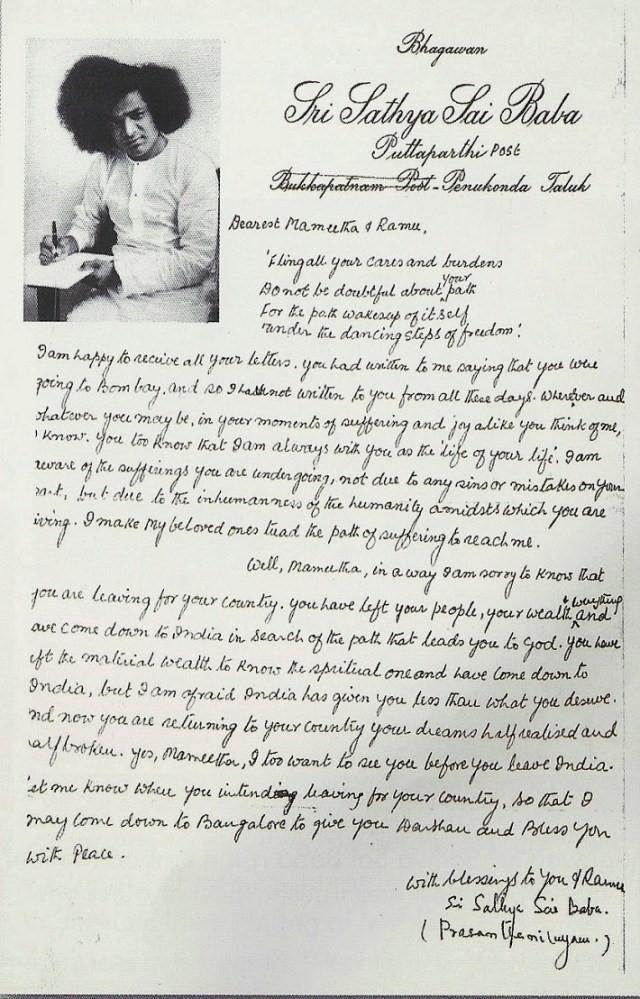
Dearest Mameetha and Ramu,
“Throw away all your cares and burdens
Have no doubts about your path
For the path awakens of itself
Under the dancing feet of freedom.”
I am happy to receive all your letters. You had written to me that you were going to Bombay, that’s why I didn’t write to you all these days. Wherever you are, and whatever you are, in your moments of suffering and joy alike, you think of me, I know. You also know that I am always with you as the life of your lives. I know the sufferings they endure, not because of any sin or error on their part, but because of the inhumanity of humanity among whom they live. To those I love I make them travel, to reach me, the path of suffering.
Well, Mameetha, I am somewhat sorry to hear that you are leaving for your country. You have left your people, your wealth, everything, and you have come to India in search of the path that will lead you to God. You have given up material wealth for spiritual wealth, and you have come to India, but I am afraid that India has given you less than you deserve. And now you are returning to your country with your dreams half realized and half destroyed. Yes, Mameetha, I too wish to see you before you leave India. Let me know when you plan to leave for your country so I can come down to Bangalore to give you Dharshan and bless you with Peace.
With blessings to you and Ramu
Sri Sathya Sai Baba
(Prasanthinlayam)
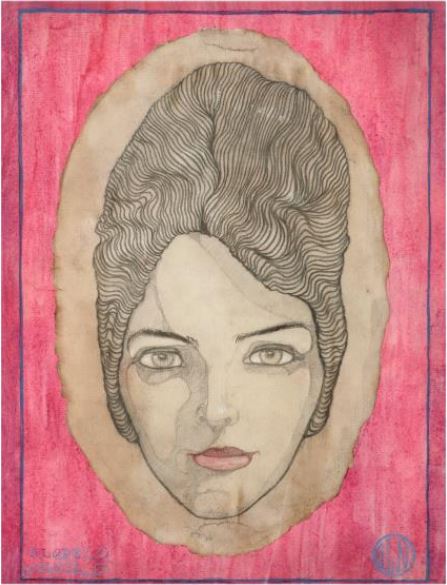
From 1925 is the portrait he does again of Adelina del Carril de Güiraldes in a new demonstration of his skill in handling the line. With an extreme synthesis the artist defines the captivating look of the model and reiterates the lush hair as an excuse purely ornamental debtor, formally, of those early portraits. Those portraits from 1915 and 1919 now reappear in an image that pushes his interest in the female prototype of the belle époque
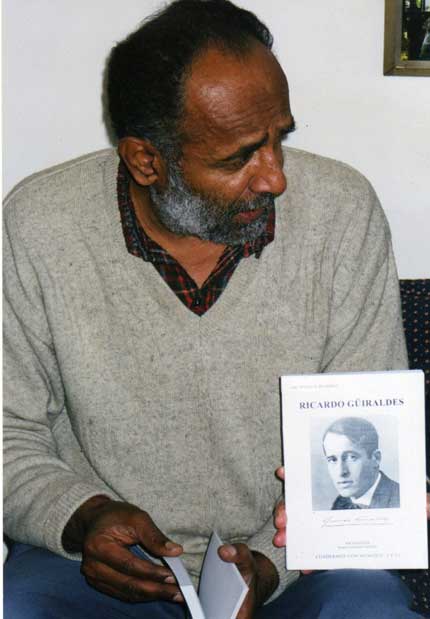
Patricia Di Rado coneys the story about her meeting with Ramachandra Gowda, the child adopted by Adelina del Carril de Güiraldes, in Puttaparthi while visiting Prasanthi Nilayam with a group of Argentinians in 2000.
One evening they decided to have dinner at a Italian restaurant in Puttaparthi. During dinner their guide, Hugo, introduced an Indian man who told them of the story, in English and translated by Hugo, of Madam Adelina and her adopted child, Ramachandra Gowda, who she educated and raised as her own son.
Upon completion of the story, he said in perfect Spanish “that boy was me, grown up in your country, Argentina. I am visiting India.”
His daughter, Maria Kausalya Gowda, writes in 2019 – “Dad was never legally adopted by Adelina del Carril. The document that was signed at the Argentine consulate in India was Adelina’s commitment to return him to her parents within a year. A commitment that her breast cancer and her destiny did not allow her to fulfill… A long story that José Rivarola narrates in his novel Madame Mamita (still unpublished).
Adelina wanted to legally adopt him in Argentina but my father refused to be adopted, because he had his parents still alive in Bangalore.
He was never a deputy or held any political office in any country! Gowda is a common surname in India and in fact some Gowda were even Prime Minister. But he wasn’t related to us…
Dad first returned to India in 1984 to attend his mother’s funeral (his father Channe was still alive).
He remained in India for a year and shortly after his return to Argentina, he settled in Epuyén. He then returned to India and lived there between 1995 and 2000, the year in which he returned to Epuyén where he remained until a few months before his death, which occurred in Buenos Aires on August 29, 2005.
It is worth clarifying that Ricardo Güiraldes passed away almost a decade before my father was born. However, dad fell in love with the thoughts and poetry of that being whom Adelina constantly kept alive in her anecdotes and in her ‘little pieces of paper’ about her. She declared my father the executors of Ricardo’s work and my father dedicated most of his life to rescuing that thought and the unpublished work of the Argentine writer.
Ramachandra returned to India upon the death of his father Channe Gowda, then settled in Epuyen where his chalet burned down and 8 trunks of unpublished manuscripts by Guiraldes went up in smoke (with the exception of what was in the bank vault in the name of Shatindra Mohan Khana, his friend). After the fire, Ramachandra returned to India for good and was soon appointed as a Federal Deputy. His lifelong companions were his wife and mother of his five children, then Nuggy Saubidet with whom he lived for more than 10 years and finally Ingebor Ringer.
Ernest-E Lopez-Sanson wites in 2009 – “I was from the time I met Ramachandra around 1970 until he died, his lawyer and representative. Ramachandra returned to India upon the death of his father Channe Gowda, then settled in Epuyen where his chalet burned down and 8 trunks of unpublished manuscripts by Guiraldes went up in smoke (with the exception of what was in the bank vault in the name of Shatindra Mohan Khana, his friend). After the fire, Ramachandra returned to India for good and was soon appointed as a Federal Deputy. His lifelong companions were his wife and mother of his five children, then Nuggy Saubidet with whom he lived for more than 10 years and finally Ingebor Ringer. The passage through San Telmo was so transitory…. Rama lived first in Mar del Plata, then in Azcuenaga street to finally moved to San Martin street.
French Sanskrit scholar from Sorbonne, Valestin January 1960 Prasanthi Nilayam
From Sathyam Sivam Sundaram – Part II by N. Kasturi
In January, 1960, a great Sanskrit scholar from Sorbonne, France, Valestin by name, who was in India to translate the commentaries on the Vedas into French, arrived at Prasanthi Nilayam. One evening, during an interview with Baba, he suddenly caught Baba’s hands and pleaded “Baba! Vedic scholarship is fast declining in this Holy Land. You must revive it, you must foster it.” I was there, nearby. I felt that East and West were also there, awaiting with palpitating heart, the reply that Baba will vouchsafe. For the Vedas are for both East and West, for all mankind. And Baba did not disappoint mankind. He said, “I have come for that very purpose, for Vedic revival. It shall be done. I will do it. Wherever you are, you will know of it. The world will share that joy, that light.”
Americans Bob Raymer and Markell (Binky) Brooks 1962
Joseph Robert “Bob” Raymer Jr. (1921 – 2008) of Los Angeles heard from his friend Markell (Binky) Brooks about Sathya Sai Baba. She and Bob would later marry.
Markell Brooks:
Markell had a long association with Anandamayi Ma, from The Holy Chronicle 1958 – 1964 Glimpses of the Lila of Shree Shree Anandamayee Ma there is an entry for the 13th of January, 1961, Varanasi;
Anandamayee Ma came and sat on the veranda of the Annapurna Mandir at 1:30 p.m. An American lady, Mrs. Markell Brooks, and a French lady, Madame Jean Trocume, had also arrived to spend a few days with MA including travelling with HER. Sri Upen Dutta and others were also present.
From Death Must Die: A Western Woman’s Life-Long Spiritual Quest in India with Shree Anandamayee Ma: the diaries of Atmananda
An American woman, Markell Brooks had been only for twelve days in India when she asked Anandamayi Ma:
Question: Since the will of the individual is illusory and one does not know God’s will, how can one lead a purposeful life in this world.
Ma: By contemplating the Self, one will find out. It is man’s principal duty to aspire to Self-realization.
Question: What about self-expression in art?
Ma: This also belongs to that which is fleeting. You paint a picture, but it can’t last. The most beautiful song fades away in a moment.
Question: Presuming that the striving goes on no matter what, how can one know how to live – in relation both to human beings and one’s own creative energies?
Ma: A man who is after worldly things and is occupied with the business of this world gets satisfaction out of what he does, for otherwise why should he do it? He feels he is doing well, he gets praise and fame, money and position and his mind is always occupied with his affairs. If someone is opposed to him and puts obstacles in his way, he gets angry and hostile.
A person who strives after Self-realization will turn to Mahatmas (great souls) for advice, guidance, and company. He will start reading books written by such men. He will admire them and wish to become like them and so, since he is searching for Truth, he will come to be truthful in behavior and speech. The Self is one, so remember the Oneness of all.
Although a dog may bite you, you will not bite back. The man who strives after worldly goods and satisfaction is working for death because everything in the world is constantly dying and something else is born. The child dies to the young girl and the girl to the woman etc. But the man who is after Self-realization is working for immortality. When living and working in the world one’s creative power is exhausted in the pursuit of sense objects so one may come to feel weak, tired or ill.
But by striving after Self-realization one’s creative power is preserved and strengthened.
While the person who lives in the world takes pleasure in parties, meeting people etc, the one who is out for Self-realization will take pleasure in meditation, singing the praises of God, reading books of wisdom, listening to discourses by great souls and mixing with those who are pilgrims on the path.
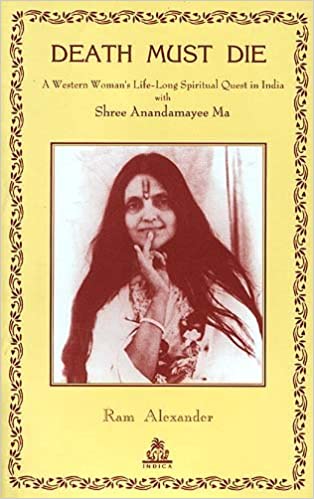
An intimate first-hand account of a courageous woman’s spiritual quest in close association with several of India’s greatest modern saints. Unfolding against the back-drop of Banaras in the 1940s, where she lived as a teacher and musician, we are given an in-depth picture of her intense relationship with the extraordinary woman who becomes her guru – Sri Anandamayee Ma. Ram Alexander, who was a close friend of Atmananda’s and a fellow disciple of Anandamayee Ma, writes with insight into the guru-disciple relationship and the particular problems that arise when a Westerner enters into this within a traditional Indian context.
*The Harvard University’s Andover-Harvard Theological Library, Cambridge, Massachusetts, received a unique archive of tapes, slides, and periodicals relating to Anandamayi Ma (1896-1982). The archives were compiled by Gary Empie, a young American who lived in one of Sri Ma’s ashrams for eight years, until his death in 1981. Anandamayi Ma taught by answering questions put to her, and Empie gathered 139 cassette tapes of these questions and answers, as well as films, slides, and photographs of Ma, and magazines and books relating to her life and work. The archives were presented to Harvard by Mr. and Mrs. Robert Empie and Markell Brooks.
Markell and Bob travel to East Africa with Sathya Sai Baba in 1968.
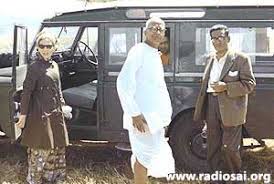
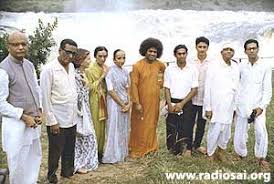
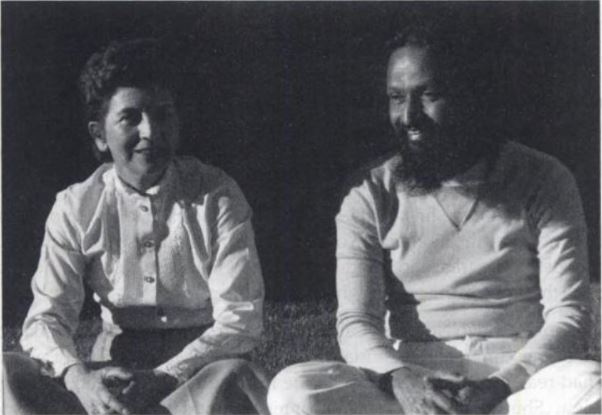
Dada Gavand writes – The idea of a book Beyond The Mind (1977) slowly took shape. Soon we had many transcripts of talks and personal interviews covering various aspects of life and the challenge of going beyond the mind. It was all important information, but how to make use of it in a meaningful format became the question before me. This being my first book, it proved difficult to visualize its structure and design. I had no one to consult about how to do this, and I pondered over a basic plan to put the material together. Publishing a book would not be an easy or quick job if we wanted to do it well.
Meanwhile, I went back to Los Angeles to stay with a new friend, Markell Brooks, who lived in Pacific Palisades. She had heard me speak a few times in the Los Angeles area at the home of Mr. Chakrapani Ullal, a famous astrologer, where many well-known people gathered to hear me. Markell then invited me to her beautiful and spacious home. She was a potter and pianist, a creative and talented person, with obvious interest in spiritual understanding. She organized several more of my talks at her home.
Markell liked the idea of making a book and welcomed the project. She found people to transcribe more talks and even advertised for college students to come and help us with the work. But the students mostly did not comprehend the subject matter and language of my talks. So that idea of getting help from students did not work. Markell continued to be enthusiastic and was not discouraged by setbacks or lack of help.
One day, I found Markell herself sitting in the kitchen transcribing my tapes by hand. I said that she did not have to do this, but she insisted that she loved the job. She felt she learned much more about what I was saying by transcribing it herself. Soon we found other people, including Sandra Bennett, Ira Flushman and Judith Scott, who were very enthusiastic and capable. They came regularly to do the work and also had discussions with me.
Now many more friends began helping, coming over regularly to plan, edit and work out all the details. One of the main obstacles was how to fund the publication if we decided to self-publish. Amazingly, many supporters emerged to solve this problem as well. Markell Brooks, Bob Hutchins, Helen and Carroll Wright – these and many other friends happily donated toward the publication costs. Some others suggested that we hold seminars specifically to raise money, but I would not do this. I had never charged fees for any talks or seminars, feeling I had no right to put a price tag on my talks and interviews. This understanding which I was talking about was for me to share, not to sell.
It has always been a pleasure to stay with Markell Brooks near Los Angeles. Her friendship, deepening understanding and enthusiastic efforts to organise talks have always made it important for me to go to her home in Pacific Palisades. Many people in that area have heard me speak, come for personal interviews, and then the word has spread.
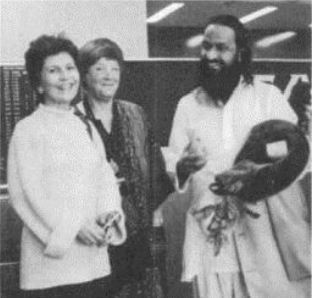
*William L. Hamilton, author of Saints and Psychopaths (1995) acknowledges Markell for providing him with food and shelter while he was writing this book and also participating with the proofreading. Dedicated to Binky who’s support in many ways has made my work possible.
Saints & Psychopaths by William L. Hamilton https://eudoxos.github.io/saints/html/index.html
*In World Wheel, One Woman’s Quest for Peace Vijali Hamilton writes that one evening we went to a meditation at the home of two friends, and as I walked down their hallway, I found on the wall a photo of the woman of my dreams. I immediately asked our hostess, Markell Brooks, about the woman in the photograph. “That is Anandamayi Ma, who lives in India,” Markell said. “She is one of the greatest saints of the twentieth century.” I left the house with a handful of books about her. I gazed at Ma’s beauty in photographs I placed by our bed. I went to sleep and woke up with the image of her face before me. I had the feeling that if I went to India, I would not tear myself away from her.
Benares, India. Later in 1972, Markell Brooks, from whom I had first learned about Anandamayi Ma, had arrived in Benares a few days before Dale and me, and she had arranged for us to have a private meeting with Anandamayi Ma. We entered her small room. A white sheet covered her narrow bed and she sat cross-legged upon it as if she expected us. Although Anandamayi Ma was in her seventies, her hair flowed long and dark over a white sari, a radiant smile was on her lips still full and youthful, and her large almond eyes glowed. She seemed to me the essence of beauty and grace. The hair on my arms stood on end. Here was the face of my dreams, in flesh and blood!
*Vedanta Study Circle Zurich. The German-speaking part of Switzerland did not have easy access to a Ramakrishna-Vedanta Centre. Swami Ranganathananda requested one of the long-time devotees, Gabriella Steyer, to start a Study Group in the German-speaking part of Switzerland. However, it was only in 2013 during the 150th Birth Anniversary of Swami Vivekananda, where many devotees from different parts of Switzerland gathered for the celebrations in Saas Fee, that this idea could come to fruition.
Bob Raymer:
From Sathyam Sivam Sundaram – Part II by N. Kasturi
“I had read of the great miracle-workers and teachers of India’s past; I hoped that some might still exist today; Yet, hardly dared to hope, that I might even meet one. For, underneath, like all men, I longed for the ‘many- splendoured thing’ that Francis Thompson says; the “estranged faces miss”, says Murphet”. Among the many who came to India from foreign lands on this search were the Raymers, husband and wife, who heard of Baba and came to the Nilayam and stayed there continuously for over six months engaged in Sadhana. When they went back, persons who had already come under the influence of Indian yoga and thought, through the teachings and inspiration of Maharshi Ramana, Aurobindo, Yoganandaji, and Ramakrishna-Vivekananda gathered at their place or drew inspiration from their example, to study Baba’s work and do Sadhana according to His directions. A large number of people have come into his Sathya Sai Sathsangh; a few have come over to India to have Baba’s Darsan and Blessings. Charles Penn is singularly fortunate, because though he has not yet come, he is able to feel the constant Presence of Baba, whether up in the sky searching for fallen aircraft or down on the sea shore collecting shells, or in his prayer room picturing His Form in his heart! Baba sits before him, converses with him, teaches him, answers his questions, as clearly as if He is concretely present, across the seven seas! The lessons are so characteristic of Baba that their authenticity is clear to all who know how Baba elucidates. Moreover, when Penn sends the typescripts to me for perusal or publication, I have often asked Baba for further clarification and never once has He disavowed His authorship; in fact, He has justified certain new examples and parables that He has told Penn at Los Angeles, on the score that He had to explain things that way, since the background of Penn differs from that of His Indian listeners. “I give him the example of daffodils, because there is a bed of daffodils outside the shrine there,” He said once. “I tell him about strong breezes and sails and ships because he knows about them, not you,” He said to me.
In June 1968, Baba commenced His first and only international tour to East Africa. Bob Raymer was part of the entourage along with a few devotees from India, and managed to take the two photos below.
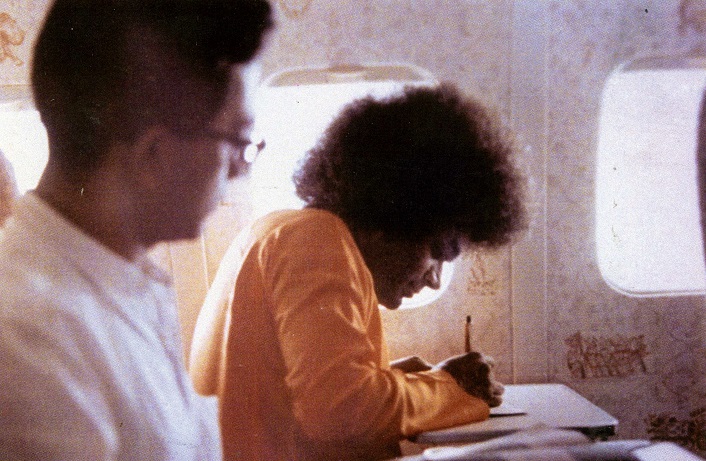
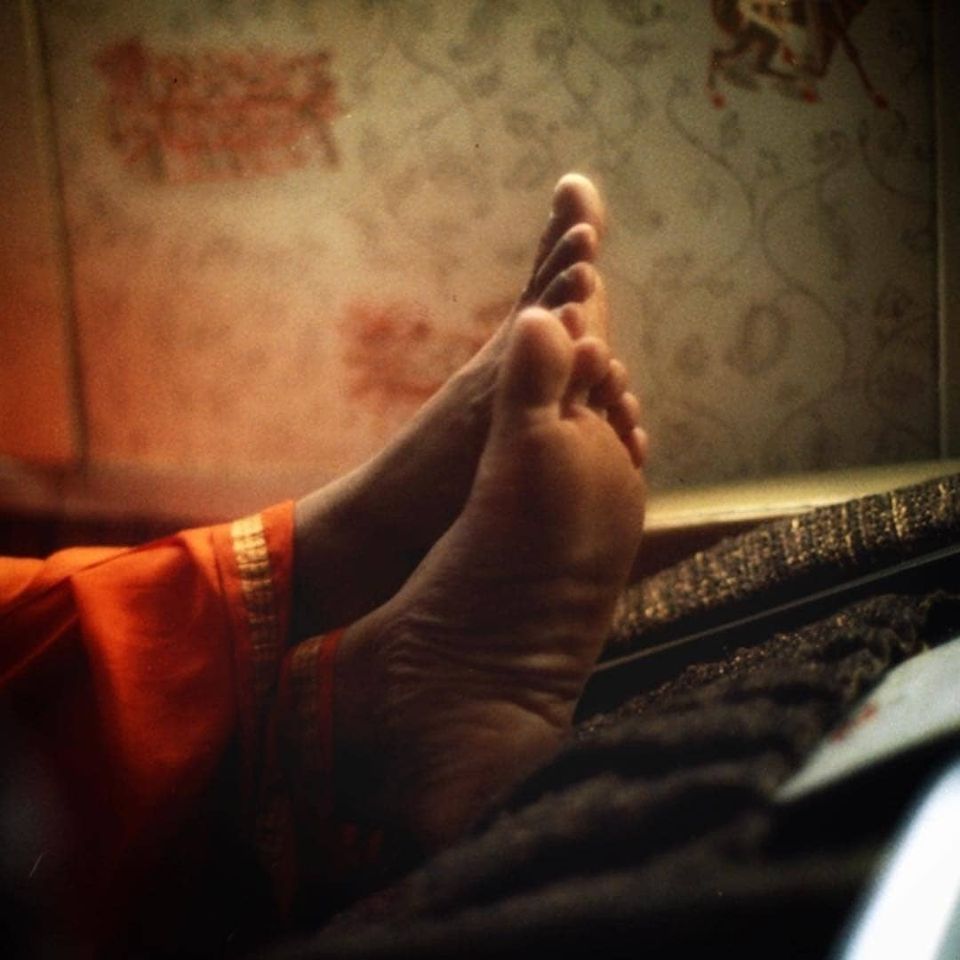
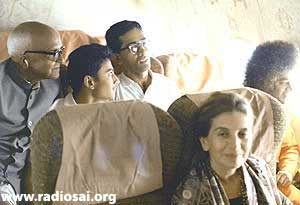
On 30th Jun 1968, Sathya Sai Baba took his only flight overseas to East Africa, onboard an Air India Boeing 707 to Embakasi, Nairobi. Flying at 590 miles per hour at altitudes of over 35,000 feet, Baba was granting the passengers, (many of whom had boarded the flight on purpose) signs of his grace, such as autographing a book or a photograph, materialising vibhuti, or furnishing illuminating answers to solve personal problems of every kind.
Bob Raymer saw Baba keep both his feet pressed on the slanting back of the empty seat just ahead of him, he did not miss the chance, he clicked twice and managed to get two good photos above.
A former commercial airline pilot, Raymer met Yogananda in the latter years of Yogananda’s life. Yogananda initiated Raymer into Kriya Yoga and made him a minister of SRF. Raymer conducted services in Minneapolis for many years, telephoning Yogananda before each to receive his blessing. Raymer later moved to Hawaii, where he conducted his Clear Light retreats, and then to Song of the Morning retreat centre in Michigan, where he was the spiritual director from 1991 to 2004.
Howard Murphet writes in his 1971 book Sai Baba – Man of Miracles
Two others we met in our early Sai days who have since become our close friends are Bob and Markell Raymer of Pacific Palisades, California. Bob, an aircraft pilot, was the red-haired American who kindly went in search of Baba for me on my first visit.
Before coming to rest at Prasanthi Nilayam this couple had, like us, conducted their own “search in secret India,” visiting many ashrams and meeting some great yogis. They had gained some spiritual nourishment here and there, but it seems that they have now found their Sadguru and the true glory. Of their inner experiences I cannot speak here, though in confidence I have been told of some. Their outer experiences include a good range of phenomena of the type described in these pages. They have often watched the magic hand stir the air or dig into the sand to produce some charming personal gift, or some confection for the enjoyment of all in the magic circle. And they have seen the same hand transmute one substance to another. Once Baba idly rolled in his fingers a scrap of paper while Bob sat near him as one of a group. Unexpectedly he told Bob to open his mouth, and popped the roll of paper into it. But there was no taste of paper; the roll had changed to a delicious piece of candy.
Like many Westerners, the Raymers have learned that Baba’s miracles are genuine, varied, of daily occurrence, and yet always unexpected. They have come to accept them as part of his divine nature.
Soon after our initial meeting the Raymers returned to America, but since then they have flown back on a number of visits to Baba, and they went with him from India on a tour in East Africa in 1968. Just before that I saw them at the Satya Sai World Conference in Bombay, following which they, with my wife and myself, travelled for a while with Swami. It was during this pleasant period that I had the opportunity of learning what sincere Sai devotees, and serious sadhaks (searchers on the spiritual path) they really are.
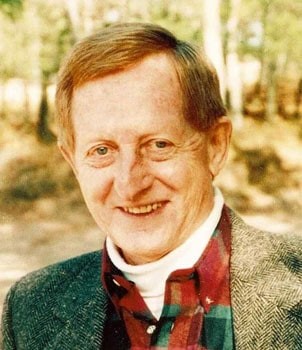
Bob Raymer, direct disciple of Paramahansa Yogananda (1893 – 1952) and Spiritual Director of Song of the Morning Ranch until his passing in 2008 writes;
I met Master in 1951, and I had previously read Autobiography of a Yogi, and the thing that struck me about that book (the whole book struck me, obviously) I felt tremendously uplifted, as most of us who have read it. When I read the book, other than feeling Master’s presence and feeling an awakening, the thing that really struck me was the part about the Kriya Yoga. I had tried to practice meditation before. I hadn’t had any teachers. I just read books. I had studied the Vedanta philosophies, I was very involved with Ramakrishna and other saints like that. I knew I had to learn how to meditate, so I would try to practice. I would try to sit down for 10 minutes or a half-hour a day, at least. That would go on for a while, but my mind was so restless, I couldn’t do it any more. I’d stop, then I’d get mad at myself. I’d write these notes: “I hereby swear I am going to meditate at least 10 or 15 minutes a day, daily.” And then all of a sudden I’d flunk out again. But after reading Master’s book, I thought, “This is the key: Kriya Yoga practice is exactly what I need.”
So I wrote to Him and I said, “Master, please, by return air mail (I was kind of naive,) send me instructions how I may do this Kriya Yoga.” So then, I got this whole packet from SRF – about joining the organization, taking the lessons, and so on. There was no letter from Master, just something from the Headquarters, and I really wasn’t interested in joining any organisations, or having anything to do with Churches. This was back in – it must have been 1949 or 1950, somewhere in there. So then, I sort of dropped the whole thing.
One cold winter in 1951, my wife and I decided we wanted to get out of Minnesota, and to have a vacation in Phoenix. I had an airplane at that time, and we flew out in my airplane and got there on a Saturday. We saw this little add in the paper, SELF-REALIZATION FELLOWSHIP, and that kind of caught my eye. My wife said, “We ought to go to the Church, and see what it is like,” and we had a big debate because I wanted to stay in the sun. We had very little sun in Minnesota. But she directed me to go.
So anyway, we went to Church that next morning. And as the Service started, I started feeling happier and happier. When Herbert Fried, the Minister, started singing, “Door of My Heart,” well, I just felt like my whole heart was beginning to open, and it really was a strange sensation. I just felt something stirring there, I didn’t know what it was. So, I got very interested in what was happening to me.
I was very confused, I never had anything like that happen to me before. I got to talking to Herbert after the Service, and he invited me to come over in the afternoons, and we could start to talk about these things. I said, “Well, I want this Kriya Yoga.” He said, “Well, I can’t give it to you now, without Master’s permission. I’m not qualified to give it. But,” he said, “we’ll just see what happens.”
Anyway, I went over Monday, and I went over Tuesday. And he came out — his eyes were big as saucers. “You’ll never guess what happened,” he said. “Master called me up about 3 o’clock this morning, and he said to bring you and Mrs. Raymer to Los Angeles immediately.” I don’t think Herbert had mentioned my name or anything, but Master just called up and told him what to do. So the next day, we all climbed into my airplane and flew over to Los Angeles. Master wanted both of us, my wife and I, to take a tour. He wanted us to go to the Hollywood Church, He wanted us to go down to visit the Lake Shrine, and also the one in Long Beach. He gave instructions and provided a car, which picked us up at the hotel. After we went to all of these different places, we were to meet back at Mount Washington, for a visit with Master. Well, my wife Betty decided that she hadn’t seen her Aunt Gertrude for a long time, and she didn’t want to go. I think it was about 3 or 4 o’clock in the afternoon. We arrived at Mount Washington in the afternoon, so they put me in the Chapel there. They wanted me to stay there, and then “Master will call you.” Well, I went into the Chapel, and I waited, and I waited, and I waited. And I thought, “Oh, my God. He’s clairvoyant, he’s omniscient, and He sees what a mess I am, and He’s decided not to see me.” All these weird thoughts were going around in my head. Just about the time I was ready to give up all hope, somebody came in and said, “Master will see you now.” So, we marched up those flights of stairs to the third floor of Mount Washington, and I was really getting nervous, because my concept of a Master is that He knew everything, and to me, it was even greater than seeing the President of the United States, or anybody I could even imagine in this world. A full blown, honest to God Master! To see a big man like that was almost more than I could conceive of.
When I got up to the third floor, I was shaking. All of a sudden, the door opened, and there was Master! He had a big smile on His face, and He just grabbed me and pulled me into His arms, and I felt such incredible love from Him. He was so beautiful – so incredible. It wasn’t anything He did or said, but it was what He radiated. It was just like He had hit me on the head with a baseball bat, it just about knocked me out.
He sat me down, and started to tell me all kinds of things about my life – some of them I had forgotten. He touched on a lot of different things. He hit the nail right on the head, and some things really hit me deeply. I haven’t spoken about these things, these were things He knew about me that were very private, and, you know, He told me in such a beautiful way that it was just incredible, He kind of shocked me. But He did everything with such love. And then He ordered some tea for us, so somebody brought in some tea with these little biscuits and baklavas – sweets. And He would put these baklavas in my mouth. So, this is how I met Master.
During this conversation we were having, I said, “Master, I want to know how to do this Kriya Yoga, will you teach me how to do this?” And somehow, He just managed to always change the subject. And so I’d ask Him again. And this time, He got a little irritated about this, and I thought, “Oh, boy, what am I going to do?” And then He’d change the subject, He’d get off on something else. Finally, I don’t know how I had the nerve to do it, but I asked Him one more time, “Master, when can I get this Kriya Yoga?” And He said, “All right. Tomorrow morning at 10 o’clock.” Master put me down on my knees, and He gave me the blessing. I was right in front of Him. He was sitting on the chair. He grabbed both of my hands together, and He kept repeating “Heavenly Father, Divine Mother, Jesus, Babaji, Lahiri Mahasaya,” and so forth. He kept repeating those names. He must have gone on I don’t know how long, it seemed endless. And I was feeling this energy in my body, It was really incredible. The next day I had the Kriya Initiation. I had it in the morning – there was a Reverend Bernard who used to be there, and I believe we did it in the Hollywood temple. I wasn’t really bowled over by it or anything like that, and I had a lot of business I was doing that day, so I didn’t practice at all, I just got the Initiation. I decided that that evening I really wanted to be alone so I could do this Kriya practice, and find out about it.
After dinner that evening, we returned to the Hollywood Knickerbocker Hotel where we had a suite of rooms, and Betty went to the bedroom. I got a chair out, and put a blanket over the chair, and then I started to practice the Kriya – the technique. I started doing a few of these things. Well, all of a sudden, something happened in my spine, and it felt just like a snake was going right up my back, and it was just wiggling, and when it got up to my forehead, my whole forehead opened up. It wasn’t like the spiritual eye, but it was like the sun itself, just like a sunburst. It was an actual experience. It was like a hose with too much power, too much water going through it, would start to wiggle, and this was going up my back, and when it got up to my head, well, then my whole head just exploded and I fell off the chair. That was the first thing. I started moaning and groaning, making these weird noises, and I thought, “Oh, my God. This is what I have been seeking. This is what I have been searching for all my life.
I used to have a lot of ups and downs, like most of us – emotional swings, depression and so forth. And I thought, “From now on, no more of this, all I have to do is a couple of these Kriyas, and that’s the end.” And so, that was my introduction to Kriya Yoga.
Markell Brooks and Bob Raymer divorced in October 1963, in Santa Monica.
American Nirmalananda 1963 Prasanthi Nilayam
The ochre-robed American from Hollywood Nirmalananda (follows Sathya Sai Baba from 1963, ed)
Howard Murphet writes in his 1971 book Sai Baba – Man of Miracles
One day several months after our return a young pale-faced woman wearing the ochre-robe of a monk came on a visit to the Theosophical Headquarters. She was introduced to us by a mutual friend as Nirmalananda, and we took her to our sitting room for morning coffee. She told us that she was an American from Hollywood, an odd place of origin for an ascetic, we thought. “Nirmalananda,” she said, was the Hindu name given her by Swami Sivananda (1887 – 1963) when he initiated her into the monastic life. After he had died she left his ashram at Rishikesh and became a follower of Satya Sai Baba. At Puttaparthi she had witnessed many wonderful miracles. Now Sai Baba was on a visit to Madras (1965) and she was one of a small party of disciples he had brought with him.
This seemed to be our golden opportunity. Iris was not feeling well enough to come, but Nirmalananda conducted me to the place where Sai Baba was staying. It was a pleasant house, standing behind lawns and flower gardens. Later I learned that it was the home of Mr. G. Venkateshwara Rao, the mica magnate who was also a devotee of Sai Baba. The lawns and pathways in front of the house were covered with people sitting quietly cross-legged on the ground – white-clad men to one side and women in saris like bright-coloured flowers to the other. There were hundreds of them, obviously waiting for a sight of the great man.
Nirmalananda led me through the crowd to the front verandah and there introduced me to a pleasant, red-haired American named Bob Raymer.
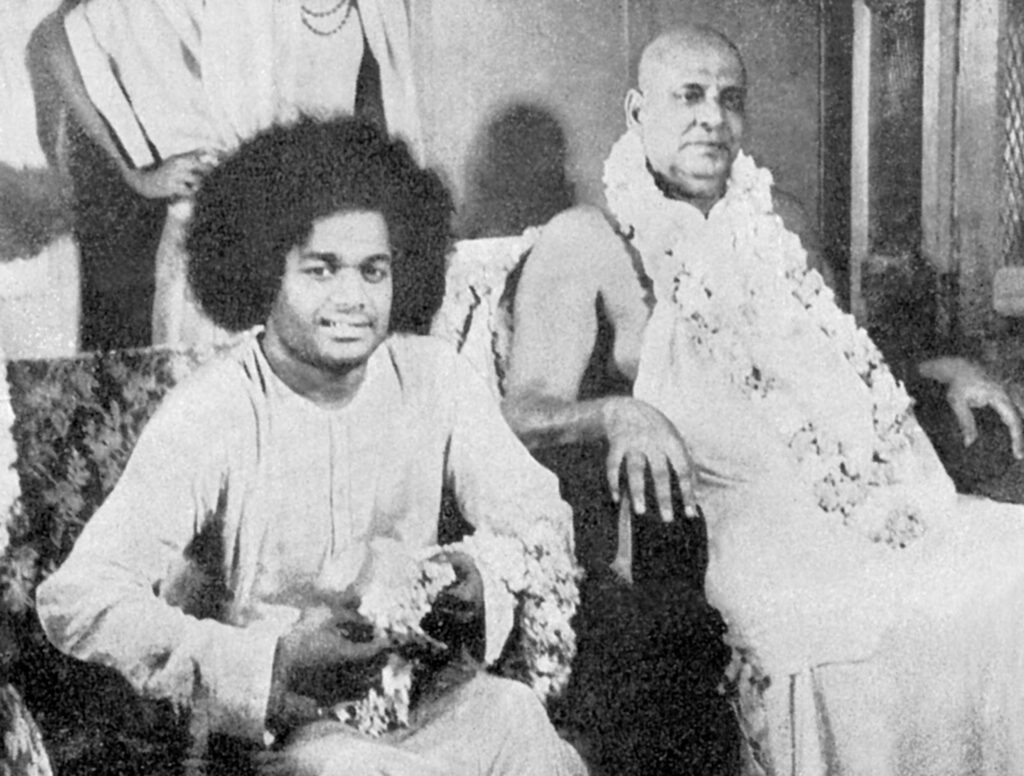
Sathya Sai Baba’s visit to Swami Sivananda’s ashram on 22nd July, 1957 which has been recorded in Sathyam Sivam Sundaram – Part I by N. Kasturi
On the twenty-second of July Baba left New Delhi by car for Rishikesh. Swami Sivananda’s monastic disciples escorted Him from Hardwar. When He reached Sivanandanagar at 6:30 that evening, Swami Sivananda called a special gathering of the disciples at the Ashram and offered Baba a hearty welcome. While Sivananda greeted Baba with folded hands, as was his custom, Baba acknowledged the greeting with His posture of the Hand which means, “Do not fear,” a sign that has given peace to thousands of troubled souls.
He then materialized by the mere Wave of His Hand a magnificent Rudraksha garland of 108 beads, a rosary made from a berry. It was of exquisite workmanship, each bead encased in gold, and all were strung in gold with a five-faced king-bead in the centre. He presented it to Swami Sivananda Saraswati. He also manifested a large quantity of Sacred Ash and applied it to the sage’s forehead. That evening when the Swami entered the Satsang Hall wearing the unique garland, everyone was awed by its lustre and workmanship and the miracle that brought it forth. Swami Sivananda spoke of Bhagavan and His message. He expounded on the efficacy of Namasmarana, the remembering of the Name of God, and appealed as a medical practitioner for a daily dose of dispassion to be taken by every person along with the regular diet of the Lord’s Name.
It came as a pleasant surprise to many in the Ashram when they saw, on the day Baba departed, Swami Sivananda enthusiastically taking Baba around his hermitage, for on the day Baba reached the Ashram, and for a number of days thereafter, the Swami had been pushed around in a wheelchair!
At that time Swami Sivananda was on a wheelchair. Swami in fact had pushed the wheelchair and had spent personal time with Swami Sivananda.
Mrs Ruth Wilson 17th January 1964 Prasanthi Nilayam
From Sanathana Sarathi magazine January 1964
Prasanthi Nilayam News On Jan. 17th, Mrs. Ruth Wilson, of Vienna. Austria arrived at the Nilayam and during her stay of four days, she discussed with Baba various problems of Sadhana as well as the essentials of Sanathana Dharma, which raise it to the level of a Religion, for all Humanity. On Jan. 18th, T R Ganesan from Tokyo, Japan who has inspired a number of Japanese to hearken to the Message of Baba arrived and sought guidance for wider and better service.
American Hilda Charlton July 1964 Prasanthi Nilayam
From Sanathana Sarathi magazine July 1964
Prasanthi Nilayam News July 8th. Mrs Helda Charlton of Pasadena, California, U.S.A. now on a visit to India to practise spiritual Sadhana, arrived at the Nilayam for a few days’ stay to receive the Blessings of Baba for success in her Search.
Hilda writes; Years ago I went seeking those who could take the cork out of me and let me merge with the Ocean of Truth. I left San Francisco on a freighter to see the holy ones of India. As Nityananda, the great saint and my teacher, said, “The mind must come to a certain point of dedication, of mindlessness, before the Masters will appear.” I went to India as a dancer and gave concerts throughout the country. I left here with a one-way ticket, with eighty dollars in cash, and with a million dollars worth of faith. I travelled all over India, and I’ve been going ever since on that eighty dollars. Right? And on the million dollars of faith.
In India I had gone to Shirdi Sai Baba’s shrine, and wonderful things had happened there. Shirdi Sai Baba had said before he passed that he would incarnate again in South India eight years later. When Sathya Sai Baba was a boy, he said that he was that incarnation of Shirdi Sai Baba.
Well, I was about to leave India on my way home after all those many, many years, almost 20 years there, and I heard somebody say, “There’s a Sathya Sai Baba who does miracles down in South India.” So I went to the stationmaster in this little town and I took that old train. Back then I used to get down to the station very early and go third class and sleep in the luggage racks. I was thinner then. The luggage racks are very narrow. I wouldn’t make it now, I’m telling you. I said to that stationmaster, “I want a ticket back in three days because I am going home to my America.” And he said, “I can’t give you a return ticket. You haven’t seen the Master yet.” The Master was Sai Baba – the stationmaster knew where I was going. I said, “You give me that ticket.” I got a little on the tough side. But he shook his head and said, “You haven’t asked for permission yet from the Master.”
I didn’t come home in three days. I stayed a long, long time over with Baba. He was very, very kind to me.
Hilda Charlton was born in London in 1906, and moved to the United States with her parents when she was 4 years old. She was raised in Salt Lake City, Utah, and Los Angeles, California. At the age of 18, she began performing as a modern dancer. For the next 20 years, she danced and taught in the San Francisco area.
Hilda toured India as a dancer from 1947 to 1950, and stayed in India for fifteen more years, studying eastern mysticism and meditation. She was guided by great spiritual masters and holy people, including Nityananda of Ganeshpuri, Sri Mahadevanansa of Bombay, and Sathya Sai Baba of Puttaparthi. Bhagavan Nityananda, Yogananda, Yogaswami, Ammal, and Baba Muktananda were also her teachers.
Hilda taught and shared with many spiritual teachers including Ram Das in the 70’s, Robert Hansen (Sivaya Subramuniyaswami) and Albert Rudolph (Rudi) to name a few.
She died in New York City on January 29, 1988.
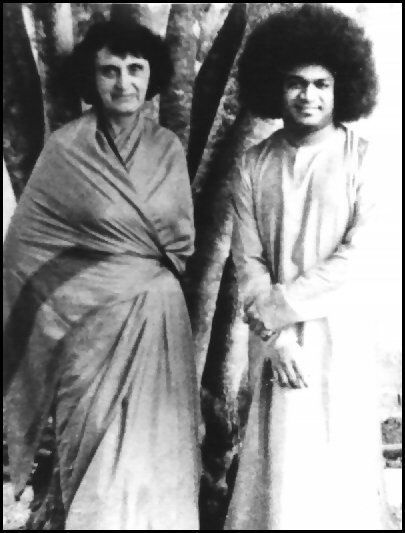
From Sanathana Sarathi magazine July 1965
Prasanthi Nilayam News July 14 Speeches by Hilda Charlton and H. Sunder Rao, M.A
Swiss school teacher Gabriella Arpita Steyer 24th December 1964 Whitefield and stayed for two years
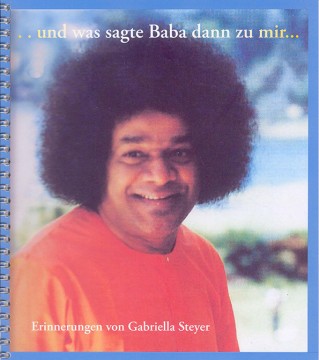
In this book (40 pages) the Bernese Sai devotee, Gabriella Steyer, reports on her experiences with Sathya Sai Baba. She met him for the first time in December 1964. She writes about this first encounter:
“So on December 22nd 1964, I simply flew to Madras, where late in the evening I was surprisingly received at the airport by two Sai sisters. Bhagavan Sri Sathya Sai Baba, who was giving speeches in Madras at that time, commissioned Sarjuma and Lily to take care of me at 4 pm on December 24th. The two sisters and I then traveled by train to Bangalore, where I was allowed to stay at their house. The next day we drove to Brindavan in their passenger car, where Baba also arrived by car from Madras at 4 p.m.
The first sight of Sai Baba was overwhelming. When Baba got out of the car, all I saw was a huge face full of love and kindness. I was not aware that this gentleman whom the two sisters worshiped was a known and divine master, since I had not remembered the book hidden in the laundry room at home, let alone its cover. The heavy iron gate of the park garden opened and Baba walked to the spacious mansion with the hosts of the summer residence and with Sarjuma, Lily and me. Christmas Eve was soon celebrated there with singing and merry gatherings, and I was actually allowed to sit at the feet of a great master, although I was not yet aware of his holiness as an avatar. I was just happy and felt comfortable and at home in the presence of this baba from the start.”
In this book, Gabriella Steyer tells what she experienced during this and many subsequent stays with Sathya Sai Baba. Not only does she tell of the daily miracles she was allowed to experience up close, but she also connects her stories to what she was able to learn from Sathya Sai Baba on that occasion. Here’s another quote from the book:
“My wish at the time was to always love God equally, not with all my heart one day and then with less intensity the next. But Baba explained to me that the ups and downs could be compared to water. It rises from a spring, hops over hill and dale, becomes a brook, then a river and finally flows into the ocean. If the water came to a level and stopped flowing, it could stagnate over time and be dried up by the wind and weather and the sun. The ups and downs are necessary because they give the driving force to reach the goal.”
Gabriella further writes in another article My first encounter
It was on December 24, 1964, when I was destined to meet Bhagavan Sri Sathya Sai Baba for the first time in a miraculous way.
Three days earlier, in Calcutta, I told my Indian friend that I wanted to spend Christmas Eve either in the main centre of the Sri Ramakrishna Mission in Belur Math (Bengal), (where Christmas is nicely celebrated), or at the feet of a great saint if the two guest rooms in the Ramakrishna Mission were occupied. As the latter was the case, I booked a flight to South India.
Sathya Sai Baba, who at that time was giving lectures to devotees in Madras, heard in his omnipresence my conversation with my friend in Calcutta. He asked two devotee sisters to pick me up on December 22nd at the Madras airport and take me to (Brindavan) in Whitefield on December 24th at 4 pm.
So, on the eve of Christmas, we drove together to Bangalore and reached (Brindavan) where South Indian devotees offer their magnificent summer residence to Sai Baba. This allows the local devotees to meet the Avatar from time to time.
Swami welcomed the three of us with a beautiful smile and led us into the house, where he settled down on a chair in the devotional room and we were allowed to sit at his feet.
Gradually the sun sank behind the horizon and a pleasant, holy atmosphere surrounded us.
Christmas Eve began. Sai Baba sang and spoke with us. I had only just arrived and was not yet aware of his divine qualities.
Baba‘s radiance was so sublime and at the same time so loving that our hearts became very warm.
He seemed like a father and friend to me, which allowed me to feel at home near him and to behave towards him with ease, happiness and trust. So Sai Baba, in his infinite love, fulfilled my heart‘s desire from far away Calcutta.
Suddenly my gifts, which I had wrapped in Switzerland for my trip to India and which were still in my luggage, came to my mind and I presented Swami with a few of them.
As he started to unpack, he rejoiced like a child and added: “Look at the beautiful wrapping paper the Swiss make; we Indians just wrap presents in newspapers!” He also seemed to be impressed by the quality of the Swiss products. No wonder, since his materialised objects are also perfectly beautiful and testify his benevolence and his pleasure in human craftsmanship.
Suddenly, from nowhere, Swami handed me a piece of nougat, neatly wrapped in cellophane. It was exactly the same as it used to be given to me in my childhood at the stands on Petersplatz during the Basel Autumn Fair – or as when I used to buy it myself from my pocket money. Nougat was my favourite speciality back then. I was deeply moved by the fact that Baba materialised this sweet from the ether – after all these years.
On January 1, 1965, he gave us sweets again. Baba surprised us early in the morning with his Darshan. Markel, a young woman from California, and I had just got up when Baba came to us and put a soft and fragrant warm piece of pastry in to the mouth of both of us with the words “I wish that this year is as sweet as this sweet.” At that time, Swami spoke few words of English. But more often, he said: “It‘s easy” especially in those moments when we would be present during his materializations and would open our mouths and eyes wide in amazement.
(From Sanathana Sarathi magazine January 1965 – 4th Jan Baba arrived at Prasanthi Nilayam accompanied by Mr. And Mrs. Jr. Raymer of Pacific Palisades, California, U S and Gabriela Steyer of Burgdorf, Switzerland.)
In the years that followed, I was able to witness many of his miracles and experienced that all his gifts came from the inexhaustible fullness of God. The gifts are signs of his sympathy, joy, compassion, help, grace, and above all of his infinite love.
Later, Hilda, an American, joined our small group of foreigners. After her stay with Sai Baba, Hilda led a yoga school in New York. One afternoon, Baba asked Hilda and me to join an Indian devotee in his car on a little tour of Bangalore and then do some shopping.
We liked that suggestion! “What should I buy? I don`t need anything,” I thought. But then, a wish arose in me: “Oh yes I do, I want some chocolate.” So we patiently drove from shop to shop, but could not find a ‘Swiss chocolate.’ As consolation for my efforts, I bought an English Cadbury chocolate.
Back in Brindavan, Whitefield we had afternoon tea. Swami rushed over. With His lotus feet, He flew over the ground so that we did not hear him coming. Suddenly he was standing in the midst of us. “What did you buy?” He asked innocently, as if He didn’t already know what we had bought. After Hilda had listed her cosmetics shopping, I confessed: “Chocolates, Swamiji, English Cadbury chocolates, as I could not find Swiss chocolates.” When I answered, Baba burst into a hearty, resounding laughter, so much so that we all just laughed along.
From that moment on, Sai Baba gave me the nick-names ‘Chocolate’ and ‘Switzerland.’ When he saw something brown, He would often shout, “Switzerland, Chocolate, come here.” Or He would say, “Switzerland, go there and do this” or “Switzerland, how are you?” It was funny. Swami once gave me a Sari in the colours of milk chocolate.
Sai Baba was always ready for jokes; they were a part to Him. Laughter and jokes, speaking and silence – Swami`s utterances and gestures always had meaning.
Each of his actions contained a deeper message.
Baba was not only a fabulous judge of character, he was also well informed about world history.
Of course, he also knew the common goods of the different countries, such as chocolate, cheese and the world-famous watches with their immaculate Swiss precision movements. So I also realised that the Swiss watch was not missing in Swami’s ‘miracle store.’
Here is what happened. One morning Baba shouted:
“Get ready, we’re leaving right away!”
In his surroundings, you always had to be ready to go – whether for day trips or longer journeys. This was al-ways a great challenge for me, because I had to gather up all my luggage within a very short time, depending on the project. Swami always said: “Less luggage – less worries.”
As a destination of that trip, Swami led us into a distant jungle which included an elephant ride. For us foreigners, this was of course a great treat. In the beginning we could only discover monkeys. But suddenly the elephant guide spotted a group of wild elephants. He told us: “Stand still, don‘t move and don‘t make a sound.” For Hilda and me, it was not easy, we rolled around laughing because of the wobbly seat. At the same time, however, we were overcome with a queasy feeling because wild elephants are unpredictable and can run away impetuously when they see something moving. They are then capable of destroying whole areas with their power and stomping.
However, since our beloved protector Sai Baba was among us, we felt very much at ease in His care. At the end of the elephant ride, which lasted several hours, Baba‘s elegantly circling hand movement brought the elephant keeper a shiny men‘s watch with ‘Swiss made’ stamped on the dial as a tribute to his good bush management.
We were able to experience Baba‘s soothing and fascinating miracle every day in his immediate presence. Baba was not only an actor of God, but also an expression of divine omniscience, omnipotence and omnipresence.
He healed acquaintances of mine and appeared to them in his ethereal body in Switzerland, although they neither knew nor revered Him. He simply let me know with his letter that he would take care of them, and his promise came true.
I often wished that Swami would visit Switzerland.
I waited for a long time until he finally came. Not by plane, as I had imagined, but in his own way, in the form of a vision.
He stood on a hill in the middle of the Swiss Alps in His long red robe and in solid mountain boots, his gaze fixed on the magnificent landscape. He rested within himself and blessed our homeland – his Swiss-Sai-Land.
After several years, Baba commissioned his ‘Swiss Sai-land’ to establish a Sathya Sai Baba Centre in Switzer-land, which was opened in 1979 on Lord Sri Ganesha Day in Bern. Since then other Sai Baba Centres have been established in the Confederation Helvetica, from which Swami‘s love radiates all over the world and into the universe.
We can never be sufficiently grateful to Bhagavan Sri Sathya Sai Baba for all the wonderful things he has given us in his infinite love and kindness.
Gabriella further writes in another article On the banks of the Chitravati River
Before an evening Bhajan chant in the Mandir, Baba announced that everyone should go to the dried out Chitravati river-bed and wait for him there.
This message was auspicious and filled us with a tingling excitement of a special event. I walked down along the devotee stream to the destination and decided to mingle with the crowd so as to go unnoticed.
As I was the only remaining foreigner who was treated preferentially in many things and was usually allowed to sit at the front of the queue, I wanted others to get this privilege. But Swami had planned differently.
Suddenly, an Indian devotee grabbed me by the arm and pulled me literally like a bundle of wood behind her to a point where she ordered me to sit down.
As soon as I sat on the spot of sand, a rectangular, rather high sand hill was built up in front of me. Around the sand hill, a few other devotees were asked to sit.
The full moon rose in the sky. A gentle breeze blew and spread the sound of Bhajan singing that had begun in the meantime in all directions. The hearts of all trembled in joyful expectation of what was to come – but no one could guess. Then Baba appeared in the semi-darkness and sat down on the piled up sand-seat. How happy I was to be allowed to sit directly at his feet and be so close to Him.
With his melodious and powerfully soft voice Baba sang the first line of the Bhajans and the choir of devotees repeated after him in waves of joy and devotion. The atmosphere was enchanting. While singing, Baba raised his right index finger and drew something in the sand with a few strokes. The joined strokes seemed to me like a kindergarten drawing.
Then came the big moment. Baba reached into the sand with his right hand and lifted out two matching silver statues. These statues were of the deities Lakshmi and Narayana.
The statues were then lifted so as to be visible to all – to the delight of the devotees. The chanting continued and hundreds of happy eyes were fixed on Sai Baba.
A second surprise followed. Baba knows how to make his actions always exciting and interesting. This time, the drawing lasted barely two seconds. An oval circle became visible in which Baba again put his right hand through the sand and dug out a silver plateau.
Why did He dig up this plateau?
Baba placed the Lakshmi and Narayana statues on top of the silver plateau in order for them to have a proper base. Again, the devotees uttered sounds of “Ahh’s” and “Ohh’s.” The festive mood continued and the choir sang with increasing strength and devotion. What followed next? The divine Leela had even more in mind. Baba’s index finger again sketched a few lines on the sand, but they were drawn so quickly that I couldn’t guess what they meant.
The object that was born out of the sand this time was a beautifully shaped Kamandalu, a small shiny jug that looked like the Kamandalu that the monks carry with them. The creative artwork of the evening performance was not yet finished. As the last item, Baba dug out a small spoon out of the sand after doing similar sketching. All good omens in India are five and hence this number is considered very special in this sub-continent.
Apparently, the great performances were not yet finished. Baba still sat quietly on the sand cushion and sang with us. Meanwhile it had become dark, but the light of the full moon, as well as Baba’s divine light and the light of the devotees’ hearts sent their blessing rays into the vastness of the universe.
Suddenly I felt as if I was drunk – there was a strong heavenly fragrance – it appeared as if a perfume had been brewed from all of the most fragrant flowers in the world. I looked around me but could not tell from where the scent reached my senses.
Soon the secret was revealed. Baba, in his majesty and beauty, held his right hand over the Kamandalu with the lid back and (who would believe it!) let Amrit (divine nectar) flow from his fingertips into the Kamandalu until it was filled to the brim with divine nectar. The loud Bhajan singing suddenly stopped and reverential silence replaced it.
Baba rose and asked the crowd to return home and to gather the following morning in double rows in front of the mandir. As per his request, everyone sat on the floor in front of the mandir. There was enough space between the rows for Baba to walk past everyone and (which was part of the conclusion of the Chitravati evening) to pour a spoonful of the amrit (nectar) directly into the mouths of each one of us. As he approached me, I noticed that the Kamandalu was almost empty. What did Baba do then? He simply gave the lid of the Kamandalu a gentle tap, and there was enough of the precious amrit for all of the five hundred or so devotees present.
THANK YOU BABA! THANK YOU! THANK YOU!
Reading about Amrit in legends and fairy tales is one thing, but receiving nectar from the Avatar personally is an indescribable and unforgettable experience. Prasanthi Nilayam was indeed a daily festival site. What a blessing for all who had found happiness in this place of peace!
Below is a message from Bhagavan Sri which he sent me in His letter in 1966.
It is so beautiful that I want to share it with all devotees.
“Gabriella,
Feel that every act and activity of yours is for God and of God. Think of every inch of the ground that you tread as the floor of the Temple of God. Remember, that every word that you utter is part of a conversation with God himself. Be aware always that whatever you see are but glimpses of the Body of God. When life is such dedicated, imagine the bliss you will experience.”
Bhagavan Sri Sathya Sai Baba JAY SRI SAI RAM OM SRI SAI RAM
Sai Ram, Gabriella Steyer – Interlaken
From En los pasos del Señor (In the footsteps of the Lord) by Michel Coquet
It would have been impossible to write this biography without the precious help of the reference works of Sri N. Kasturi, Mr. Indulal Sha, Lucas Ralli, Erlendur Haraldsson, John Hislop, Howard Murphet, J. Jegathesan, Gabriella Arpita Steyer and the many others who collaborated.
A few years ago, we had occasion to meet a friend in India who had been in close association with Sai Baba since 1964, although we were unaware of it at the time. This friend, originally from Switzerland, is called Gabriella Arpita Steyer, and she lived near Sai for several years. She was one of the first Westerners to talk about Sai Baba’s divine games to Howard Murphet when he went to India. During a stay at Sri Ramakrishna’s ashram in Gretz, Gabriella was kind enough to tell us about some of Sai’s divine games, which she witnessed. Her meeting with Sathya Sai Baba was unusual. Without going into details, Gabriella told us that being a devotee of Sri Ramakrishna herself, she was invited one day to the home of a Hindu couple in Delhi. There, he saw Sai Baba’s photo for the first time next to that of Sri Ramakrishna, Sri Sarada Devi and Swami Vivekananda.
After this trip to India, he returned to Switzerland, but two years later, she felt an inner need to return. Her first visit was to Brindavan, where she met Ma Ananda Moyi, a decisive encounter that made her decide to dedicate her whole life to the spiritual quest. Before leaving for India, she had already prayed a lot for guidance in this direction. Later, she had several visions where the face of Ma Ananda Moyi appeared and also that of a older man whom Gabriella later recognised on some paintings in India as being Shirdi Sai Baba. Shirdi Sai appeared to Gabriella in Switzerland, silently inviting her with a mischievous smile in her eyes to come and visit him in India in her present incarnation, that of Sathya Sai Baba.
At that time, while teaching at a school in Bern, Gabriella decided to leave her job to meet the great souls of India. Ma Ananda Moyi travelled often and Gabriella was not always able to follow her. He then decided to take advantage of this period to visit South India and especially the ashram of Sri Ramana Maharshi, whose teaching suited him perfectly. Christmas was near and Gabriella hoped to spend the eve either at the Ramakrishna Mission in Belur Math or at the feet of a great sage. She then travelled from Calcutta to Madras where she was welcomed by a couple of Indian friends. However, instead of going to their home, they invited her to go with them directly to Whitefield, near Bangalore, where Sai Baba would be staying for Christmas. The rush was due to the fact that the couple had talked about Gabriella’s arrival to Sai Baba andvBaba had asked them to bring the Swiss woman to his house in Brindavan on December 24th at exactly 4:00 p.m. Gabriella and her friends were waiting in front of the grand portico at the appointed time when the car carrying Sai Baba from Madras pulled in.
The first thing that captivated her was his face of rare majesty and his truly divine smile. In 1964, devotees still lived in close proximity to Sai Baba. It was, Gabriella told us, a true family life. The Indian devotees, who were the vast majority, regularly received advice and instructions, sang and ate together, and Sai Baba appeared fundamentally happy and joyful. He was chinchón and playful, and nobody in his presence could be bored. Every day was a reason for a spiritual event and miracles were daily, although he minimized them considerably, emphasising the fact that they had no importance if it was not to make his devotees happy.
A few days after her arrival, Gabriella was sharing a room with a devout American. On the morning of January 1st, they had just got up when Sai Baba entered the room and wished them a Happy New Year, offering them a still hot sweet which, it seems, had just materialized: “I wish this New Year to be for you so exquisite as this sweet.” Gabriella was so taken with her that she stayed at the ashram for nearly two years.
One day, Sai Baba suggested that she go to his ashram in Puttaparthi where she stayed for a few weeks with her American friend. The Puttaparthi ashram was not then what it is today. There were no amenities or toilets and he often slept under the stars.
Gabriella told us that the most captivating thing about Sai Baba was his divine love for everyone, and the most amazing thing was his ability to know everything. His omniscience was such that he seemed to know everything about his innermost thoughts, both past and future.
‘Om Sai Ram’ is mantra is often repeated by devotees of Sai Baba with devotion and sincerity, and is also used as a greeting. Sometimes these sacred words are engraved on Sai Baba’s materialised jewellery. Sai Baba materialised this mantra for Gabriella on a ring made of five metals (gold, silver, copper, brass and iron) with Shirdi Sai Baba’s sphinx in relief. When he materialised it, the ring was too big, but Sai Baba already knew in advance that Gabriella would unwittingly gain weight over the next three months, so from then on, the ring no longer fell off her finger.
Anothetr story told by our friend Gabriella Steyer. In the 1980s, a Hindu couple she knew wanted to give her a Christmas present while they were in Switzerland. Sita, the wife, went shopping in Bern and found three small picture frames. One of them might do, but he searched in vain for a picture of Sai Baba that would fit. Since all the ones he had had to be cut down, he preferred to abandon the idea. The next morning, Sita saw a bag of vibhuti on the table. Surprised, she put it away in a drawer, but in the following days, the same package appeared in other furniture. This intrigued Sita’s husband, who never let such bags lie around, and kept the bag of vibhuti, but it reappeared the next day. Sita, who always had a desire to find an image of Sai, ended up wondering about the mysterious appearance of the package and decided to open it. To his astonishment, the bag, in addition to the vibhuti, contained three images of Sai Baba. And, of course, the photos fitted perfectly in the little frames Sita had bought. Later, the small portrait that Gabriella kept was partially covered in vibhuti for a time.
Gabriella explained to me that she was one of the lucky ones who were lucky enough to be with Sai Baba at a time when devotees still gathered from time to time on the banks of the Chitravati River. She remembers a day when she saw Sai Baba alternately materialise a small pot and a spoon. At that moment, the place that was in the open air was flooded with an incomparable fragrance, like the most wonderful of perfumes. Everyone wondered where it could come from, until Gabriella, who was watching Sai Baba intently, realised that he was filling the little jar with nectar flowing from his fingers. When the jar was completely filled with the scented liquid, Sai Baba asked everyone to go away and get ready because the next day would be a major holiday. He also told them that once everyone was gathered in front of the temple, he would make them taste this elixir of the gods. The next day they were all sitting in a row, the men on one side and the women on the other, as usual; There were several hundred and Sai Baba went through each line, giving each one a spoonful. As she approached Gabriella, she had the thought that such a large crowd could not be fed from the already half-empty little jar. At this point, Sai Baba patted the jar and, in an instant, it was again full to the brim. Quantity is also not an obstacle for Sai Baba. Thus, during one Christmas, he materialised the nectar that he distributed to almost four thousand devotees.
Gabriella told us an interesting story about the law of karma and how Sai can intervene. It is the story of a father who came to Puttaparthi hoping to see his eight or nine year old son recover from a long and serious illness. The father used to carry his son on his shoulders and go around the temple praying very loudly. He did this for several weeks until one day Sai Baba agreed to receive him, welcoming him with great compassion, asking him to choose. He could, if the father so wished, immediately cure his son, but in that case the boy would have to relive this karmic ordeal in his next existence. Or, accept your child’s illness for a few more years, and then your child would be completely debt-free in later life. The father chose the second option. Therefore, let us be restrained before judging the actions of the Lord that, despite our misunderstanding, are always carried out with a view to a greater good.
Indra Devi writes that Gabriella Steyer, a Swiss school teacher sweetly took care of her on her arrival to Prasanthi Nilayam in April 1966, who had by then spent a year and a half there.
The Murphets had meet Gabriella in Madras when Howard was returning the day following his first meet with Baba in Madras. Howard Murphet writes in his 1971 book Sai Baba – Man of Miracles
“The next afternoon found Iris and myself at the same house. In the entrance we met Gabriela Steyer of Switzerland, one of the small western contingent in Baba’s travelling party. She, very friendly and sympathetic, led us to an upstairs room where about a score of women, most of them Indian and all in saris, sat cross-legged on the carpet.”
“Every day now saw the crowd swelling. The buildings were all full and people were beginning to spread their beds under the trees. In this gathering tide of dark-faced, white-robed Indians I was the only western male. Bob Raymer having returned to his home in California. Among the ladies there were only two pale faces left ochre-robed Nirmalananda and Gabriela Steyer.”
“Earlier in the book I spoke of Miss Gabriela Steyer who was living at the ashram when I first met Swami. She stayed there for many months and when I visited Prasanthi Nilayam the first time (February 1966) she told me about many wonderful miracles she had personally witnessed. She had had a very rich experience of these outward signs of power and grace. But, as always, the most important factor was Baba’s love; this was the magnet that held her to the discomforts and austerities of ashram life month after month. Gabriela finally had to tear herself away and return to her own country and profession. But I doubt if her life could ever be the same again after it had once been kindled by the Great Flame. There were many outer signs of the inner glow.”
Howard and Iris Murphet Indian Spring 1965, at the Madras home of G. Venkateshwara Rao
Howard’s first book Yoga for Busy People sold well for many years. His psychic research led them into the Theosophical Society’s library in the West End which in turn led them to be accepted as students in the School of the Ancient Wisdom at the Theosophical Society Headquarters at Adyar, in Madras, India.
Based at Adyar, they ventured forth and spent time with the young Dalai Lama and met many extraordinary figures including J. Krishnamurti, Swami Ranganatananda of the Ramakrishna Mission, Maharishi Mahesh Yogi, and Tat Walla Baba, among others.
Then came the truly pivotal event in Howard’s life; meeting Sathya Sai Baba and going to his ashram, Prasanthi Nilayam. This not only opened his spiritual heart to an extent he could never have even dreamed of, but also inspired the writing of his best-selling book Sai Baba, Man of Miracles.
Murphet also wrote biographies throughout 1967 of the two founders of the Theosophical Society, Colonel H.S. Olcott and Madam H.P. Blavatsky. The first of the two, Hammer on the Mountain is a detailed and inspiring account of one of the most outstanding men that ever lived – Henry Steel Olcott.
The second biography When Daylight Comes on the controversial Russian noblewoman, Madam Helena Petrovna Blavatsky.
In the midst of writing Man of Miracles from their base at Adyar, Howard and Iris still found time to visit the ashram of the late Sri Aurobindo at Pondicherry, thus beginning a life-long study of this great spiritual master’s published works. Then, after the completion of Man of Miracles they set off in the footsteps of that earlier writer/seeker, Paul Brunton, to visit the sacred mountain of Arunachala at whose feet rests the ashram of the late Ramana Maharshi, famed for his teachings on self-enquiry. There they spent time with Arthur Osborne and his wife: “It was this gifted spiritual searcher who wrote the book The Incredible Sai Baba (on Shirdi Sai) which had done so much in our lives”, as well as the seminal work The Life and Teachings of Ramana Maharshi.
First meets Sathya Sai Baba in the Indian spring of 1965 at the Madras home of the home of Mr. G. Venkateshwara Rao, the mica magnate who was also a devotee of Sai Baba.
Howard Murphet writes in his 1971 book Sai Baba – Man of Miracles
This, I thought, might be my great chance to find out if the fantastic tales that have come out of India belong to the realm of fact or fiction. I decided that I must see Satya Sai Baba as soon as convenient. Later, when I heard that his followers regarded him as a reincarnation of Sai Baba of Shirdi, my desire to meet him became even stronger.
But the bullock-cart safari into the interior of south India would have to wait a little while. It sounded more than arduous, and we had recently discovered on our northern journey that ordinary travel in India saps one’s vitality. On our return, we were glad to recuperate for a time in the tranquil tree-filled Theosophical Estate.
One day several months after our return a young pale-faced woman wearing the ochre-robe of a monk came on a visit to the Theosophical Headquarters. She was introduced to us by a mutual friend as Nirmalananda, and we took her to our sitting room for morning coffee. She told us that she was an American from Hollywood, an odd place of origin for an ascetic, we thought. “Nirmalananda”, she said, was the Hindu name given her by Swami Sivananda when he initiated her into the monastic life. After he had died she left his ashram at Rishikesh and became a follower of Satya Sai Baba. At Puttaparthi she had witnessed many wonderful miracles. Now Sai Baba was on a visit to Madras and she was one of a small party of disciples he had brought with him.
This seemed to be our golden opportunity. Iris was not feeling well enough to come, but Nirmalananda conducted me to the place where Sai Baba was staying. It was a pleasant house, standing behind lawns and flower gardens. Later I learned that it was the home of Mr. G. Venkateshwara Rao, the mica magnate who was also a devotee of Sai Baba. The lawns and pathways in front of the house were covered with people sitting quietly cross-legged on the ground – white-clad men to one side and women in saris like bright-coloured flowers to the other. There were hundreds of them, obviously waiting for a sight of the great man.
Nirmalananda led me through the crowd to the front verandah and there introduced me to a pleasant, red-haired American named Bob Raymer.
“I think Sai Baba has finished interviews for the morning, but I’ll go and find out,” he said.
He took me into a small sitting-room and left me there. Nirmalananda had already gone off somewhere. In the room were only two Indian men, both standing and apparently waiting for someone. I also stood waiting.
After a few minutes the door from the interior of the house opened and there entered a man the like of whom I have never seen before nor since. He was slight and short. He wore a red silk robe that fell in a straight line from shoulders to feet. His hair stood up from his head in a big circular mop, jet black, crinkly, to the roots like wool, and seemingly vibrant with life. His skin was light brown but seemed darker because of the thick beard which, though closely shaven, still showed black through the skin. His eyes were dark, soft and luminous, and his face beamed with some inner joy.
I had never seen a photograph of Sai Baba. Could this be he? I had expected someone tall and stately with a long black beard, and dressed in white robes. I had a preconceived image of what a great yogi or master should be like perhaps derived from early theosophical descriptions of the Masters.
He came swiftly and gracefully across the carpet towards me, showing white, even teeth in a friendly smile.
“Are you the man from Australia?” he asked.
“Yes.” I replied.
Howard and Iris Murphet arrive at Prasanthi Nilayam in February 1966.
Dr Hernando de la Cuesta from the United States and Pole Marek Tollik from the University of Paris 9th August 1965 Prasanthi Nilayam
From Sanathana Sarathi magazine August 1965
Prasanthi Nilayam News August 9 Dr. Hernando de la Cuesta from the United States and Mr. Marek Tollik from the University of Paris arrived at the Nilayam and had discussions with Baba on spiritual problems.
Australian Frank C. Becker 22nd September 1965 Prasanthi Nilayam
From Sanathana Sarathi magazine September 1965
Prasanthi Nilayam News Sep 22 Arrival of Frank C. Becker from Western Australia.
Mr Harding from London arrived for a short stay 22nd January 1966 Prasanthi Nilayam
From Sanathana Sarathi magazine January 1966
Prasanthi Nilayam News Jan 22 Harding from London arrived for a short stay
Swiss Bruno Kueazi 5th February 1966 Prasanthi Nilayam
From Sanathana Sarathi magazine February 1966
Prasanthi Nilayam News Feb 5 Mr. Bruno Kueazi from Switzerland arrived for a short stay at the Nilayam.
Norwegian Alf Tideman Johanessan March 1966 Bombay
From Sathyam Sivam Sundaram – Part III by N. Kasturi
Another ‘for-near’ who was drawn by Baba from Shirdi, the arena of His previous life, is Alf Tideman Johanessan of Oslo, Norway. Head of a prosperous company doing business at Bombay harbour as shipping agents, His rivals attempted to ruin his reputation and income, by every foul means that could be devised, including black magic! Some friends of his and a Parsi priest took him to (of all places!) the shrine of Shirdi, to invoke grace to ward off the calamity.
During one of his visits, in February 1966, while Alf was sitting disconsolate before the tomb of the ‘Previous Body’, the present body took over his problems in His inimitable way! A short man in a blue shirt patted him on the back and asked, “Have you ever met Sathya Sai Baba?” Alf had not heard the name before. The short man whispered in his ear, “If God ever came upon the earth, this is He,” and placed in his hand a small locket studded with an enamelled oval piece containing a portrait of a person wearing a robe and having a mop of hair. “This is Sathya Sai Baba,” the short man said, “You can see Him at Bombay on March 14th,” and then left.
Alf asked all those he knew for more details about this ‘God on Earth’, but none of them had heard about Him, nor did they know where He could be found on March 14th. In fact, as he came to know later, it was only a week after the short man in blue shirt announced the date at Shirdi did the Sathya Sai Seva Samithi of Bombay receive information about the date of Baba’s arrival with directions to look for and engage a suitable place in any easily accessible part of the city with plenty of open space around for devotees to gather.
Let it be said that Baba reached Bombay in the small hours of the night on 13th March, and gave Alf the smile of recognition on the 14th, during the Bhajan session in the morning at Gwalior Palace! In the very first interview that Alf gained, consequent on this divinely arranged contact, Baba said to him, “Do you remember the black magician? I helped you then.” Relating to him his triumphs and trials, both in his business and in his efforts at bridging the gap between despair and delight in the realm of the spirit, Baba told him, “From now on, I shall be your guide, in all matters.”
Howard Murphet writes in his 1971 book Sai Baba – Man of Miracles
Here is the story, in condensed form, of how one man of the western world came to Sai Baba and of how it affected his life.
Mr. Alf Tidemand-Johannessen of Oslo, Norway, arrived in India with nothing but the proverbial typewriter and his own ability, grit, energy and ambition to make a fortune. Within twelve years, that is, by 1962, he had built up one of the largest ship agency companies in India, handling more ships each year than any other individual company. His was India’s pioneer company in grain discharging. It handled more than half of the grain ships bringing enormous quantities of food to India to avoid large-scale starvation there. His big success did not pass unnoticed. Into certain minds entered jealousy, envy, and schemes for getting control of his business. Certain key men on his executive staff were soon actively engaged behind the scenes in misusing their powers to divert the company’s assets into their own pockets.
“When I found out that malpractices were taking place,” Alf Tidemand told me, “I knew that I would have to face a furious battle with a ruthless enemy. As soon as I took steps to seal the leakages, the executives concerned terminated their services and started a competing company. Their aim was to take away all my business.”
As part of their scheme his enemies sent anonymous letters to Income Tax, Reserve Bank and Customs authorities indicating that the Tidemand Company was abusing the laws and regulations of the country. Apparently it is customary for such authorities to take action on anonymous letters: they soon discovered who the senders were, and then months of investigations followed during which Alf had to provide documents covering all the past years to prove that the allegations against him were false.
Naturally his business clients were disturbed at the sudden exodus of his key staff and the rumours that were floating around. To add fuel to the fire his scheming enemies sent letters to all his clients informing them that his company was in trouble with the Government. All this put tremendous restrictions on his business operations, and things looked very black indeed.
Nevertheless, because of his past integrity, Alf’s clients did not immediately desert him, and the new competing company established by his defecting executives was not doing well. So then they made their next move, a move that is apparently not uncommon in the concrete jungles of modern India. They engaged a black magician to work against him.
Alf said: “I could handle the other assaults, but was not prepared for this attack from occult black science; nor did I at the time have the slightest idea that such methods were being used. Even if I had known, I would have laughed at it as pure superstition.”
But Alf’s lawyer in Bombay, who was working on the company’s problems, soon caught a whiff of the black magic. He had known similar cases before. Being a good friend and knowing Tidemand’s innocence and integrity, the lawyer took him along to a Parsi priest who lived in an old temple in Bombay. The priest, who was clairvoyant and had other powers, confirmed that strong dark forces were being used against Alf Tidemand. The latter kept in regular touch with the old Parsi priest and, he says, “By many strange methods he began piloting me and my business through the troubled waters stirred up by the black magician.”
The magician, himself, now came out of hiding. Discovering that counter forces were being played successfully against him, he decided to strike directly and boldly. He turned up at Alf’s office and by various methods, well-known to students of sorcery, tried to gain dominion over his intended victim. But Tidemand had been warned of this possibility by the Parsi priest, and immediately suspected the evil-eyed old Indian who, by clever ruses, had gained admittance to his private office.
Alf managed to avoid the initial traps, and then manoeuvred the sorcerer into his car, planning to take him along to the old Parsi priest. On the way, perhaps recognising Tidemand’s strength and also his liberality, he decided to change masters. He admitted involuntarily that he had been employed by Alf’s enemies to destroy him, his family and Company. But he had changed his mind, the magician said, and would work for Tidemand if the latter paid him reasonably well. He would see to it that all Alf’s enemies were completely annihilated.
“Black magicians are very powerful,” he announced, and added meaningly, “they can even kill a child in its mother’s womb.” Alf had just received that very morning a cable from Norway informing him that his wife had lost her child in its seventh month. This must be more than coincidence, he thought.
At the temple the Parsi priest immediately recognised the sorcerer for what he was and chased him away, threatening to report him to the police. He warned Alf to have nothing whatever to do with this man of unclean powers.
Soon after that Alf Tidemand was taken by a business friend, his Taxation expert, to Shirdi. There he had “the feeling that God had opened a door to let me feel his greatness for a blessed moment, during which the great weight fell from my shoulders and my troubles evaporated”. He learned that the old Parsi priest who was helping him was a devotee of Shirdi Sai Baba, and he began to understand that it was really the Sai power that was guiding him through the reefs and shoals of strange, difficult waters.
Soon the black magician gave up the unequal struggle; the Government authorities decided that the accusations were false and baseless and all the intrigues of Alf’s underhand enemies fell to the ground. The difficulties that had threatened to destroy him were completely overcome, and the troubled year came to an end.
Early in 1963 the Tidemand Company was getting back on its feet and beginning to prosper again. Though the struggle had taken a toll of Alf’s strength, it had also shown him a light. This light, and a power that brought peace and refreshment to his mind and spirit, were at the village of Shirdi over which the spirit of old Sai Baba seemed to brood. It was only a few hours car journey from Bombay and Alf paid regular visits there during the next three years.
On February 26th, 1966 he was at Shirdi with the friend who first took him there, and the Parsi priest, whom he now addressed as “father”. In front of the temple a short man in a blue shirt walked up to Alf and asked, “Have you ever met Sri Satya Sai Baba?” Alf replied that he had not, and the man went on: “You must see him. He is coming to Bombay on the 14th of March. If there is any God on this earth, he is God.” Then he gave vibhuti from a silver container to each of the party, and to Alf he gave a small locket with a picture of Satya Sai in a blue shirt.
“Don’t forget to see him in Bombay on the 14th of next month” he repeated, and went away. Later as they were about to leave Shirdi, they again saw the man – by the side of the road. He greeted them, and repeated again the advice to Alf, that he should see Satya Sai on March 14th.
The Norwegian was at this period in the middle of another deep problem. Because of his wife’s bad health she could not live in India and really needed him with her and the children in Norway. He felt that he must somehow sell his business and return there. But how could he find a good buyer?’
He had built the business on his own personal integrity and efficiency. He knew that it depended very much on the goodwill felt towards him personally in the shipping world. Potential buyers would think that with Tidemand himself gone, the business might not be worth much. He had faced many mountainous obstacles in his life, and this was one of the biggest.
He had learned that the Sai power was very great. If in fact Satya Sai was a reincarnation of Shirdi Sai, and was a divine avatar as people said, he could solve this or any other problem. Alf decided that he must have an interview with this man if he should come to Bombay as predicted by the character in the blue shirt. But deciding such a thing and achieving it are two different things. Most people have to work hard and overcome obstacles to reach Sai Baba. Some have to go through the labours of Hercules; Alf was one of these.
Certainly Satya Sai was in Bombay by March 14th, just as blue-shirt had foretold. Day after day for many hours the Norwegian sat cross-legged in the broiling sun with the big crowds outside the place where Baba was staying; first the Gwalior Palace and then the house of Mr. Savant, the Food Minister of the Maharashtra Government. Or he sat with even bigger crowds in the Stadium listening to Baba lecture in Telegu, with a translation into Hindi by Dr. B. Ramakrishna Rao. Alf understood neither of these languages.
During this time he saw the little figure of Satya, with his shining robe and black dome of hair, walking among the people signing photos, blessing objects presented for his touch, producing vibhuti here and there. The big blond Norwegian was favoured with a nod, a friendly smile, a greeting now and again, but there were no signs of the longed-for interview.
Being one of the very few Europeans in the crowds, Alf was becoming well-known among the Sai following. He was invited to homes of devotees and heard wonderful stories about Baba’s love, grace and miraculous powers. This was all very inspiring, but it did not solve his problem. After four days of trying and getting nowhere, he almost decided to give up.
It was then that a strange man with a curved nose and black beard said to him: “Would you like to meet Sai Baba?” The stranger said that he could arrange an appointment, and Alf decided to take a sporting chance with him.
There was still much to go through. Under the direction of this bearded stranger Alf had to buy grass for a cow, give something to beggars, visit a temple and touch the floor with his forehead before an image there, buy garlands of flowers and kan-kans (circlets) of Mogra flowers. Perhaps all this ritual helped, or maybe the stranger knew the right people near to Baba. Anyway, on the morning of March 18th Alf went for his first appointment. Stepping out of the car in front of Mr. Savant’s house, he took off his shoes, and with a garland kan-kans in his hand, began to climb the steps. Suddenly he looked up and there stood Baba as if waiting for him.
“I am so happy to see you,” Baba said with simple friendliness. Usually Swami will not let people place garlands on him, he merely places it aside. But now before the ministers and V.I.P.s who had gathered in the entrance, he permitted the tall Norwegian to garland him.
“Please come up,” he said, patting Alf on the back. The latter soon found himself on the first floor of the huge house occupied by the Food Minister. There, sitting on the carpet with about twenty people, he heard Swami give a discourse – again in Telegu with Hindi translation. But every so often during his talk, Baba paused to perform a materialisation miracle.
In one pause he materialised vibhuti, in another a small locket with a picture of Shirdi Baba. These were for Alf, who writes that “they were taken right out of the air in front of the ministers, who all consider this to be a normal procedure for him”. Then the Master went on teaching, mainly in parables, which were later translated into English for Tidemand. Came another pause in which he autographed a photo for one of the women and materialised for her a locket of Vishnu. Then he got up and put a vibhuti mark on everyone’s forehead. During the talk he had been playing with Alf’s kan-kans. Now he gave the big Norwegian another friendly pat and a few encouraging words before leaving the room.
Although Alf had at last gained regular access to the house where Swami was staying, the long-awaited private interview and the solution to his big problem still seemed difficult to obtain. But other things happened. Urged on by the man with the curved nose, who also seemed to Alf to have a precognitive nose for Baba’s movements, he even had the temerity to invite the great Master to his top-floor apartment. The latter graciously accepted and came with a small group of close devotees on March 24th, ten long days after Alf had first sighted him at the Gwalior Palace.
Elaborate arrangements had been made under the direction and supervision of that curved, precognitive nose. These included lavish floral decorations, a children’s band, a young woman (she was supposed to be, and probably was, a virgin) to blow a conch shell and wash Baba’s feet on his arrival. She blew the shell successfully, but Swami would not permit the feet-washing ritual. He was more interested in some sick people who had been brought than the display and splendour of decorations. But he listened to the children’s music with pleasure and “took” vibhuti for each and a nine-stoned ring for the leader out of the fresh sea-breeze stirring the flowers in the roof garden. Most important of all he invited Alf to come to him for a private interview on the following morning.
During this hard-earned climactic interview, Alf Tidemand discovered, as many have done before and since, that Sai Baba already knew his problems and his past.
“I have been thinking about selling my business,” Alf said.
“I have been thinking about the same thing,” Swami answered.
Then the Norwegian began to explain the difficulties.
“Do not worry,” Swami told him. “I will help you find a reliable buyer and obtain a good price.” He went on to say that it was now right for Alf to get away from life in the Bombay business circles with all it entailed, and settle down in Norway with his family. In this way his wife’s health would improve. Perhaps to infuse more confidence and dispel any doubts in the mind of the worried shipping man, Baba said, “Do you remember the black magician? I helped you then.”
In his notes on this interview, the turning point of his life, Alf writes: “He gave me convincing evidence of his divine powers and I was made to understand the purpose of my life. I knew that all the prayers I had made to God during my lifetime, and all the help I had got as a result of those prayers, were known to Baba. I knew too that though there had been many obstacles in the final stage of reaching him – many tests to my faith and courage – he had really called me to him through strange and miraculous ways. The man in the blue shirt at Shirdi, for instance, who was he? I had found on enquiry that none of Sai Baba’s closest devotees, not even Mr. N. Kasturi, knew that Baba would be coming to Bombay on March 14th.
“Swami seemed to know too that I had long been searching for a living spiritual teacher, and at this first interview he said: ‘You need not look for a guru any more. From now on I will guide you.’ At the end Baba materialised for me a locket with his picture, some sweets to eat and some vibhuti.
“The next day the manager of the Bombay branch of one of the largest companies in India phoned me to say he had heard I might be interested to sell my company. He would like to talk to me about it.
“During the negotiations that followed I was in regular touch with Swami, seeing him often. And in my early morning meditations, which Swami had told me to observe with regularity, I received amazing inspiration for solving the complex problems in connection with the proposed selling contract, for which there was no sample precedent of any kind available. After some months of difficult negotiations, helped by the ever-present guiding hand of Baba, a very favourable contract materialised for the sale of my shipping agency business in India.”
Alf Tidemand returned to his wife and family in Oslo. His early dream had come true; he had made his fortune. But something much more important had happened to him in India. He had found his Sadguru his spiritual guide and mentor, who brought meaning to the chaos and emptiness of life lived only at the material level.
Talking to him recently, learning something of his eventful and sometimes heroic saga, I came to the conclusion that my friend Alf Tideman-Johannessen will always have hard problems to solve because he is of the type whose spiritual muscles grow through solving such problems. He is essentially a man of action. But in the future his karma will, I feel, be nishkama karma – action without greed for the fruits of action. It will be action that in some way in keeping with his own dharma will help to spread the glory of God and his message of light for this age. All this through the grace of Sai Baba.
Yogini Indra Devi April 1966 Prasanthi Nilayam
Yogini Indra Devi is one Sathya Sai Baba’s first Western devotees, she lived on the ashram, Prasanthi Nilayam, in April 1966.
She writes in a 1967 edition of Sanathana Sarathi magazine – The idea of starting a Meditation Crusade for “Light in Darkness” was born on the dark day of 22nd November, 1963, when President Kennedy was shot in Dallas, Texas. I happened to be there at that time and was supposed to be introduced to him, in order to present to him my books on Yoga and to suggest that Asanas and deep breathing exercises would enrich his `physical fitness’ program and make it most effective.
Howard Murphet writes in his 1971 book Sai Baba – Man of Miracles
But among the non-Indian followers of Sai Baba one of the best-known names is Madame Indra Devi, the internationally famous yoga teacher and authoress of several books on yoga.
Once when she was on a visit to the Theosophical Society Headquarters at Adyar, my wife and I told her some of our experiences with Baba. This was apparently the first time she had heard his name but she at once sensed intuitively his great importance. Immediately she seemed to have no doubt whatever that this was one man in India she must see at no matter what cost in time and trouble. She was scheduled to fly to Saigon for a lecture engagement, and had originally intended returning to her Yoga Foundation in southern California directly from Vietnam. But now she changed her mind and came back to India in order to meet Sai Baba.
After a mountain of difficulties, because Baba was touring and his movements were uncertain, she finally made the contact at Prasanthi Nilayam, reaching there in the hammering heat of an Indian summer. She seems to have recognised his great spiritual stature from that first meeting, and straight away became a fervent and very active devotee.
At that time she was just starting on her mission to teach and encourage meditation throughout the world. Baba gave his blessings to this work – her mission of “Light in darkness.” Since then Indra Devi has made the long journey from California to India several times a year to spend a period with Baba at Prasanthi Nilayam and other places. I will leave her, as a writer herself, to tell whatever she wishes of her own spiritual and miraculous experiences. But of the various materialisations Baba has performed for her, and which she has described to me, there are two I would like to record here, for their interest as well as their evidential value, coming from a witness of world renown.
One is this: in front of Indra Devi and a party of American visitors, Baba “took” for her, from his “land of nowhere”, a long, bulky jappamala – a string of 108 large pearls. She was wearing it when a little later I saw her at Adyar in company with one of the Americans who had witnessed its production.
Indira Devi narrates her first meeting with the Omnipresent in human frame (as extracted from Sanathana Sarathi, August 1967) – I had never heard of Him before although I still was in Bombay during the first 3 days of His visit there. In retrospection, I am glad things happened the way they did, as otherwise I would not have gone to Puttaparthi to see Him if I had met Him at Bombay. I had first heard of Him only when I stopped off at Adyar, Madras, from Howard Murphet. When, after returning from Saigon to India, I was finally on my way to Puttaparthi, I kept asking myself, why am I going to see Him. I was, after all, not in need of any help or in search for a guru; but the Inner Voice calling me there was so strong that I could not disobey it.
It was a hot April afternoon when I arrived in Prasanthi Nilayam. I was given a room where Gabriella Steyer, a Swiss school teacher sweetly took care of me. She had spent a year and a half there. Listening to her experience during her stay there was like listening to a fantastic fairy-tale. She had witnessed many miraculous cures. She had seen Him multiply food, taking from the air any object He wished to give to His devotees and even produce Amrita by squeezing His hand and giving it to drink to about 500 people without refilling the vessel. Gabriella was not tired to go on with her stories, and I was not tired to listen to them. Finally she suggested that we go to sit outside the Mandir doorsteps. Then Baba appeared in the doorway. Except for the bright orange colour of His robe and the thick crop of His hair standing like a black halo round His head, He did not at all resemble the photographs of Him I had seen. His tiny, slim figure and finely cut features were exactly the opposite of the way He looks in photographs.
“May be, He will see you tomorrow morning before you leave,” whispered Gabriella. A few minutes later, Sri Sathya Sai Baba appeared on the upper balcony and looked down. Our eyes met. Suddenly my heart began beating violently. I was called in for the interview. As I stood up I felt I was growing taller and taller. If Gabriella and other girls had not supported me, I would have fallen down upon entering the interview room, as I did not any longer feel the floor under my feet. Some one switched on the fan, but I was not feeling hot or faint.
“I don’t know why I have come here,” were my first words. “I was already in Saigon on my way home but the pull was so strong that I had to come and see You.” I also told Him about our Yoga Centre in Tecate and showed Him some pictures. “You must come there, Swami,” I said. He took my hand in His and tapped it three times, stating, “I say three times I shall come. I will keep My promise.” I told Him that I was guided here by Swami Vivekananda, who, so I was told by two clairvoyants, is my protector and guardian on the other side. At the end of our interview He asked me what I wanted. “Jyoti,” I answered, “since I want to start a crusade for “Light in Darkness.” He made movements with His hand in the air and handed me a bright little image of Himself. And, although I had been told by the Murphets about His way of taking things from the air, yet seeing it happen with my own eyes did something to me. I kept looking at the little medallion with wonder, when He took it back saying, “Wait, I’ll give you some Vibhuti too.” A light movement of His fingertips and the ashes poured over the little image like a snowfall. Overwhelmed, I had to joke it off in order not to break into tears. “Don’t make it disappear now,” I said “No, no, if I gave it to you……” “I am only joking”. And we both laughed.
“Call Me whenever you need Me and my Grace. I shall be with you,” were His parting words.
Indra Devi (Eugenie V. Peterson) (1899 – 2002), daughter of European nobility, born in Riga, Latvia. She was the Mother of Western Yoga. Eugenie Peterson was born in Riga, Latvia. When she was fifteen, she came across a book Fourteen Lessons in Yogi Philosophy and Oriental Occultism by Yogi Ramacharaka (William Walker Atkinson, 1862-1932). Ramacharaka was an American attorney who left his practice to join the religious New Thought movement at the turn of the century. She also read a book by the poet-philosopher Rabindranath Tagore. Eugenie became so excited reading these books; she vowed to go to India someday.
After the Russian Revolution of 1917, there was brutal civil war. Eugenie fled to Latvia, then Poland and ended up in Berlin in 1921. Because she was a trained actress and dancer she joined a theatre troupe and travelled all over Europe. In 1926, she learned there was an upcoming congress of Annie Besant’s Theosophical Society in Emmen, Holland and decided to go there. One evening at the congress, she heard the renowned yoga master, poet and philosopher Jiddu Krishnamurti chanting in ancient Sanskrit. She was instantly moved. She was to say later her time at the congress changed her life.
In 1927, Hermann Bolm, a wealthy banker asked her to marry him. She agreed if with the caveat that he pay for a trip to India for her before they were married. He agreed and she spent three months in India. When she came back, she returned the engagement ring, telling Bolm her place was in India. She sold what jewels and furs she had and returned to India. Under the stage name of Indra Devi, she became a rising star as a dancer and actress in Indian films. During a social gathering, she met Jan Strakaty, the commercial attaché to the Czechoslovak Consulate in Bombay. They were married in 1930. Through him she met the Maharaja and Maharini of Mysore, who maintained a yoga school in their palace where Sri Tirumalai Krishnamacharya taught.
Indra became a colonial socialite attending receptions, balls, and horse races. She tried to meet Indians of all castes and ranges. She became friends with Mahatma Gandhi, Rabindranath Tagore and Jawaharlal Nehru. Her husband was very open and understanding, even though she was violating social convention. This lifestyle soon took its toll on her and she began experiencing chest pains. She spent four years taking unsuccessful treatments for her condition. A yoga practicing friend of hers suggested she try practicing yoga.
She approached Krishnamacharya in 1937. He refused on the grounds she was a Westerner and a woman. The Maharaja finally intervened and Krishnamacharya agreed to take her on as a student, staying for a year complying with the strict discipline, observing a strict diet, eating only whatever the sun shined on. Some of her fellow students were to become the great masters: K. Pattabi Jois and B.K.S. Iyengar. She experienced a complete recovery from her heart ailment.
In 1938, her husband learned he would be transferred to China. Krishnamacharya urged Indra to teach yoga. In 1939, she opened a yoga school in Shanghai in the home of Madame Chiang Kai-shek, wife of the nationalist leader and a yoga enthusiast.
Indra returned to India after the war and wrote her first book Yoga, the Art of Reaching Health and Happiness, believed to be the first book on yoga written by a Westerner to be published in India. She was also the first Westerner to teach yoga in India. In the meantime, her husband returned to Czechoslovakia where he died in 1946.
She returned to the United States. About a year later she opened a yoga school in Hollywood. In an effort to publicize and spread word about yoga, she cultivated movie stars and other famous people to come to her school. Gloria Swanson, Yehudi Menuhin, Pandit Nehru, Ben Gurion, Roman Navarro, Jennifer Jones, Greta Garbo and Robert Ryan were just some of her students. She became friends with Elizabeth Arden, the expert cosmetologist who incorporated yoga into her health spa programs. Indra wrote two more books, Forever Young, Forever Healthy and Renew Your Life by Practicing Yoga which soon became best sellers.
In 1953, she married Dr Sigfrid Knauer, a distinguished physician and humanist. She became an American citizen in the mid-fifties and her name officially became Indra. Dr Knauer bought her a twenty-four room estate in Tecate, Mexico where she gave training courses in yoga. She began speaking at conferences and on television and radio to spread word about the benefits of yoga and writing more books. She went to the Soviet Union in 1960 and tried to convince the government that yoga was not a religion and should be practiced there. It was finally legalized in Russia.
In 1966, she became a follower of Sathya Sai Baba. She began calling her yoga Sai Yoga. In 1977, Indra’s husband died. She was traveling the world lecturing and teaching, aided by her fluency in five languages: English, Spanish, Russian, French and German. In 1982, she travelled to Argentina and fell in love with the country. Her popularity was immense and she was to spend the rest of her life there.
In 1988, she created the Fundación Indra Devi which exists to this day. In 1989, the first national conference was held in Russia with Indra Devi, B.K.S. Iyengar and Guru Bhajan. In 1999, over 3,000 guests attended a party celebrating her 100th birthday. As she became older she still travelled but began to slow her pace. In 2002, her health was to worsen and she was to die peacefully in Buenos Aires on April 25, 2002. She was cremated and her ashes scattered over the Rio de la Plata. amazingwomeninhistory.com
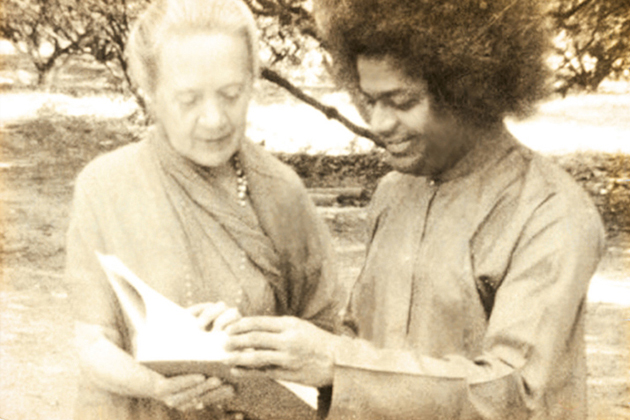
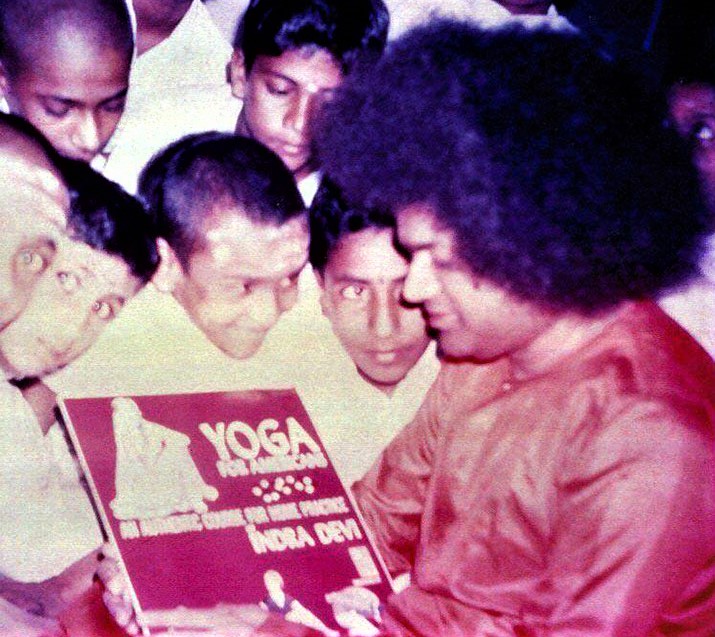
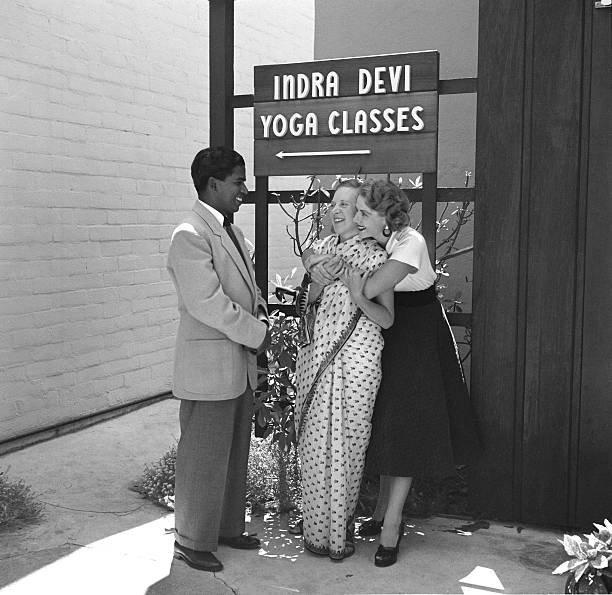
Light in Darkness.
Light meditation is a meditation technique that helps you connect with your inner spirit – your essence or core self. It uses the light that is already within you as an object of focus. It’s a fairly simple meditation, but is powerful and potentially very deep. As is clear in the article, the author, Indra Devi, chooses to consciously suppress her ego by using the letter “I” in the lower case when referring to herself.
The idea of starting a Meditation Crusade for “Light in Darkness” was born on the dark day of 22nd November, 1963, when President Kennedy was shot in Dallas, Texas. i happened to be there at that time. i was scheduled to be introduced to him to present my books on yoga and suggest that asanas [postures in yoga] and deep breathing exercises would enrich his physical fitness program and add to its efficacy.
At the shocking news of his assassination, i remained in my hotel room pondering as to what could be done to prevent or lessen crime that is so prevalent in many big cities in the United States. It seemed to me that we must all make an added effort for our immediate surroundings to become a happier and friendlier place to live in. I felt compelled to start a crusade by conducting meditations on the light in one’s own heart, and by teaching that it is a part of the eternal Divine light.
Photo of Sathya Sai Baba hoped it would lead people to realize that it is important to act, think, and live in a different manner. Sharing a kind word and a smile, treating all living creatures with compassion would make daily living so much more enjoyable and productive. Every evening after meditation, one should ask oneself, “What did i do today to make the light a little brighter and the darkness a little less dark?” This, i hoped, might bring an illuminating and practical message to the fear-ridden, mentally disturbed, and spiritually forlorn world of today.
To carry out this plan, i decided to dedicate the rest of my life to it and to give up teaching yoga, which i had been doing for the past 28 years when i had to leave India for Shanghai. There i opened the first yoga school, according to the wishes of my teacher Sri Krishnamacharya. I had been living for 12 years in Bombay, where i got married to a foreign diplomat. I am a Russian-born American citizen with an Indian name duly registered in my passport. My plans were noble but the only trouble was that i did not know how to go about starting the crusade. Conducting meditations at our Yoga Centre in Tecate on the border between California and Mexico and speaking to various people about my idea did not get me too far, in spite of every one’s interest and support.
Finally, i decided to start the crusade in my spiritual motherland, India. This seemed especially relevant after Clara Schuff, a clairvoyant in Los Angeles told me that i would be going to India shortly, where i would fulfil my destiny by taking the first step toward my life’s mission. She added that i would meet in India “an unusual Swami of a very high order who will play a prominent part in my life and help me convey a spiritual message to the world.”
Two months later, i was in India, and on March 4, 1966, i presented to the Prime Minister, the Perpetual Flame which we had carried all the way from Tecate. This gave me an opportunity to conduct meditations on light for hundreds and hundreds of people, both in Delhi and Bombay. I was scheduled to leave for Saigon after visiting my old friends, the Yuvarani of Mysore and Dr Sivakamu in Adyar, near Madras.
It was there that i first heard of Sai Baba from an Australian writer, Howard Murphet, and his wife Iris. They were very surprised that i did not know anything about the Sai Baba of Shirdi and His Avatar, Sri Sathya Sai Baba. They immediately showed me His photos and a ring with an image of the late Shirdi Sai Baba, produced by the present Sai Baba and told me many a story about His incredible and miraculous powers to which they were witnesses. However, my prior commitments in Saigon made it impossible for me to stay, and i subsequently left for Vietnam.
Shortly before my departure, my host, the Indian Consul General, suggested that i open a centre in India and offered to me his palace in Kathiawar (he is the Thakore Saheb of Kotda Sanghani). I seized this idea as an opportunity of returning to India – to look at his palace was only a pretext. So, i advised our Director, Mr. Candia, who was accompanying me, to return to Tecate, and he gladly agreed.
From Calcutta, i immediately headed for Madras instead of Kathiawar, as the desire to see Sai Baba became very intense. On the way to Puttaparthi (the village in Andhra Pradesh, India, where Sai Baba was born and has His ashram), we met another car from the same company returning from Prasanthi Nilayam [abode of peace, ashram in Puttaparthi] with Dr Sen, Vice-Chancellor of the Jadavpur University. We greeted each other, and upon learning that this was my first visit to Baba, Dr Sen warned, “You may never want to leave the place once you get there.” “But, you are doing so,” i answered, “i shall have to do the same.”
A charming Swiss school teacher, Gabriella Steyer, gently took me under her wing. My plane was departing the next day, and so i had to leave fairly soon. Baba was gracious enough to grant me an interview. To describe everything that happened during that hour would make a story in itself, and i may relate it at some other time. It will suffice to say that what i saw and heard made an indelible impression upon me—it was more than kindness, more than goodness, more than grace. It was something i could not even name. “Call me whenever you need me,” He said at parting. “I shall be with you.”
Happy to have come to see Him, i left for Bangalore the next morning, feeling fresh and rested. But soon i was seized by a feeling of great longing and i remembered Dr Sen’s phrase, “You may never want to leave the place once you get there.” This nostalgia dulled my senses. I didn’t care to speak to the driver, to distribute sweets to the children, or to feed the monkeys, dogs, and bullocks. In fact, i didn’t care for anything—all i wanted was to be back in the Nilayam and to listen to the powerful chant of Om [the primordial sound] coming from hundreds of throats and to lose myself in the beauty of the Sanskrit Suprabhatham (Morning Prayer).
Back in my room in the Bangalore Palace, i closed the suitcases without thinking, forgetting to pack the rest of my belongings—something that has never happened to me in all my travels. In Bombay, four other places were offered to me for establishing our centres, but my thoughts were still in Puttaparthi. The day before my departure, i wrote a letter to Sri Sathya Sai Baba saying how glad i was to have returned from Saigon to meet Him, but that i felt miserable now, which is foreign to my nature. I asked Him to help me to get over this feeling. That same afternoon, waiting for a taxi on a busy street corner with Enakshi Bhavnani, a long-time friend, i suddenly felt a stream of brilliant light pouring on me and giving me a tremendous sense of .joy. Happiness was filling my entire being. “Thank you, Baba,” i whispered in gratitude.
Carrying this radiant light within me, i left for Hong Kong to conduct meditations and address meetings, before i returned to Los Angeles and Tecate.
Now that i was ready to begin the Crusade for Light in Darkness in April, in San Diego, California, with the co-operation of its mayor, council of Churches and civic leaders, i knew i had to go to Puttaparthi to get blessings from Bhagavan. Without His help i did not want to undertake this mission of awakening the light in the hearts of people so that it may shine on now and for ever.
From the unreal to the real, from darkness to light, from death to immortality.
Om shanti, shanti, shanti (peace, peace, peace) ~ Indra Devi
Source: Sanathana Sarathi, March 1967.
Granddaughter of Indra Devi’s friend Ruth Taylor, Francesca Rheannon speaks with Michelle Goldberg about Indra Devi. Her biography is The Goddess Pose: The Audacious Life of Indra Devi, the Woman Who Helped Bring Yoga to the West.
From The Goddess Pose: The Audacious Life of Indra Devi, the Woman Who Helped Bring Yoga to the West author Michelle Goldberg writes Devi published her own book, Sai Baba and Sai Yoga (1975), which attempted to marry asana practice to Sai Baba devotion. The short volume is divided in half: first comes a hagiographic account of her miraculous encounters with the guru, and then instructions for assuming yoga poses, coupled with messages of spiritual uplift and suggestions for meditation. Sai Yoga, writes Devi, depended on learning the postures so well that one no longer needed to think about the position of the body while practicing them and could instead turn the mind toward the divine. As a Yoga Journal writer described Sai Yoga, “The main pose of each class includes an invocation, so that the fulcrum of each practice involves a meditation in the form of an ecumenical prayer.”
Devi began taking groups of Westerners to India to meet Sai Baba in 1968, and by 1975, nine years after her conversion, she’d made nineteen trips to see him. His followers often referred to her as Mataji, an honorific form of “Mother.” For ashram novices, traveling with her was the easiest way to get close to the guru. Baba was famously capricious and would keep some visitors waiting weeks for one of his coveted private audiences. His followers adored his playful unpredictability, seeing in it a divine whimsy characteristic of Indian gods, but for an impatient American with limited time, it was immensely frustrating. Those traveling with Devi, however, could usually be assured of meeting him. Indeed, at both Prasanthi Nilayam and Brindavan, Sai Baba’s summer residence in the Bangalore suburb of Whitefield, everyone with her would be treated like a VIP.
At the start of her first group visit, Baba sent beautiful new saris to the women in her party of thirteen, saying that the garments were easier to wear while sitting on the ground than Western dresses. Then, during the group’s audience, he produced for Devi a jap-mala (a sort of Indian rosary) made of pearls, which he said she could use to cure others. It was as if he were endowing her with some of his supernatural gifts. “The jap-mala created quite a stir in Prasanthi Nilayam,” Devi writes, obviously proud. Everywhere she went, people would ask to see it, then press it reverently to their faces. Some claimed that, afterward, their physical afflictions were lifted.
Sai Baba visited Devi’s group every day at their guesthouse, giving them private lectures on his reassuringly ecumenical religious philosophy. They must always avoid sectarianism and fanaticism, he said. All those who revere God, however they describe him, are brothers: “God is only one.”
“Returning to India from Vietnam, Devi first went to Adyar, where she got a letter of introduction from the Murphets. From there, she headed three hundred miles inland, to Mysore, where, courtesy of a princess named Rani Vijaya Devi, she was put up at the palace where she’d lived while studying with Krishnamacharya. Then, packing just enough for a few days, she hired a car for the bumpy two-hundred-mile drive to the ashram. The final hours of the trip were jarring, as the car jerked along a dirt track through barren, red-clay countryside, stopping whenever animals wandered in front of it. It was April, the height of summer in the region, when temperatures regularly climbed past one hundred degrees Fahrenheit. Finally, they arrived in the desiccated South Indian town where Sai Baba was born.
The ashram was on Puttaparthi’s outskirts and had become the center of its economy. On the dusty road to Prasanthi Nilayam’s main gate, makeshift stalls catered to a constant stream of pilgrims, offering photographs of Sai Baba and rings and buttons bearing his image. Dozens of women sat in the dirt peddling shriveled produce. Beggars, some with maimed or deformed children, put out their hands for alms. Inside the brick wall that enclosed the ashram, things were more orderly. Rows of coconut palms lined the path to a spacious, whitewashed prayer hall, built in a vaguely Mughal style. It was the center of ashram life, and Sai Baba lived above it.
Most Indian visitors camped out in enormous open tin-roof sheds, where up to two hundred people would sleep end to end on the floor and cook on small kerosene stoves. Westerners and upper-class Indians who were accustomed to greater comforts were put up in a spartan guesthouse, and that’s where Devi was assigned a room. There was a list of rules on the veranda. One of them forbade giving donations or gifts to Sai Baba, even customary offerings such as fruit or flowers. This was highly unusual for an Indian ashram, and it impressed Devi. Would a fraud refuse to let people give him money?
A young Swiss woman named Gabriella Steyer, one of Sai Baba’s earliest Western acolytes, met Devi and showed her around. They visited the small hospital, the only one for miles, which was built by Baba’s devotees and offered care for free. Though there were two doctors on staff, Baba was said to intervene in cases where medical treatment wasn’t enough, and the ashram buzzed with stories of remarkable, inexplicable cures.
Steyer took Devi to the Veda-Shastra School, where boys studied religious texts, learning to chant the Vedas by heart, a project that could take twenty years. Tuition was free, said Steyer, and Baba gave students food, lodging, and clothes. There was a small press that produced a monthly ashram magazine in English and Telugu, the local language, as well as a post office, a bank, a police station, and a canteen staffed by volunteers.
Back in Devi’s room, Steyer regaled her with stories of Baba’s miracles. She recalled a holiday when Baba led the ashramites to a river outside the village and, after drawing on the sand with his finger, reached in and pulled out a silver idol, a chalice, and a spoon. He then squeezed heavenly nectar out of his closed fist, filling the chalice with it, and giving each of his devotees a delicious spoonful. Each time it ran out, he tapped the chalice to fill it again.
Devi was not yet convinced, but she was eager to meet the man said to work such wonders. Finally, Steyer took her to the prayer hall, where Baba was speaking privately with some of his devotees in a room set apart for such meetings. A side door opened to let some people out, and Devi got her first sight of the guru.
Draped in a saffron-colored robe, he was slight despite his full face and more handsome than she expected—he looked hardly at all like the coarse-featured man in the Murphets’ photograph. His bristly hair seemed to form a black halo around his head, and he appeared divinely gentle, glowing with compassion. He said a few words in Telugu and disappeared. Someone translated: “No more interviews—it is too late.” A few minutes later, though, Baba appeared on the balcony outside his apartment, surveying the crowd below. His eyes met Devi’s, and she felt sure he was going to summon her. Her heart started pounding. Sure enough, in what felt like an instant, he was standing in front of her, beckoning her into the room where he held his private audiences. As she walked toward him, she felt as if she were floating.
Steyer and a few other women, who had also been invited, had to hold her up. Sai Baba had an armchair in the room, but he took a seat opposite Devi on the floor. She told him she didn’t know why she was there—she’d heard his name for the first time only a few weeks before, and she didn’t need anything from him. “It was in Saigon that suddenly I was overcome by a desire to see you,” she said. He asked her where she was from, and she showed him a picture of Rancho Cuchuma. “You must come there, Swamiji—it is a beautiful place,” she said. He took her hand and promised that he would, repeating it three times.
Then, looking at the sleeve where she kept the photo, he noticed that she also had a picture of Swami Vivekananda. She told him that she believed Vivekananda was her protector and guardian angel and that he must have guided her steps to Prasanthi Nilayam. “You would not be here otherwise,” he said. As they parted, he asked her, “What do you want?” She had been told to expect the question. “Jyoti,” she replied. “Light. Light in my heart.” “You have it,” he said. “Not enough.” “Bangaru, bangaru,” he said, a Telugu endearment. He told her he was going to give her something to keep with her during meditation. Turning his palm down, he made a circling motion. When he flipped his hand over, he held a little enamel image of himself, which he put into her hand. She was astonished and didn’t doubt the authenticity of what she had witnessed. “Wait,” he said. “Let me also give you some vibhuti.”
That was the name for the sacred ash that was Baba’s signature, a substance that linked him in some mysterious way to Shirdi Sai Baba and his ever-burning fire. Devi writes that he poured the vibhuti from his fingertips until it covered the image in her hand. Then he took the icon and the ash and wrapped it in a piece of paper. “Call me whenever you need me, I shall hear you no matter what the distance,” he told her. “I am yours.”
She was overwhelmed, dazed, and ecstatic. Sai Baba had a way of making the world seem enchanted, as if the magic that filled ancient religious books could also pervade modern life. Devi had never stopped hungering for such rapture, even if she’d stopped actively seeking it after Krishnamurti. Now here she was at sixty-seven, as filled with spiritual excitement as she was in Ommen forty years earlier.
At five o’clock the next morning, Devi joined hundreds of other devotees to await darshan, the ritual in which Sai Baba allowed his acolytes to gaze upon him and feel the blessing of his presence. Life in the ashram, she quickly discovered, revolved around darshan—Bill Aitken, one of Baba’s biographers, calls it the “both the central communion and the theology of the movement.”
As she walked toward the temple, the echoing sound of “Om” floated toward her from devotees who had already assembled. Two hours passed, anticipation mounting. Then, finally, Sai Baba appeared outside his apartment on the second-story balcony and raised his hand in benediction. In the audience, a few lucky ones felt his eyes meet theirs, and bliss surged through them. Hope for such a moment was part of what kept them coming back, morning after morning, for the same wait and the same brief appearance. “Away from Sai’s presence,” writes Aitken, “our imperfection is almost too painful to behold, hence the provision of photographs, medallions and other seemingly trivial mementos of Sai Baba . . . hence, too, the discipline of sitting long hours in Puttaparthi, building up the longing of the heart for its moment of re-contact with the divine.”
Devi couldn’t return the next morning—she’d planned on staying only a couple of days, and she had to begin her journey home, but she felt changed by her short time in Sai Baba’s orbit. Back at the Mysore Palace, she absentmindedly packed her things, forgetting many of them in the drawers. From there, she went to Bombay, where she stayed with Enakshi Bhavnani, another old friend from the Theosophical Society. As she prepared to go back to Tecate, she found herself growing despondent, just as she had when she left India after her rapturous first visit. It had been many years since she’d felt that way, and it unnerved her. How could she return home and lecture about the transcendent peace to be found in yoga when she herself was unhappy and unsettled? She began writing Sai Baba a letter asking for his help, and then put it in her handbag while she and Bhavnani went shopping.
Suddenly, she writes, while the two of them stood on a street corner waiting for a taxi, her sadness disappeared and she felt a flood of inexpressible joy, as if a “cascade of brilliant light” were pouring over her. Convinced that Sai Baba had answered her letter before she even finished writing it, she was flooded by the same sort of bliss she’d once experienced after meeting Krishnamurti, but this time, she’d found a guru who accepted the role.
Almost as soon as she got home, Devi started making plans to return to Prasanthi Nilayam. Howard Murphet recommended that she go for the Maha Shivarathri festival, a great all-night celebration of Shiva and a holiday when Sai Baba was known to perform public miracles. The festival is held during the dark night of the new moon in the middle of the Indian month of Magha, which in 1967 fell in early March.
Devi arranged to arrive a month before. At the ashram, she heard new stories almost every day about Sai Baba’s miracles. Most devotees believed that the guru spoke to them in their dreams, and so they eagerly discussed and analyzed their visions of the night before, looking for divine direction. Devi heard miraculous tales of healing and clairvoyance.
The Maharani of Jind came to her room one day bubbling with excitement to tell her that Sai Baba had given her daughter, who was engaged to be married, a necklace of diamonds and pearls. “You have no father, so I am taking his place and giving you something befitting your status as a princess,” he told the maharani’s daughter. A pearl fell off the necklace, but this didn’t lead anyone to question the piece’s value. Instead, Devi recalled the story of a man who started wondering about the monetary worth of a gold medallion Sai Baba had given him. As a result of his greed, the medallion vanished from its box. Then, when the man fell to his knees and begged for forgiveness, Baba returned it. The missing pearl was likewise taken as one of Sai Baba’s playful reminders to his devotees about what truly mattered.
As the festival of Shivarathri approached, more and more people arrived at the ashram. The sheds filled up quickly, so newcomers slept under trees. When there were no more spots near the trees, they unfurled their bedrolls in the open air. By the day of the festival, around thirty thousand people had crammed into Prasanthi Nilayam.
That morning, Sai Baba hoisted the ashram’s flag over the temple, telling the ashramites to hoist the flag of love in their hearts. “Practice Yoga, or the mastery of the mind,” he said. “Then the lotus of the heart will bloom, and illumination be attained.” He spoke of the significance of Shivarathri. The waning of the moon was associated with the waning of the mind, whose constant restless whirling and unending cacophony of desires obscured the apprehension of God.
Shiva, destroyer of illusions, revealed to man his true, sacred nature. The day devoted to him was a uniquely auspicious occasion for progress toward spiritual liberation. It was a day of fasting, to abstain not just from food but from negative words, deeds, and thoughts.
Later that morning, the crowd assembled in and around one of the pilgrim sheds, which had been converted into an auditorium. On the stage, a silver statue of Sai Baba of Shirdi was placed on an urn shaped like a serpent. Sathya Sai Baba walked out to perform a ceremonial bath. First he materialized a statue of Ganesh, Shiva’s elephant-headed son, and placed it on the silver statue’s head. Then, as the crowd sang bhajans, Sai Baba held up a small vase and poured vibhuti over the idols. The ash kept flowing, far more than such a vessel could seemingly hold. There seemed to be pearls and precious stones intermixed with it, filling the serpentine urn. Devi felt herself falling into a trance, losing all sense of what was going on around her. When she opened her eyes, the ritual was over and the auditorium was nearly empty.
Shivarathri’s miracles had barely begun. At the ashram, the most exciting part of the holiday was the ecstatic all-night vigil that reached its apotheosis when Sai Baba produced lingams, the phallic oval objects that symbolize Shiva. This, more than anything else, was what Devi and thirty thousand others had longed to witness.
By the time evening approached, every inch of space at the ashram was occupied by yearning devotees. Walking around was nearly impossible. All eyes turned toward the Shanti Vedika, the ashram’s elevated rotunda, bathed in bright lights, where the night’s mysteries would unfold.
People camped out for hours to be close to it, but as a foreigner, Devi would have been escorted to a privileged VIP area nearby. At around 6: 00 p.m., Sai Baba took the stage with a group of disciples. He spoke in Telugu about the meaning of the lingam as a symbol of God. He led the crowd in bhajans, whose delivery grew faster and more rapturous as the hours went on. Then he began to cough. He’d start to sing again, and then would stop, struggling. He appeared to be in pain. The crowd knew what was happening, since it proceeded this way every year. Over and over, they repeated the last line Baba had uttered, an urgent prayer. His agony seemed to mount until, finally, he held a white towel under his chin and the first lingam came out of his mouth and dropped onto it.
Baba was known to produce lingams made of all sorts of precious materials. This one, egg-shaped and four inches long, was the color of amethyst. The crowd’s singing became ecstatic. A second, smaller lingam of the same color emerged from Sai Baba’s mouth. He left the stage, and the lingams were placed on a flower-covered tray. The singing continued till dawn.
In the morning, Devi volunteered to help serve the food that was distributed to break the fast. She wondered how the ashram’s little kitchen could prepare meals for so many thousands of people and was told that the dishes multiplied at Sai Baba’s touch. “Why are you so surprised?” asked one young man. “Didn’t Christ feed a multitude with five loaves of bread and two fish?” Over the following days, Devi was thrilled to find herself pulled into this Christ-like figure’s inner circle.
Shortly after the Shivarathri festival, Sai Baba was due to travel to Bombay with a group of boys from the ashram school who were going to perform a musical about the life of Krishna. He asked Devi to come along. The caravan stopped for lunch in the village of Hampi, set amid the ruins of an ancient capital and dominated by an ornate, pyramid-shaped Shiva temple.
Narayana Kasturi, Sai Baba’s official biographer, describes how much fun the guru had showing the boys around: “He caressed them lovingly like a mother and attended to the demands of their curiosity and wonder about the areas through which they passed.”
In Bombay, they stayed in a large, old colonial bungalow on the city’s outskirts. Sai Baba’s fame was spreading, and every morning, thousands of devotees gathered outside to sing bhajans, overflowing the lawn and crowding the streets outside. At 9:00 a.m., the avatar would emerge to wander among the throng, blessing household objects, accepting beseeching letters, or simply letting people touch his feet and experience his darshan. The boys performed their play, written by Baba, for an eminent audience that included the governor of Maharashtra, the enormous state that had Bombay (now Mumbai) as its capital.
Sai Baba addressed teeming crowds in city stadiums. An elderly man named Ramakrishna Rao, a hero of the independence movement and the onetime governor of Uttar Pradesh, one of India’s largest states, stood beside him, interpreting from Telugu into Hindi. Like Vivekananda, Sai Baba spoke of India as a light unto the world: “The greed and selfishness that are infecting this country are tragedies for humanity, for India has the role of guiding and leading mankind to the goal of self-realization.”
For Devi, the week in Bombay was like a “fairy tale,” each day suffused with whimsical magic. One day, as she sat on the bungalow’s veranda, Sai Baba came out followed by a local Bombay politician. He was trying to fit onto his finger a ring that Baba had given him, but it was too tight. Sai Baba took the ring, put it in his palm, and blew on it, and when he handed it back, not only did it fit, but it was now adorned with precious stones. Devi was amazed. “That is nothing,” another devotee told her. “I have seen him return sight to a blind man by just blowing into his eyes.”
Devi was flying home from Bombay, and on the morning of her departure, Baba lit a temple lamp for her Crusade for Light in Darkness and gave her a silver medallion bearing his image. “Be happy,” he told her. Happy didn’t begin to describe it.”
American author Opal Macrae (nee Wheeler) 10th September 1966 Prasanthi Nilayam
From Sanathana Sarathi magazine January 1966
Prasanthi Nilayam News September 10 Arrival at the Nilayam of Mrs. Macrae from New York, via Hong Kong.
From Sathyam Sivam Sundaram – Part II by N. Kasturi
The Hospital Day Celebrations in October 1966, were presided over by Opal Macrae, a famous writer and social worker from United States who had come to the Nilayam for her Sadhana. She spoke of her attempts to cure insanity, feeblemindedness and other defects by the therapy of music in New York and Hongkong. Baba said, “Music is the instrument by which passions are sublimated, emotions tamed, and impulses directed to higher purposes. India has recognized the therapeutic excellence of music long, long ago.” Baba declared that medicine and hospitalisation are for those who hesitate and argue in doubt. For those who rely on the Supreme Doctor, His Name is drug enough.
From Sanathana Sarathi magazine January 1966
Prasanthi Nilayam News Programme For Dasara October 15 8 A. M. Hoisting of the Prasanthi flag. 5 P. M. Festival of the Tenth Anniversary of the Sri Sathya Sai Hospital. President: Mrs. Opal Macrae of New York.
From the article Shivaratri of the yesteryears – During Shivaratri celebrations in 1967 in Bombay, Sai Baba placed in his hands the book The divine heritage of Prasanthi Nilayam: Excerpts from the writings of Bhagavan Sri Sathya Sai Baba selected and arranged by Opal Macrae of New York, who originally published it.
Publisher John Macrae was married on September 20, 1893, to Katharine Green of Virginia, by whom he had two sons: John (1898) and Elliott Beach (1900), both of whom joined his firm (E. P. Dutton & Co) in 1922. In the early years in New York, the Macraes lived on Staten Island; later they moved to Manhattan’s Gracie Square. Macrae’s first wife died in 1913, and on September 5, 1939, he married Opal Wheeler of Beverly Hills, California, the director of Miss Yates’s School in New York City and coauthor of several children’s books published by Dutton.
From Time Magazine – September 18, 1939, in the Milestones section;
Married. John Macrae, 72, longtime president of E. P. Dutton & Co. (books), famed for his white whiskers, pink shirts, and garrulous letters to the trade; and comely Opal Wheeler, fortyish, musicologist and schoolmistress; he for the second time, she for the first time; in Rosebank, Staten Island.
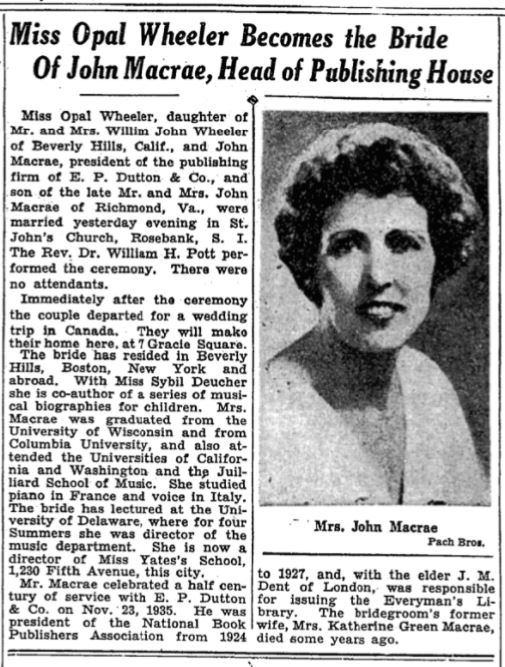
Americans Mr and Mrs Margolis 28th October 1966 Prasanthi Nilayam
From Sanathana Sarathi magazine October 1966
Prasanthi Nilayam News October 28 Arrival of Mr. and Mrs. Margolis from USA
Canadian Mrs. Jasmin 10th November Prasanthi Nilayam
From Sanathana Sarathi magazine November 1966
Prasanthi Nilayam News November 10 Arrival of Mrs. Jasmin from Canada
French Miss Gena Letang 13th November 1966
From Sanathana Sarathi magazine November 1966
Prasanthi Nilayam News November 13 Arrival of Miss Gena Letang from France, via Hong Kong.
American Jaclyn Garon 1966 Prasanthi Nilayam
From Sanathana Sarathi magazine 1967
Sri Sathya Sai Sathsangh Samachar – Pacific Palisades: (California, USA): Janurary 18: The members of the Sri Sathya Sai Baba group were addressed by Jaclyn Garon, on the “Wonder and joy” of Prasanthi Nilayam which she had visited recently.
Greek Constantine Letnis 23rd January 1967 Prasanthi Nilayam
From Sanathana Sarathi magazine 1967
Sri Sathya Sai Sathsangh Samachar – Constantine Letnis, a Sadhaka from Greece arrived at the Nilayam for a short stay.
Julie Taylor and George Reid 29th January 1967 Prasanthi Nilayam
From Sanathana Sarathi magazine 1967
Sri Sathya Sai Sathsangh Samachar – Hong Kong: January 29: Julie Taylor, Associate Editor, ‘Hong Kong Standard’ and George Reid, Yoga Sadhakas from Hong Kong arrived at the Nilayam.
American yogini Judith Tyberg 1967
American yogini Judith Tyberg visits Sathya Sai Baba in 1967. Judith, along with Charles and Faith Penn they edited a biography, covering the years 1968 to 1971, of Sathya Sai Baba called Sathyam Sivam Sundaram Part III by N. Kasturi.
From Sathyam Sivam Sundaram – Part II by N. Kasturi
Baba reached Prasanthi Nilayam from Brindavan, Whitefield, on the third day of July; the Murphets accompanied Him thither, drawn by the Love that He showered on them. Howard Murphet spoke on Baba at the Prasanthi Nilayam on the 21st and on the 23rd. Dr Judith (Jyothi- priya) Tybarg of the East-West Cultural Center, Los Angeles addressed the residents; she had a long talk with Baba, during which she asked Baba, whether movie films of His miracles can be taken and shown, to convince people of their authenticity. Baba replied that doubts would still persist. It is only by strengthening one’s own faith, by clearing the doubts in one’s own mind, that one can convince others. “Faith travels from one mind to another.” Baba then created some sweets for the group, demonstrating that He had nothing in His hand or up His sleeve. They came, through His “Sankalpa, Resolve.” They were not in the hand, but, “in the head,” He said. He revealed Himself thus to Dr. Judith, for, she was an earnest Sadhaka, soaked in devotion and scholarship. Her arthritis had been miraculously mitigated by Baba, who sent a few packets of Vibhuthi for her use through a person who returned to the U.S.A. from His Presence. He told her, “I am in all hearts. I am one with all. But, yet I never share their pain or their joy. I never experience sorrow or anger. I am Anandaswarupa (embodiment of bliss) and Premaswarupa (embodiment of Love).” No wonder that Maharshi Mahesh Yogi, the chief proponent of transcendental meditation, the holy man who has cast a powerful spell over the youth of the West, (“We who are tired of dead and decayed Western Culture will follow His Holiness, our Master, to the grave,” say, the hippies to him) wanted that Baba should bless the leaders of the youth of the world who are training themselves at Sankaracharya Nagar, Hrishikesh, to become the guides of Youth!
From Sanathana Sarathi magazine 1967
Sri Sathya Sai Satsang Samachar – July 24: Prasanthi Nilayam: Speeches: Dr. Judith Tiberg and Prof. V. K Gokak. Discourse by Baba.
From Sathyam Sivam Sundaram – Part III by N. Kasturi
Dr Judith M. Tyberg of the East West Cultural Centre, Los Angeles, writes, “It is now almost three years that I was in Puttaparthi, and had the Divine Blessings of Sri Sathya Sai Baba. His help to me on all planes of being is still evident, and I am very grateful.”
Judith Tyberg (1902–1980) was an American yogi (“Jyotipriya”) and a renowned Sanskrit scholar and orientalist. Author of The Language of the Gods and two other reputed texts on Sanskrit, she was the founder and guiding spirit of the East-West Cultural Centre in Los Angeles, California, a major pioneering door through which now-celebrated Indian yogis and spiritual teachers of many Eastern and mystical traditions were first introduced to America and the West.
Many eminent Indians, political leaders and yoga masters alike, were impressed with Tyberg’s scholarship and her feeling for Indian culture: Mahatma Gandhi, Maulana Azad, V. K. Gokak, B. L. Atreya, Anandamayi Ma, Ramana Maharshi, Sri Ramdas, and Krishna Prem, and at the Sri Aurobindo Ashram: Kapali Shastri, Indra Sen, Sisir Mitra, Prithvi Singh, and former freedom fighters-turned-yogis Nolini Kanta Gupta and A.B. Purani, friends she referred to as “the cream of Hindu culture.” Tyberg spent a week with the sage Ramana Maharshi at his Arunachala ashram where he told her “You’re already realized, you just don’t know it.” Another lifelong friend was Swami Sivananda alongside whom Tyberg served as India’s representative to the 1948 World University Round Table. Tyberg was the first President of the International Students Union, founded by S. Radhakrishnan, who called her “a real force in international understanding.” Professor T.R.V. Murti declared “I am convinced that you are destined to play an important role in bringing the West and the East together on a spiritual plane.”
In Autumn 1949, Tyberg went back to Pondicherry for a six-month stay as a disciple at the Sri Aurobindo Ashram. During her two years in India, Tyberg had kept up regular correspondence with an extensive network of American seekers. When certain people criticized this as unyogic, Tyberg asked The Mother for her view. Her reply was “How do you think the Divine works if he doesn’t work through people like you?” and she repeated what she’d told Tyberg at their very first meeting: “You have chosen it, to serve, long ago.” After a final reverence to Sri Aurobindo on February 21, 1950, Tyberg recorded her impressions: “Vast deep calm with a mighty wisdom … his consciousness seemed infinite … such currents!”https://ashramsofindia.com/judith-tyberg-jyotipriya/embed/#?secret=jy1mtyM1YK#?secret=es2IC2YaKY
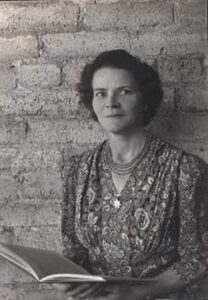
American Annalisa Rajagopal (nee Beghe) 1968 Prasanthi Nilayam
Annalisa Rajagopal (nee Beghe, December 21, 1922 – March 29, 1996) is one Sathya Sai Baba’s first Western devotees, she lived on the ashram in 1968.
Annalisa married Rajagopalacharya Desikacharya (commonly known as D. Rajagopal) who was an early associate of Jiddu Krishnamurti, and for decades edited Krishnamurti’s teachings and helped manage his foundation.
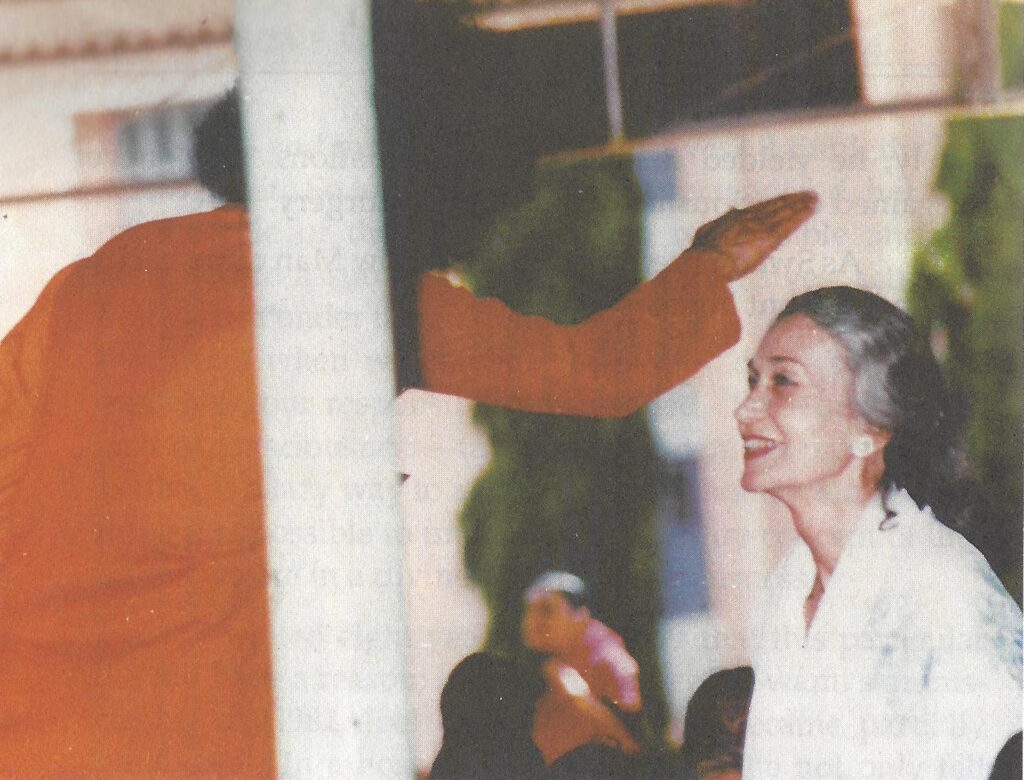
Her daughter Diana Baskin writes of this moment when the photo was taken in her 1990 book Divine Memories of Sathya Sai Baba “For about two years, at the conclusion of the puja to the lingam, my mother would pray for the welfare of the world. At the very end of the prayer, she would ask Swami to bless her and her family: Raja, Diana, Robert, Christina and David, in that order.
At darshan in Brindavan, as soon as she arrived, Swami greeted her, then put his hand on her head and said something she did not understand. He repeated the gesture a few times. Each time he would lightly touch her head and say; “I bless…” (The remainder of the long statement was not discernible to Mother). Since the procedure was most unusual and took quite a bit of time, my mother was perplexed by the length of the blessing, and wondered what the words were that she could not grasp. After some thought, she concluded it was simply a unique greeting.
The next day at darshan, Swami repeated the whole procedure He put his hand on her head a few times and again said words she could not understand. A very unique blessing indeed! She was certain now that it had great significance, but what?
On the following day, Swami came over to her at darshan and put his hand on her head once again, and it was obvious he intended to repeat the procedure, but there was a difference. This time she heard every word. Touching her head with his hand six times, he said; “I bless you, I bless Raja, I bless Diana, I bless Robert, I bless Christina, I bless David.” In that moment she understood Swami was repeating the names in exact order that she said them in her daily prayer. He was acknowledging and fulfilling her prayer! A joyous thrill swept over her and a realisation of complete happiness came over her face.
American John Hislop January 1968 Prasanthi Nilayam
The first visit of Dr John (Jack) Hislop (1904-1995) to Sathya Sai Baba was in January 1968, after being told of the guru of Puttaparthi by Diana Baskin’s mother, Mrs Annalisa Rajagopalacharya. He taped two deeply spiritual conversations with Baba who, he immediately felt, was the true source of wisdom. At that time there were only a few foreigners in Puttaparthi and Hislop was especially privileged to have daily meetings with Sathya Sai Baba and receive visits from him, lasting up to two hours per day (My Baba and I, p.15). The results of these long conversations (mainly question and answer sessions) were later published in California (in 1978) as Conversations with Sathya Sai Baba, a book which offered many invaluable insights into Baba’s teachings and revealed to foreign devotees and others his opinions on many topics. As a result of many further visits and periods of residence in the ashram, Dr Hislop later wrote My Baba and I, which, like the first book, has been instrumental in the US and around the world in increasing knowledge about Sathya Sai Baba and drawing devotees to him (especially foreigners).
Jack and his wife Magdalena were prominent devotees.
From Sathyam Sivam Sundaram – Part III by N. Kasturi
John Hislop’s wife Magdalena was drawn towards Sai Baba quite early in her life. Baba had to appear in Havana, Cuba, years ago, concretely before her, to imprint on the immaculate mind of the child, just a year old, the shining splendor. She was just learning to walk, says Hislop, when she saw the Sai Baba of Shirdi (Baba assumes that form too to bless and confer grace) standing in the corner of the garden! She started to toddle towards Him, saying, ‘Dada! Dada!’; then, confused, she stopped. For her real daddy was standing at the entrance to the house. “Wonder of Wonders,” Hislop writes, “last year while we were in India, Baba confirmed to Magdalena her experience was a fact; He described the costume He wore then and how He was standing in the corner of that garden, 35 years previously!”
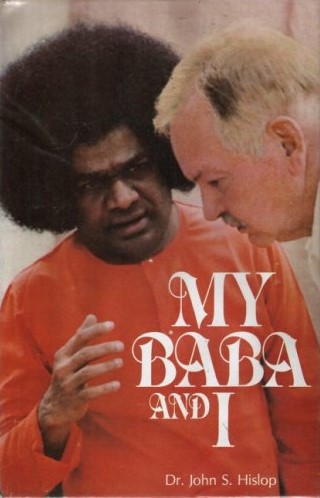
Australian born American pilot, Charles Penn midnight 9th May 1968 Bombay
Australian born American pilot, Charles Penn first meets Sathya Sai Baba in Bombay, midnight May 9, 1968 after first having heard of him in June 1965 when he read Sathyam Sivam Sundaram by N. Kasturi. “Touching that book Sathyam Sivam Sundaram, was for me like touching the fingers of God’s outstretched hand. That momentary action changed my entire future.”
Together with Faith, who he married in 1970 with Sai Baba’s blessings, visited many times over the years.
Polish Ramana Maharshi devotee Lucia Osborne May 1968 Prasanthi Nilayam
From The Hagiographer and the Avatar (2021) by Antonio Rigopoulos
As the call for a world conference indicates, by 1968 Westerners had begun to be increasingly attracted to the ashram of the guru of Puttaparthi.
For the first time, the Sathya Sai Organization welcomed foreign delegates from all over the world – Ceylon, 2 Singapore, the Philippines, Kuwait, Dubai, Casablanca, Mombasa, Nairobi, Kampala, Hong Kong, Fiji, Tehran, Tokyo, the West Indies, Peru, Brazil, and the United States and Kasturi remarks that among them were Indra Devi and Charles Penn, who was to be the editor of the American edition of Sathyam Sivam Sundaram. He also mentions the presence of Lucia Osborne (1904 – 1987), the Polish- born wife of Arthur Osborne (1906 – 1970) who in 1957 authored a biography of the saint of Shirdi titled The Incredible Sai Baba, which for the first time made him accessible to the Western public.
From Sathyam Sivam Sundaram – Part III by N. Kasturi
Mrs. Osborne addressed the gathering in English. She was introduced as the wife of the author of the book ‘Incredible Sai Baba’ written about the previous incarnation of the Inexplicable Sai Baba now with us!
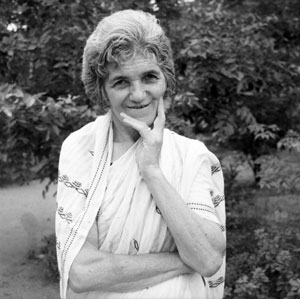
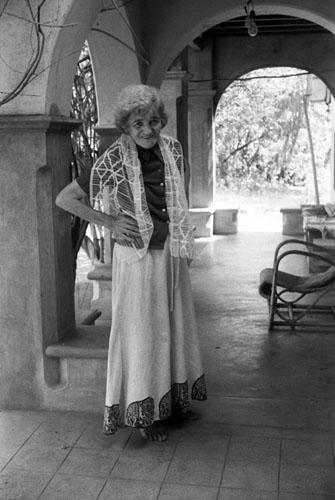
The photo is from New Lives: 54 Interviews with Westerners on their search for spiritual fulfilment in India Compiled, Edited and Mainly Photographed by Malcolm Tillis. Although the 54 Interviews were recorded in India as far back as 1980 – 81, the ageless life-enhancing spiritual wisdom which was discussed and explored (the purpose behind collecting the Interviews) is even more appropriate today. A small selection of 21 interviews was first published in book form under the title Turning East in New York in 1989. A fuller selection of 50 was printed in Varanasi, India in 2004 by Indica Books under the collection’s original title, New Lives.
Americans Walter and Elsie Cowan 1968
A friend who had been to the East West Cultural Centre, gave Elsie a book about Sai Baba. That evening, Elsie intuitively felt he, Sathya Sai Baba was the one who had returned her to her body the previous evening when she was unable to do so while travelling around the “inner planes of consciousness.” Elsie and Walter then made a quick secret trip to see Sai Baba in India.
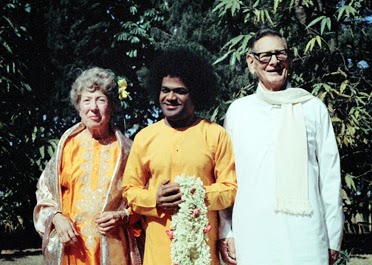
https://www.youtube.com/embed/bJYgXXvRSec?feature=oembedThe Cowan’s speak of their unusual experience with Sathya Sai Baba at 09:38 in this 1975 film Man of Miracles by Don C. Como.
Hosted by Rod Serling. You are about to witness the apparently spontaneous manifestation of objects from thin air or, perhaps, another dimension. This particular phenomenon is only one among many attributed by his followers to a man of extraordinary mystical powers, an Indian mystic and guru known throughout the world as Sathya Sai Baba. Some of the psychic powers reported by his followers are the ability to read minds and see into the future, to cure disease by miraculous means, to project his astral body anywhere in the world and to adopt other forms, both human and animal. In this film you will witness events which may be unbelievable. However, try to keep an open mind, for some of this man’s feats have been captured on film, and you will see them now as they actually happened.
Americans Mr and Mrs Anderson on Baba’s 43rd birthday celebrations in November 1968 Prasanthi Nilayam
From Sathyam Sivam Sundaram – Part III by N. Kasturi
While Indra Devi was placing a few drops of oil on His Hair with a flower dipped in the cup I was holding, Baba saw a certain Mrs. Anderson who had come from the United States. She was a chronic invalid, unable to walk or use her lower limbs, being helped around by her husband in a wheeled chair. As soon as she came to Prasanthi Nilayam, she was admitted to the Hospital so that she could be nursed there by professional hands. Baba presented her, and all other ladies from beyond the seas, saris on the 22nd, so that they could wear them on His Birthday; He deputed some ladies to help this one to wrap it around her. On the 23rd, she was brought down from the Hospital hill and allowed to watch the function from the far end of the dais, where she sat on her inevitable wheel chair, which had become more or less a part of her anatomy!
Baba turned to me and said, “That lady in the wheelchair will be happy if you take the cup to her, and get a flower dipped by her in the oil, which can later be placed on My Head.” I was thrilled by His compassion but, there was more to follow.
Before I could turn to the left and proceed towards her (the distance from the silver chair of Baba to her wheelchair was over 40 feet), Baba stopped me and said, “Wait! I shall Myself go to her!” People were astonished when they saw Baba descend from the chair and proceed towards the invalid lady, with me holding the oil cup. Baba bent His Head before her, so that she could place a few drops of oil on His halo of glorious hair! The gathering was overwhelmed with grateful joy, when they saw this spontaneous flood of Divine Mercy, and the happy glow of ecstasy on the pale face of a foreign invalid! She applied the flower three times. The third time Baba held her hand, saying, “Stand Up” … and she stood!
The gathering was amazed with delight! “Come with me!” Baba said. And she walked the forty feet, towards the silver chair, keeping pace with Baba! I was so overcome with joy that I ran towards the mike and announced to the entranced gathering that Mrs. Anderson, who had not walked for years, was cured of her illness, and that she has risen from her wheeled chair at the bidding of Baba and got her limbs back in perfect condition. Every one was thrilled by this miracle of healing. “Normal feet” was the Birthday Gift she received from Baba.
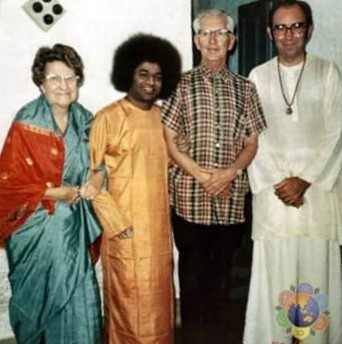
American Richard Bock on Baba’s 43rd birthday celebrations in November 1968 Prasanthi Nilayam
Richard Bock joined Indra Devi in India for Baba’s forty-third birthday in November 1968, and returned with eight millimetre film and the recordings of Baba which became the LP entitled, Sathya Sai Baba Chants the Bhajans.
Richard Bock was the Founder-President of Pacific Jazz and World Pacific Records. Through a long personal and professional relationship with Pandit Ravi Shankar, the world renowned sitar maestro, Mr. Bock was instrumental in introducing classical Indian music to large audiences in the West. He has produced several films on Sathya Sai Baba.
This article by Richard Bock was originally featured in Golden Age, a compilation of devotees’ experiences, and published in 1980.
Modern technology has made it possible for the voice and likeness of Bhagavan Sri Sathya Sai Baba to be spread over the face of the earth through films, photos and tape cassettes. For those outside of India and, indeed, many within India as well, the first memory of contact with Bhagavan has been a photo or film. This was my experience also.
In early 1968, after some years of practicing meditation and reading philosophy, I began to ask seriously to be shown who my true guru was. A few weeks later Ravi Shankar, the renowned musician who recorded for my company, World Pacific Records, and was and is a very close friend, mentioned the name Sathya Sai Baba to me.
Shortly afterwards Mataji Indra Devi played a tape recording of Baba singing bhajans and showed me a film she had brought from India. I was fascinated by the sound of Baba’s voice and asked if she thought it would be possible for me to get permission to make a recording of Baba in India.
A few weeks later I saw another friend named Ivan Markov, a hatha yoga teacher, who asked me to read a manuscript he had just finished. It was a biography of Baba, the first written in the West, but never published.
At that time (1960s) only a handful of people in the United States even knew of Baba and books and photos of him were unknown there. So it seemed extraordinary that within such a short time after asking the question, I had heard his name, listened to His voice, seen Him on film, and read His life story.
Now I was eager to see Baba in person. Having received permission to bring my recording equipment, I flew to India in mid-November of 1968 to record Bhagavan’s bhajans at the Birthday celebrations. During a brief stop-over in Tokyo, casually, and without any indication of its future role in my life, I bought a Super-8 movie camera and a few rolls of film.
I arrived at the ashram and soon was standing at the edge of the crowd waiting for my first darshan. Baba appeared on the verandah of the mandir. A path of flowers had been carefully laid for him to walk from the mandir to the auditorium and devotees were crowding on either side of it.
Baba looked in my direction and motioned for me to come out of the crowd with my camera.
Following His direction, I soon found myself preceding Him along the flower strewn path, walking backwards and filming as He walked through the crowd.
Mr. Kasturi was holding aloft the ceremonial umbrella, and Baba’s mother followed just behind. My field vision, circumscribed by the camera’s view-finder, was filled with the enlarged image of Baba’s smiling face as he turned from side to side acknowledging the crowds who strained towards him with out-stretched hands.
Earlier that day I had set up recording equipment on the auditorium stage where Baba was to speak. When he arrived he took a garland of flowers and wrapped it around one of my microphones, as if to reassure me that I had his permission and everything would be OK.
After speaking, Baba sang bhajans for almost forty-five minutes. That tape became the first long playing record of His bhajans released in India and the West.
In retrospect, I can see how those moments with Baba signalled a turning point for me, the beginning of the process of acquiring faith and developing the discrimination which has led me to follow Baba’s beckoning hand out of the chaotic world of corporate business which at that point had already caused me to suffer one heart attack.
Actually, it was immediately after the heart attack that I made the journey to Him. By the time I got to the Ashram, I was feeling fine. I couldn’t believe that I’d ever been sick. I had my interview with Baba and he materialised some Vibhuti for me, opened my shirt and put it on my chest. I hadn’t told Him anything, but the next thing He said was that my heart was not damaged. (I had the attack in September and I was in India in November). “Good heart, don’t worry. Why fear when I am here?” Then He materialised a ring and said, “Wear this, I will always be with you.” I had a likeness of Baba in it. That gave me a connection with him and it started to change my life.
It is a practice in the world to attach names and credits to the results of efforts of individuals, as though they were the creators, rather than the Lord working through them. The fallacy of this practice is never more apparent than when we complete a project knowing that the inspiration, the energy and the results are all His. The only thing to do then is to pray that the instrument has not distorted the melody and message He wishes to convey.
It was so natural that I didn’t even have time to be shocked about it. I had heard that he did this. In fact, it was one of the things that kind of concerned me. Before going to the Ashram, I told Indra Devi, “Everything but the miracles, I can accept.”
Those miracles bothered me because I had read from Ramakrishna that you have to beware of the siddhi powers; they will lead you astray. So, I was afraid that showing off this power was somehow egotistical and not on the highest level of expression. Therefore I had doubts as to his motives in doing it.
But when I got closer and began to experience it, I realised that it was so natural to him, and the reason behind it so sound, that I realised he was coming from a different space. He was not becoming something; He was that already. And so there was nothing that could spoil him.
Baba is here to try to evolve people out of the insanity they have created for themselves, into the Light. For anybody who comes into his orbit, who is willing to meet him half way, he is going to do everything He can to help, because that is his mission, that is why he is here. With a Westerner it usually takes something to blow his mind to get out of the material world that he is trapped in, and out of his idea that everything can be figured out scientifically.
So Baba creates something out of time breaking what looks like scientific natural laws and creates a so-called miracle. That is very hard for someone steeped in the intellectual world to handle. They have to confront it and question it. And the only answer is, God. And most of the time, people who are intellectual cannot get to God, because it doesn’t work for them.
It is the simple-minded person, who has faith and love that can embrace God without having to understand God. But it is the intellectual who has to understand God before he can embrace Him. And the understanding of God is impossible! There are millions of people out there trying to figure out and going bonkers, because they can’t. And, an act of suspension of time is going to stop people and make them pause and think.
Russian born American Herman 1968 Prasanthi Nilayam
From Tal Brooke’s Avatar of Night
Herman disclosed his story in snatches. He had been an Olympic swimmer in the late 1930’s, and soon skipped the country to go to America.
“When I come to Baba a couple a’ years back, he tellz me it’s no accident. He bringz me. He treats us real special; me, Cowans, Charles Penn, Indra Devi, Murphets, just a handful of older Americans. Then there wasn’t so many big crowds. Baba, he talkin to us individually each day alone. Sometimes he come to my room several times a day. But you don’ find him doin that now. One day he tell me I was a yogi in former life, that’s how come I go to India.”
Mrs Elizabeth Palmer 1968, again in 1970 and again in 1972 with her family
Elizabeth Palmer had learned of Sathya Sai Baba from Indra Devi and visited him in 1968. On the second visit in1970, she had the fortunate experience of riding in the car with Baba. She also knew what to take, such as foodstuffs, sleeping mats and kitchen utensils, since living conditions those days were still quite primitive for foreign travellers. Because of her prior visits, Mrs. Palmer was given a flat in the ashram in 1972, which everyone somehow managed to fit in. She had travelled with her family and Arlette Meyer. There was no western toilet, but such inconveniences were part of the game of adapting to a culture far different from the West.
American playwright Arnold Schulman Whitefield in 1969 and a second visit in 1970
Arnold Schulman met Sathya Sai Baba in Whitefield in 1969. He returned in 1970 to write a book, Baba was published by Viking Press in New York in 1971.
On his arrival in Prasanthi Nilayam in the interview that followed Baba told him “I did not call you here to write a book for my publicity. I wanted you. I wanted to bring a change – a spiritual change in your life. It is not for nothing that I cured your wife’s tumour and looked after your family till now,” ‘If it is so then please give me proof!’ said Schulman.
“Very happy,” said Baba. Then Baba created Vibhuti, opened his shirt and applied it on his chest. Schulman experienced an indescribable feeling. He was electrified.
“You write only what you have seen and got convinced,” said Baba. Schulman stayed for three months attending all interviews and witnessing all wonders directly. He was convinced that Baba was an incarnation of Divinity.
Schulman describes in his book, his first meeting with Sathya Sai Baba in the late 1960’s.
Baba was on a thin mattress supported by a simple frame and four wooden legs, which served both as a studio couch during the day and his bed at night. He was leaning against a few small pillows propped against the wall. Before he looked up to note the writer’s arrival he continued to go through his mail, looking at each letter, still unopened and in its envelope, until a thought formed in his head, then he put it on top of the stack of letters on the couch to the left of him before reaching to take another letter from the stack on the couch to the right of him.
After a minute or two he looked up and smiled at the writer. “Come in,” he said. “Come in.” The writer stepped into the room and bowed slightly, both palms together on his chest just under his chin. “So,” Baba said. He paused to look directly into the writer’s eyes. “So, you have seen enough.” “Too much. I don’t understand anything I’ve seen.” Baba laughed. “Appearance is not different from emptiness,” Baba said struggling for the words in English.” Yet within emptiness there is no appearance.”
The writer felt he should smile or nod or indicate in some way that he understood what Baba had said, but he did not understand and he resisted the temptation to pretend that he did. Baba nodded. “Life is only the memory of a dream,” he said. “It comes from no visible rain. It falls into no recognizable sea. Some day, not for a while yet, you will understand how meaningless it is to spend your whole life trying to accumulate material things. I have no land, no property of my own where I can grow my own food. Everything is registered in the name of someone else, but just as those people in the village who have no land wait until the pond dries up so they can scratch the land with a plow and quickly grow something before the pond fills up again, I grow my food which is joy or love. To you the words have different meanings, but to me both words are the same. But I have to do it quickly, quickly in the hearts of those who come to see me, quickly before they leave.” He looked up again into the writer’s eyes. “The kind of belief in me I ask of people is more, much more than most people think is faith or love,” Baba said. “That’s why many people who come just to see the miracles stop loving me the minute I stop entertaining them and giving them presents. No. What I ask you to do is give me everything. Not fruits or flowers or money or land, but you, all of you with nothing held back. Your mind. Your heart. Your soul… ” He stopped and paused, then nodded to himself. “But those are just words.”
They were silent for a time. The writer stood behind the couch and waited. There was nothing he could say. A kind of warmth and closeness he had never known before was spreading through his consciousness and it frightened him. He felt in danger of being smothered by it, but it wasn’t just the intensity of the feeling that disturbed him. It was the sudden realisation that this feeling of love – he thought it was love – was different from any other kind of love he had felt or heard about or read of before. It may have been this inability to define what he felt that caused him suddenly to panic. In less than a minute he had become a displaced person, emotionally, isolated in the dark unknown, and to cope with this puzzling anxiety the only defence he could find was to turn it off. Baba watched him for a time with intensity. “You cannot run away from me,” Baba said. “As I told you, no one can come to Puttaparthi, however accidental it might seem, without my calling him. I bring only those people here who are ready to see me, and nobody else, nobody, can find his way here. When I say ‘ready’ there are different levels of readiness, you understand.”
Baba laughed. “You wonder why I called you here instead of millions of other people because you don’t like the way you feel for me. Isn’t it? And it makes you worry why I called you.” The writer laughed, his tension broken, and Baba laughed with him. “It worries me,” the writer said. “When you ask me to give myself to you completely. I can’t do that. I spent too long getting control of my life to just blindly become somebody’s slave, even if you’re God, or not God, just a man with superhuman powers of yoga. I don’t trust anybody that much.” “Do you trust yourself?” Baba asked. The writer smiled, “Not much.” “I know your past and I know your future so I know why you suffer and how you can escape suffering and when you finally will.”
“When I die?” The writer was being half-facetious. “Yes, I know,” Baba said. “In all your past lives too, you were always afraid of death.” “I’m not afraid of death.” “That’s all you are afraid of,” Baba said. “You think death is something bad, but death is neither bad nor good. Death is death.” “What purpose does it serve?” “Why does a person die?” Baba took a moment to reflect. He looked at his finger. “So he won’t die again. He is born so he won’t be born again.” “I don’t understand,” the writer said. “Life is only relatively real,” Baba said. “Until death it only appears to be real. And, after all, the only part that dies is the body, not the person who lives in the body. When a cat or a dog dies he leaves the world the same as before he lived in it, but a man should leave the world a better place then when he came into it. For no other reason was he born, for no other reason does he die.”
“Are you God?” The writer heard himself say. He had not planned to go into that subject at all. “Why do you waste your time and energy trying to explain me?” Baba said, with a trace of irritation. “Can a fish measure the sky? If I had come as Narayana with four arms they would have put me in a circus, charging money for people to see me. If I had come only as a man, like every other man, who would listen to me? So I had to come in this human form, but with no more than human powers and…” he groped for the word, “wisdom.”
“Then you are God. Is that what you are saying?” “First you have to understand yourself. I told you that. And then you will understand me. I’m not a man, I’m not a woman. I’m not old. I’m not young. I’m all of these.” The writer laughed, without quite knowing why. He was embarrassed for having asked the question and unnerved by the answer. Here was a human being, or what looked like one, curled up on a studio couch, his legs tucked beneath him like a teen-age girl, and there was nothing the writer could think of that would allow him to accept the idea that this person with the Afro-hairdo and the orange dress could actually, literally, be God. “Some people think it’s a beautiful thing,” Baba said, “for the Lord to be on the earth in human for, but if you were in my place you would not feel it’s so beautiful. I know everything that happened to everybody in the past, present, and future, so I’m not so quick to give people the mercy they beg me for. I know why a person has to suffer in this life and what will happen to him the next time he is born because of that suffering this time, so I can’t act the way people want me to. They call me cold-hearted one time, soft-hearted the next. Why don’t I do this? Why don’t I do that? Why don’t I stop all wars forever and get rid of all disease and suffering? What they don’t know is I’m not responsible for suffering. I don’t cause suffering any more than I cause happiness and joy. People make their own palaces and their own chains and their own prisons.”
“Can I write about that in my book?” the writer asked. “What do you know about me?” Baba asked. “Do you believe in me the way I said you had to believe in me?” “Not yet.” “Then how can you write about me? You’re like a child. When I give you what you want or make you laugh, you love me, but the next minute when I’m too busy and can’t see you the minute you want me to, you want to kill me. Isn’t it? You listen to me with respect, but then in private you laugh at me. What kind of book can you possibly write about Me?”
“That kind of book. Exactly.” “For what purpose? Publicity? I don’t need publicity. I’m not your Mahesh Yogi, don’t forget, on television with the singers.” “What are you telling me? I can’t write the book?” Baba laughed. “Write it. Write your book. That’s your duty, dharma. But write the truth. Only what you saw here. Only the truth. How you laughed at me, hated me, that’s part of it; and if you want to, how you loved me, the few times you let yourself love me.”
Baba took both of his hands and rubbed them as hard as he could on the writer’s chest, massaging it vigorously as if to stimulate the writer’s spiritual circulation. “I’m always with you,” Baba said. “Even when you don’t believe in me, even when you try to forget me. Even when you laugh at me or hate me. Even when I seem to be on the opposite side of the earth. But you need material things to remind you, isn’t it?” He pushed up his sleeves and rotated his open palm as he closed his fingers. When he opened them he was holding a gold ring with his picture painted on a porcelain in the centre, surrounded by sixteen stones which seemed to be diamonds. He put the ring on the writer’s finger. It fit perfectly. The writer laughed. “How can I ever get this through customs?” “Don’t worry,” Baba said. “I’ll take care of it.” He touched the ring with his fingertips. “I am in you,” Baba said, “You are in me. Don’t forget that. We cannot be separated.”
From Sathyam Sivam Sundaram – Part III by N. Kasturi
Arnold Schulman, a screenwriter and playwright of repute, favourite of Hollywood and New York, met Baba once at Whitefield and returned to America. “One-day,” he says, “for no reason I could discover, I realized that I had somehow developed a compulsion of my own, which I could not suppress or shake off or overcome or rationalize; I wanted to write a book about Baba!” Later, when he came to India and Baba called him into His room, He told him, “When the time comes, I call all those who need Me, to Me. It was I who told you to write the book, because I wanted you. Understand! I wanted you, not the book.”
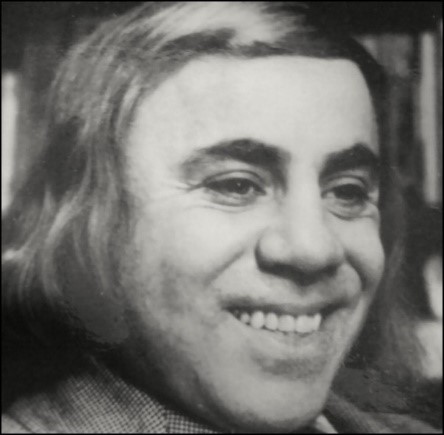
American Lyn Rubenstein (Leela) 1969
Lyn Rubenstein (Leela) is a high school friend of Michele Kaplowitz (nee Malvin), she writes to her friend to say that she should come to India to meet God. Leela first went to India in 1967.
English woman Victoria (Vicki) Mills (Later Ruff and then Cruickshank) from London 1969 Prasanthi Nilayam
Early Days with Baba by Victoria Cruickshank.
The autumn of 1969 found me in Kerala, South India, studying and travelling with Swami Chinmayananda, fulfilling the desire that had brought me overland from England to learn more about Vedantic philosophy. But, sadly, the teaching programme came to an abrupt end when this saint had a heart attack. It was whilst enquiring after his health at a devotee’s house that I first made contact with Sri Sathya Sai Baba. There, on the walls, were pictures of this strange-looking person with large amounts of hair. When I asked why they had pictures of this Holy Man, when Swami Chinmayananda was their guru, I was told that ‘Yes, Chinmayananda was their Guru, but this was God Himself!’
They took us down the street to another house where there were many, many pictures of Hindu gods and goddesses and also of Sai Baba.
Extraordinary things were happening underneath the glass of these pictures. The ones of Sai Baba were covered in ash with only the eyes showing, large, beautiful jewels had appeared on foreheads, but most memorable of all was the picture of Krishna holding a pot, out of which streamed honey that was seeping through to the outside of the glass. We tasted it, and it was like no other honey. Everywhere, a sweet smell coupled with a sense of serenity that seemed to be “other” worldly. The elderly couple, who lived there, took us upstairs to a bedroom where we were allowed to look from the doorway at a rumpled bed with footprints on the floor in ash, and the same sweet atmosphere. They told us that at night Sai Baba would come and sleep on the bed and leave footprints; before going to bed the wife would straighten the bed clothes and they would find the bed rumpled again the next morning. So we decided that a visit to “God” must be made, and set off for Puttaparthi. Eventually, a couple of hours after nightfall, we arrived there. No electricity in the village then and apart from the moon and stars, and small kerosene lamps in a few little shops all was dark and silent. It felt like the heart of the continent.
I will never forget waking up to the sound of the mandir bell and Omkar the next morning, and joining the couple of hundred people for darshan. Despite the wonder of the place, the next few days were somewhat difficult (and) there were no other western women for me to talk to, the sexes were segregated.
Sri Sathya Sai Baba Himself seemed enigmatic but distant. After a few days of feeling quite confused and physically under the weather; I decided to leave when He caught my eye at Darshan. At that moment when He looked at me I knew, that whoever He was, He had always been with me, had experienced everything I had experienced, knew everything about me, and the look just said, “So now you know.”
Next day we were called for an interview, and Baba told us to stay.
It was soon Shivarathri and some more westerners turned up. It was after the festival that we all went to Brindavan in Whitefield, Bangalore, and then followed three extraordinary months. We lived in Kadugodi village, and Swami used to call us in to His house in the evenings and talk and sing with us. We were a group of about seventeen, all in our early twenties or younger. He used to tell us again and again, “Swami’s love is like the love of a thousand mothers.”
Another time, all dressed up in the uniform Baba had allocated to us, convict style pyjamas for the boys, and brown and green saris for the girls, we were whisked off to the opening of the Joy ice cream factory near Bangalore, following Baba in and out of the enormous freezers, singing bhajans and eating too much ice cream cake!
Many extraordinary things happened at that time. We were treated like children in the way He kept us close to Him, and there was a feeling of safety and belonging which can only be described as a sense of “coming home.” He used to say that most of the westerners came to Him because they had never really known a mother’s love!
“Ladies must have nerves of steel, and hearts of butter”, was one of the important remarks He made to me personally; and when someone asked Him what is the best way to pray for others, He said, “Pray that they may find good work to do”. But for me the most profound words were said one evening when He came up behind me as I was sitting, no doubt waiting for Him, He took me by surprise, tapping me on the shoulder said, “Don’t worry, the ONLY thing that matters is your contact with the God INSIDE.”
These words, combined with the practice of Namasmarana have been my life raft over the past twenty five years. It is an initiation into the heart of religion, which is the prayer of the heart as practised by Christians, Sufis, Buddhists and Hindus. Whether you call it chanting a mantra, or saying the rosary, it is, according to Baba, the only safe way in this polluted century to purify the mind and eventually attain the mystical union with God.
(Reproduced from the Sri Sathya Sai Baba monthly magazine, Hatfield Centre, Oct. 2001).
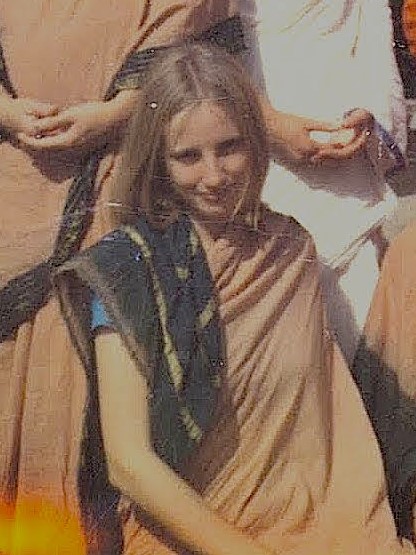
Honduran Miss Rosa Celeste Ravaneau 1969 Prasanthi Nilayam
Miss Rosa Celeste Ravaneau was the first person from Honduras to visit Sathya Sai Baba, in 1969. Originally from Tegucigalpa, the capital of Honduras, she was living in New York. She narrowly missed death or serious injury when, one day in 1969, her Volkswagen van rolled over in an accident. This brush with mortality prompted her to begin questioning herself, “What if I had died? What is this life all about? Am I wasting it without knowing why I am here?”
These thoughts led her to read different spiritual texts, and at one point her roommate remarked, “Why don’t you go to India, you’re reading so many books from there.” Rosa wanted to go to Russia, but when she called her travel agent, he told her about a $400 round trip available for India. This was too good to pass up.
The Eventful First Journey
An artist friend called and advised her to go to Goa and Puttaparthi, without mentioning Sai Baba. When Miss Ravaneau was traveling in India, she met a Mr. Gupta and his family in Madras (now Chennai). They were en route to Puttaparthi the next day and offered her the one space available in their car. Rosa recalled the name Puttaparthi from her friend and agreed to go along. The Gupta family were travelling in two cars and Rosa rode with the ladies, who did not speak English. Only Sri Gupta spoke English, but he was in the other vehicle.
So she came to Puttaparthi without any idea about Sai Baba and, arriving late at night, found rooms in the village. In those days there were no facilities for visitors, people used the Chitravati River for bathing, used the hill for a bathroom, and slept on the floor in a rented room in the village. No one sold mattresses, and food other than South Indian spicy fare was difficult to come by. The only thing in abundance were the mosquitoes.
At that time, a total of five foreigners were at Prasanthi Nilayam. When Miss Ravaneau arrived, she thought she made a mistake, but there were no buses or taxis, so she had to live with her supposed blunder. Soon, however, she saw Swami as an enchanting personality. She wanted to talk to Him and approached Professor Kasturi (Baba’s biographer) while he was at his ancient typewriter. He explained it was up to Swami to call someone in.
Rosa thought that if she could find Swami’s cook, she might help her get an appointment with Baba while He was eating. She found the cook in a tin hut behind the Mandir. The lady was very nice and said she would help. Over the following days, she told Rosa to come in the morning or afternoon and that Swami said He would see her. However, all the appointments were canceled.
Finally, she was escorted into a small room at the end of the Mandir where the lady indicated she was to wait. There was only one chair, so she sat down. Of course, it was Swami’s chair. She waited more than an hour until Professor Kasturi came to report that Swami was tired and had retired for the evening and would not be seeing anyone.
She visited many more times in the following years and, in 1972, came with her husband and mother-in-law to Whitefield to attend the first Summer Course in Indian Culture and Spirituality on invitation. Maurice, her husband, wore his hair long. After the first day of the Summer Course, Dr. Gokak, a senior devotee close to Baba, called Maurice aside and told him how Indians were conservative and not used to western styles and men with long hair. He suggested it would be a nice gesture to get a haircut.
At first, Maurice thought this old fellow doesn’t understand or respect our culture. The next night, Dr. Gokak again asked him politely to trim his hair. However, Maurice was still in rebellion. But then the next day, the thought came that it would be an indication that he could become Swami’s devotee if he had his hair cut. He then had his head shaved and now looked like a monk. When he was walking in front of Baba’s residence, Swami came out on the balcony, looked at Maurice, and said, “Very nice, very nice.”
That year, the Summer Course was held in a big tent. After the course was over, Swami called Rosa, Maurice, and his mother for an interview, during which He materialised a small silver medal for Maurice’s mother. When they left the interview room, Rosa said, “What a cheap medal. He should at least have made something from Tiffany’s.” Next day, to their surprise, Baba called them in again. Rosa stood at the back because she was embarrassed about what she had said regarding the medal.
Baba saw her immediately, and asked, “How did you like your mother-in-law’s medal?” Rosa said, “Oh, it is very beautiful Swami.” Then Baba waved his hand through the air as if to say, you don’t really mean that, but at the same time a similar medal flew across the room. Without realizing it, at that moment Rosa put her hand up and the medal landed in her palm. It was identical to her mother-in-law’s and she has it to this day.
All these divine experiences instilled a lot of faith in Rosa and her husband, and eventually they started a Sai Center in their apartment in New York and have been holding meetings there now for many years.
Swami’s Leelas In My Life: Experiencing Sri Sathya Sai Baba by Rosa Celeste Raveneau was published in 2010.
American Diana Riordan (later Baskin) November 1969 at the Women’s College in Anantapur
Diana (d 2014) travelled to India with her mother Annalisa Rajagopal (1922 – 1996) to see Sai Baba. Diana’s memoir of her time with Sathya Sai Baba is captured in her books Divine Memories of Sathya Sai Baba (1990) and Divine Lessons from Sathya Sai Baba (2009).
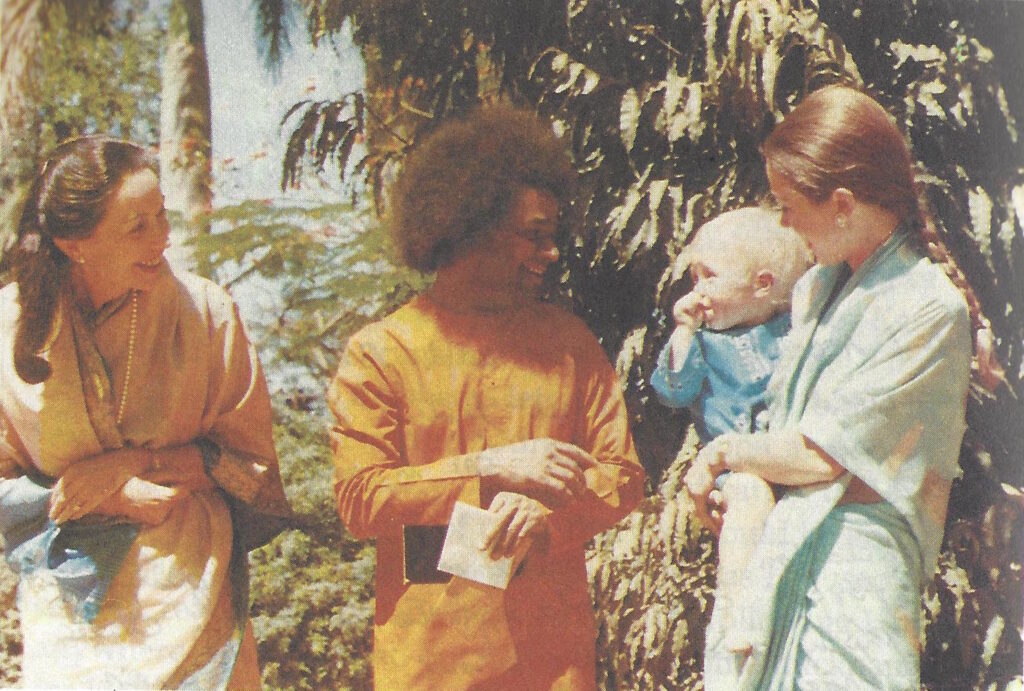
American Yoga Teacher Bittina Biggart 23rd November 1969 Prasanthi Nilayam
Bittina arrived with a group of eleven lead by Indra Devi.
American John Moffitt (1908 – 1987)
From Sathyam Sivam Sundaram – Part III by N. Kasturi
John Moffitt from New York (a member of the Ramakrishna Monastic Order for over twenty years) sought out Baba at Prasanthi Nilayam. After meeting Baba, he wrote to me from Bangalore, ‘I can never forget that talk – infinitely profound, infinitely playful, infinitely simple. I was reminded of what it must have been like to sit at Sri Ramakrishna’s Feet… I just drank in His sweet, loving, playful Self. When I asked for His Blessings so that I could come there again, He said spiritedly, “Why here? There’s no need. I am always with you. I will be in your heart.” If ever there was proof that Christ is working outside Christianity, it is in Babaji, and, before Him, Sri Ramakrishna. My mind is clear now; my doubts are resolved; I want to do His Will.’
The Bombay Ananda Bhavan Hotel on Grant Road in Bangalore was used for many years by devotees of Sathya Sai Baba.